
Vienna’s photonic quantum-computer prototype reaches orbit
A Vienna-led team launched a photonic quantum computer into orbit, with compact optical hardware and ground tests supporting its proposed satellite experiments.
A photonic prototype moves beyond the laboratory
A University of Vienna-led quantum-computing prototype launched into orbit on June 23, 2025. By July 30, project leader Philip Walther said its hardware was operating, with demonstrations of its capabilities still to follow. The photonic system uses particles of light for computation and consumes about 10 watts of power.
Walther sees possible future roles in satellite processing, quantum networks and fundamental physics experiments. Processing observations onboard could reduce the raw data transmitted to Earth. Those applications remain prospective: the launch and initial hardware operation are distinct from demonstrating a computational advantage or an Earth-observation service. Science News.

Eleven working days for assembly
A twelve-person Vienna team spent four weeks at DLR’s Responsive Space Cluster Competence Center in Trauen, Germany, early in 2025. Its cleanroom slot began on January 14, and the flight payload had to reach its integration partner in Italy by January 27.
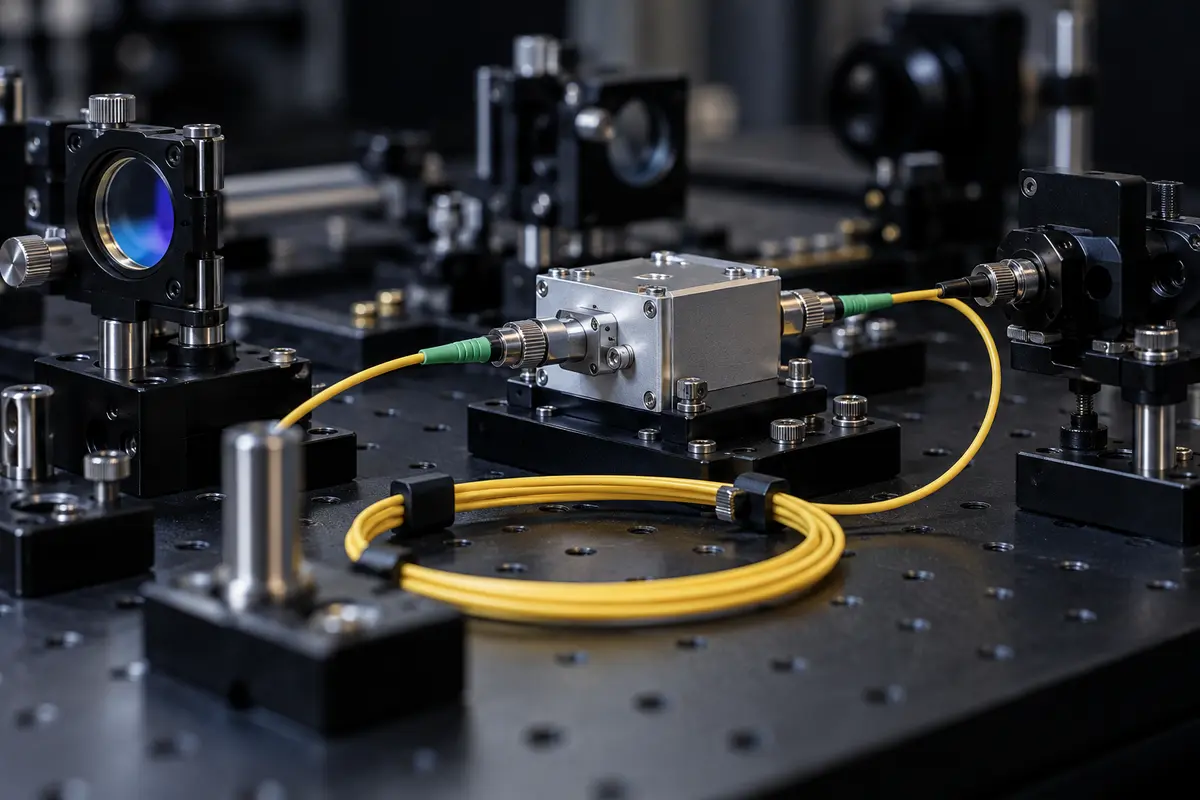
Iris Agresti and Simon Steiner recalled an eleven-working-day assembly window. The team completed the flight model first and then an identical engineering model for ground testing. Sensitive optical fibres required careful handling: Steiner estimated that a damaging bend could have cost two working days.
Preparing optics for a satellite
DLR and the University of Vienna developed software intended to control the prototype autonomously and prevent failures. Tobias Guggemos, from DLR’s Remote Sensing Technology Institute, explained that photon sources, detectors, fibres and the central processor needed adaptation to become compact, robust and remotely controllable.
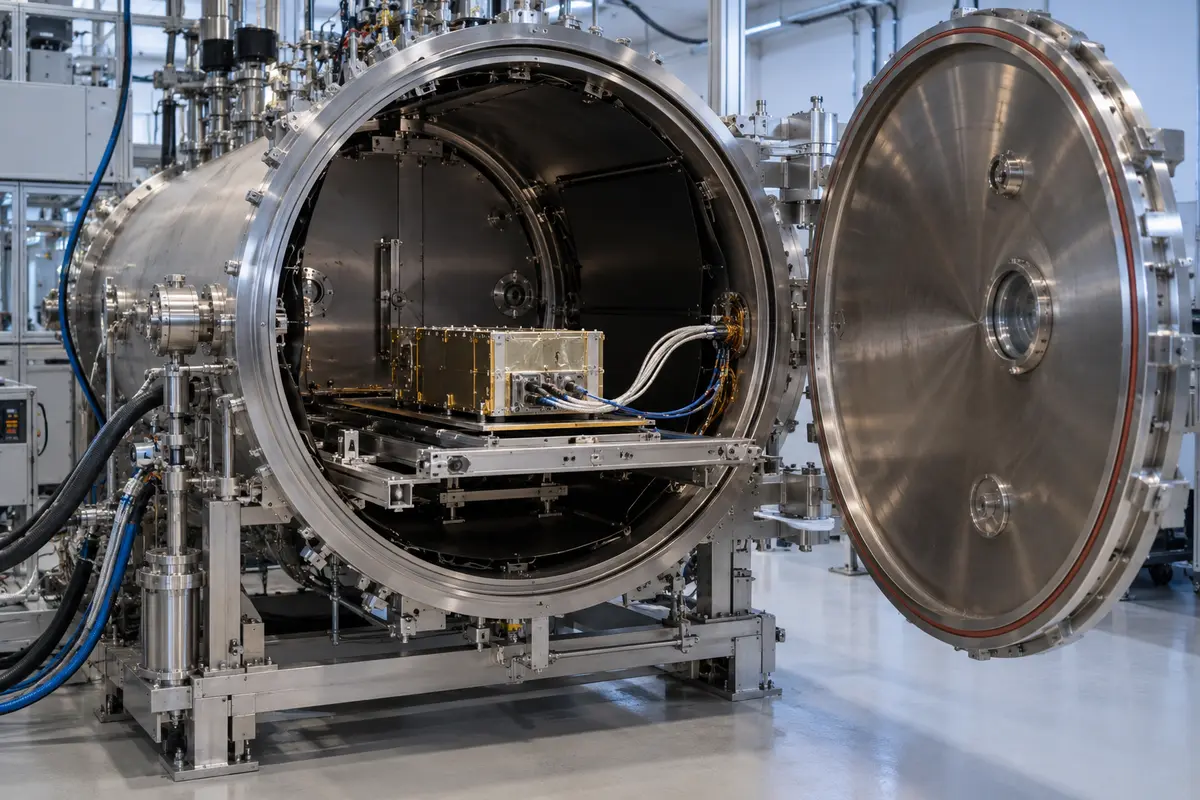
Three DLR institutes contributed facilities and mission expertise. The preparation combined optical protection, instrument checks and payload assembly. Components underwent thermal-chamber bake-out at temperatures up to 60 degrees Celsius to release trapped gas that could otherwise damage laser optics. The camera was calibrated, and the computing payload was assembled in Trauen’s cleanroom.
Environmental preparation
- Repeated heating and cooling checked the payload’s response to temperature changes.
- An onboard camera from Oberpfaffenhofen supported investigation of possible Earth-observation uses.
- The host spacecraft was an ION satellite from D-Orbit.

Two chips, separate experiments
CNR’s Institute for Photonics and Nanotechnologies developed the mission’s photonic chip in Milan, within Roberto Osellame’s group. Francesco Ceccarelli and Giacomo Corrielli coordinated two CNR devices that launched on the same rocket on June 23, aboard separate satellites. One was intended for autonomous quantum-computing tasks under Vienna’s coordination.
The other device was intended for fundamental quantum-physics experiments with the Technical University of Munich. Their shared launch did not make them one payload. CNR linked the chips’ compact modular architecture to satellite restrictions on weight, power and reliability, and described vibration, shock, temperature and ionizing-radiation testing. The two missions had separate experimental objectives.

From components to a flight payload
The project originated in May 2023. The Vienna researchers spent about a year and a half developing the computer, initially working separately on the photon source, optical circuit and detectors.
The final assembly brought together the mechanical framework, optics, electronics, onboard software and carrier-satellite interface. Quantum physics, space technology, electronics and software development all contributed to that integration.
Leave a comment