
Thorium nuclear clocks: feedback, crystal engineering and the search for new physics
Operating thorium clocks connect nuclear transitions to laser feedback, while crystal shifts and conditional physics sensitivity set separate measures of progress.
A nucleus becomes a reference
Two independent teams have made operating clocks from the thorium-229 nucleus. Thorsten Schumm’s collaborators at TU Wien in Austria and partner institutions submitted their results on Jun 3, 2026; Shiqian Ding’s team at Tsinghua University in China followed on Jun 7, 2026. Both used thorium inside calcium fluoride crystals. Neither preprint had undergone peer review by Jun 11, 2026, and neither clock surpassed the best atomic clocks at keeping time.
The new step was repeated feedback: measurements of a nuclear transition supplied corrections to a laser’s frequency. Earlier demonstrations had provided essential components without that operating loop. Independent physicist Lars von der Wense of Johannes Gutenberg University Mainz in Germany identified feedback as the missing step for calling the devices clocks. Ekkehard Peik, a coauthor of the Vienna work, had helped propose a thorium nuclear clock in 2003.
Finding the emitted light
The first directly observed radiative decay supplied an earlier experimental landmark. At CERN’s ISOLDE facility, researchers produced thorium-229 nuclei through the beta decay of actinium-229 implanted into solid crystals. A fraction of the daughter nuclei occupied the long-lived excited configuration called an isomer. Their subsequent decay emitted vacuum-ultraviolet photons, providing a direct optical signal from the nuclear energy difference. The result became public on May 24, 2023, before the later experiments that drove the transition with a resonant laser.

The measured transition energy was 8.338 electronvolts, with an uncertainty of 0.024 electronvolts. That historical measurement narrowed the energy uncertainty by a factor of seven, helping locate the light needed for excitation. Calcium fluoride and magnesium fluoride offered solid hosts for the implanted nuclei. The experiment also investigated the isomer’s lifetime in magnesium fluoride, a material-dependent quantity relevant to prospective clock performance. ISOLDE spokesperson Piet Van Duppen described the work as preparation for developing lasers that could drive the transition; an operating clock remained a subsequent objective.
Growing an optical host
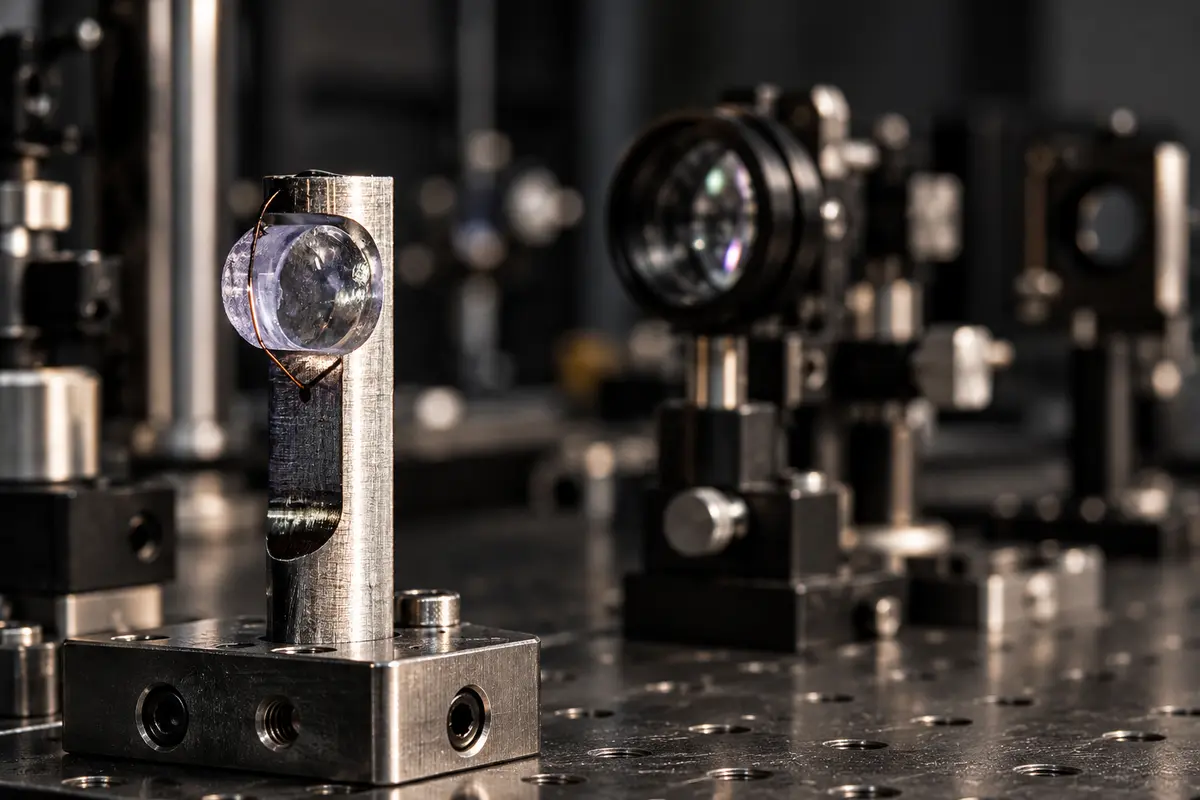
Thorium-doped calcium fluoride has to accommodate radioactive nuclei while transmitting the ultraviolet light used to interrogate them. At TU Wien, miniaturized vertical-gradient-freeze growth addressed the scarcity of thorium-229 by producing usable crystals from small quantities of dopant. Experiments with the more readily available thorium-232 isotope helped characterize growth and optical transmission. Scaling the crystal volume increased the material available for spectroscopy, but the amount of thorium incorporated and the clarity of the resulting host remained separate properties to control.
Radioactivity complicated that balance for thorium-229. Radiation-induced changes could reduce vacuum-ultraviolet transmission even when heat treatment removed visible orange coloration. The different responses indicated that eliminating visible colour did not necessarily eliminate the ultraviolet absorption affecting clock experiments. Fluorine deficiency and radiolysis were proposed explanations, rather than fully established mechanisms for every absorption feature. Replenishing fluorine during growth was a proposed direction for improvement. The practical objective was an optically useful ensemble of nuclei, rather than the largest possible dopant concentration regardless of transmission.
Driving the transition deliberately
Direct laser excitation followed the observation of spontaneous nuclear light. On Apr 29, 2024, the Physikalisch-Technische Bundesanstalt announced resonant excitation of thorium-229 in crystals developed with TU Wien. PTB supplied the ultraviolet laser, while the Vienna group supplied the thorium-doped material. The collaboration combined the search for the correct laser frequency with a sample containing many nuclei that could respond together. The experiment crossed from detecting a decay populated by another nuclear process to deliberately exciting the target transition with light.
Thorium-229’s unusually small nuclear energy gap made that approach possible. Ordinary nuclear transitions require much higher photon energies, whereas this transition lies within reach of specialized ultraviolet laser systems. PTB and TU Wien had worked together under a European Research Council project begun in 2020. The excitation opened routes to nuclear frequency references and to using embedded nuclei as probes of microscopic material properties. Those applications still required further development: resonant excitation alone did not establish continuous frequency correction, characterize every environmental shift or demonstrate a finished timekeeping instrument.
Connecting nuclear and atomic frequencies
A later 2024 experiment at JILA established a direct frequency connection between the thorium transition and a strontium optical atomic clock. A frequency comb supplied regularly spaced optical lines. Coherent conversion to its seventh harmonic moved those lines into the vacuum ultraviolet, where an individual comb line could excite thorium in calcium fluoride. The infrared comb inherited its reference from the strontium system, allowing a nuclear frequency to be measured against an electronic transition. The frequency comparison also resolved the nuclear quadrupole structure.

The experiment separated illumination from detection. A typical cycle exposed the crystal for 400 seconds, then counted fluorescence for 200 seconds with the excitation light switched off. Turning the detector off during illumination protected it from scattered ultraviolet photons. Four strong spectral features supported frequency measurements, while weaker features required further investigation. The strontium reference was periodically calibrated to correct drift; a fresh full systematic evaluation of that atomic clock was not part of the campaign. This arrangement measured the nuclear resonance without yet making it the continuously correcting reference of an operating clock.
Controlling the excited population
Nuclear population control offered another approach to the slow readout cycle. Takahiro Hiraki and collaborators used resonant X-rays to populate the thorium isomer in a vacuum-ultraviolet-transparent crystal, then detected its radiative decay. Their 2024 experiment used material cut from the same crystal ingot employed in the first resonant laser-excitation work. The X-ray pumping route addressed population preparation separately from the ultraviolet laser’s role in interrogating the low-energy clock transition. It also allowed the researchers to examine how illumination changed the subsequent nuclear population.
The X-ray beam produced enhanced depletion, or quenching, of the isomer population. Electronic excitations and defects in the host were possible ingredients in that behaviour, including mechanisms that could couple electronic and nuclear states. The microscopic explanation remained under investigation. Controlled quenching could eventually shorten an interrogation sequence by returning nuclei to their ground state more quickly, but that was a prospective application. The measured effect did not by itself constitute a feedback clock, nor did a decay time measured in one host automatically describe an isolated nucleus or another crystal environment.

Temperature still shifts a nucleus
The crystal environment affected the transition even though the reference was nuclear. Jacob S. Higgins and collaborators measured four strong thorium spectral lines at 150, 229 and 293 kelvin. Three moved by more than a megahertz across the temperature range. One preferred line shifted by only 62 kilohertz, with a six-kilohertz uncertainty, over 143 kelvin. Its reduced sensitivity came from partial cancellation between two effects: the shift of the underlying transition and the changing electric quadrupole splitting imposed by the crystal’s field gradient.
The unsplit transition frequency decreased by 776 kilohertz between the lowest and highest temperatures. Changes in electron density and the electric field gradient at the nucleus accompanied heating of the host. For the preferred line, the measured average temperature coefficient implied a demanding requirement: roughly five microkelvin of temperature stability for fractional precision at the 10−18 level. That was an estimated condition, rather than achieved clock performance. A particularly small shift between 150 and 229 kelvin suggested a region worth examining more closely, with additional measurements needed to establish its temperature dependence.
Comparing separately grown crystals
A separate investigation located a working temperature of 195 kelvin, with a five-kelvin uncertainty, where the first-order temperature sensitivity vanished. Tian Ooi and collaborators examined transition frequency, linewidth, dopant concentration and temperature across differently grown calcium fluoride crystals. Two crystals measured at that temperature reproduced the transition frequency within 280 hertz over four months, corresponding to a fractional difference of 1.4 × 10⁻¹³. This comparison concerned agreement between material references over time, rather than the short-term fluctuations of a laser already locked to either reference.

Different spectral lines also offered a possible internal thermometer. A line with a larger temperature response could help monitor the crystal while the less sensitive line supplied the frequency reference. Further improvements in thermometry and spectral resolution were projected to reduce temperature-related uncertainty substantially. Other effects still needed characterization, including magnetic shifts, strain and concentration-dependent broadening. Possible contributions from mounting stress or microscopic crystal strain were hypotheses requiring further measurements. The projected thermal contribution therefore did not establish an equally small total uncertainty for a complete operating nuclear clock.
Making a continuous ultraviolet source
A continuous-wave laser supplied another missing component. Qi Xiao and collaborators generated 148.4-nanometre light through four-wave mixing in cadmium vapour. Their 2025 preprint demonstrated 100 nanowatts of output power and estimated an absolute linewidth of about 50 hertz, limited by the input lasers. Continuous operation offered a narrow source for interrogation without the spectral breadth of earlier pulsed single-frequency ultraviolet systems. Frequency conversion had to preserve phase coherence as well as deliver photons at the required wavelength, making its added noise an important experimental question.
The researchers compared light generated in two independent cadmium ovens using shared input lasers. That arrangement cancelled common input noise and tested the additional fluctuations introduced by the conversion process. Under the stated line-shape and independent-contribution assumptions, the comparison placed a 0.08-hertz upper bound, with a 0.02-hertz uncertainty, on the conversion-added linewidth. That quantity was distinct from the absolute linewidth of the complete laser. Higher power and narrower input-laser linewidths remained development goals. The source experiment provided laser technology for a clock, without itself demonstrating nuclear feedback operation.

Reading absorption without a long wait
Continuous-wave absorption spectroscopy changed how quickly the nuclei could be read. I. Morawetz and collaborators excited the thorium resonance with less than one nanowatt of 148-nanometre light, produced through three successive frequency doublings from an 1187-nanometre laser. Instead of waiting for excited nuclei to emit fluorescence, they measured the reduction of transmitted light at resonance. That approach removed the long nuclear fluorescence decay from the detection process. A frequency-dependent absorption signal could consequently supply faster information about the laser’s position relative to the nuclear line.
The same April 2026 work distinguished two thorium environments inside calcium fluoride. One had a very small static electric field gradient, below 0.1 volts per square ångström, compared with values around 100 volts per square ångström encountered previously. Its apparent local symmetry made reduced sensitivity to lattice spacing an interesting possibility for future investigation. That material prospect remained separate from demonstrated clock operation. Likewise, a shot-noise estimate of fractional instability near 2 × 10⁻¹² at one second depended on specified measurement assumptions; it was not an April measurement of an operating clock’s stability.
From detector current to correction
At Tsinghua, the transmitted ultraviolet light became an electrical error signal. A phototube measured photocurrent without the gain saturation that restricted the earlier photomultiplier readout. Frequency modulation and lock-in detection resolved the small nuclear absorption feature against a much larger transmitted background. An acousto-optic modulator then applied frequency corrections to the laser. A second crystal with greater resonant optical depth and better transmission increased the usable signal further. The June clock demonstration combined those readout and material changes in its final configuration.

The final configuration reached fractional frequency instability of 2 × 10⁻¹² divided by the square root of averaging time in seconds, averaging down to 2 × 10⁻¹⁴ within the measured interval. The two crystals’ transition frequencies differed by 558 hertz, with a 131-hertz uncertainty, or fractionally 2.8 × 10⁻¹³. The experiment stabilized the crystals near 301 kelvin and shielded magnetic fields. Its present temperature and magnetic effects lay below the measured instability, while operation near the lower-temperature stationary point remained a proposed improvement.
Keeping the laser on resonance
The Vienna-led clock combined an optical cavity’s short-term reference with the nuclear transition’s longer-term correction. Absorption measurements fed an error signal back to the laser, with operating modes using different correction times. The clock achieved fractional instability of 3 × 10⁻¹² divided by the square root of averaging time in seconds, approaching 10−15 on a day’s timescale. Measurements at different crystal positions also revealed shifts reaching 1.7 kilohertz; local strain was a possible explanation. Between-day reproducibility and within-run averaging consequently described different aspects of the instrument’s performance.
A roughly 23-hour measurement sequence supported a search for oscillations that hypothetical ultralight dark matter could induce. No signal exceeded the analysis threshold. The resulting constraints depended on assumptions about nuclear enhancement and the proposed field’s contribution to dark matter. The investigators tested particular couplings and frequency ranges rather than every dark-matter model. Their competitive sensitivity to some new-physics parameters did not require superior ordinary timekeeping, and the absence of an above-threshold oscillation did not identify the substance making up dark matter.

Three quantities to keep separate
The nuclear response to a changing fine-structure constant required its own calculation. Kjeld Beeks and collaborators estimated an enhancement factor of 5,900, with an uncertainty of 2,300, using measured nuclear properties and a model of nuclear shape. The calculation connected changes in charge radius and quadrupole properties to the transition’s electromagnetic sensitivity. Uncertainty in the charge-radius change and assumptions about the nuclear shape limited the estimate. A large response factor described how strongly a frequency might change if the underlying constant changed; it did not mean that such a change had occurred.
That distinction leaves several separate experimental and theoretical quantities:
- Clock instability measures frequency fluctuations over a stated averaging interval.
- Reproducibility compares the frequencies obtained from different samples or measurement campaigns.
- An enhancement factor connects a hypothetical change in a fundamental constant to the nuclear transition’s response.
The sensitivity estimate could improve with better nuclear measurements and more complete treatment of nuclear deformation. Its uncertainty remained part of interpreting proposed tests of fundamental physics. Neither the model calculation nor an enhanced response established a detection of varying constants.
Leave a comment