
SVOM’s path from gamma-ray triggers to ground follow-up
SVOM combines gamma-ray triggers, X-ray optics and rapid follow-up. Its integration, early alerts and new bursts show how space and ground observations connect.
A gamma-ray monitor begins observing
SVOM began detecting cosmic explosions within days of reaching orbit. By 8 July 2024, its platform was functioning normally, all four scientific payloads had passed their power-on tests, and real-time connections linked the spacecraft with more than 40 ground stations, according to the Chinese Academy of Sciences. The mission joins China and France in observing gamma-ray bursts. Its GRM monitor captured GRB 240627B on 27 June, followed by further bursts on 29 June and 2 July. Results went to the international General Coordinates Network. Scientific observation tests were then expected to begin in August, while spacecraft testing continued. Its scientific objectives include measuring the electromagnetic properties of bursts and searching for electromagnetic signals associated with gravitational waves.
Building and testing the flight configuration
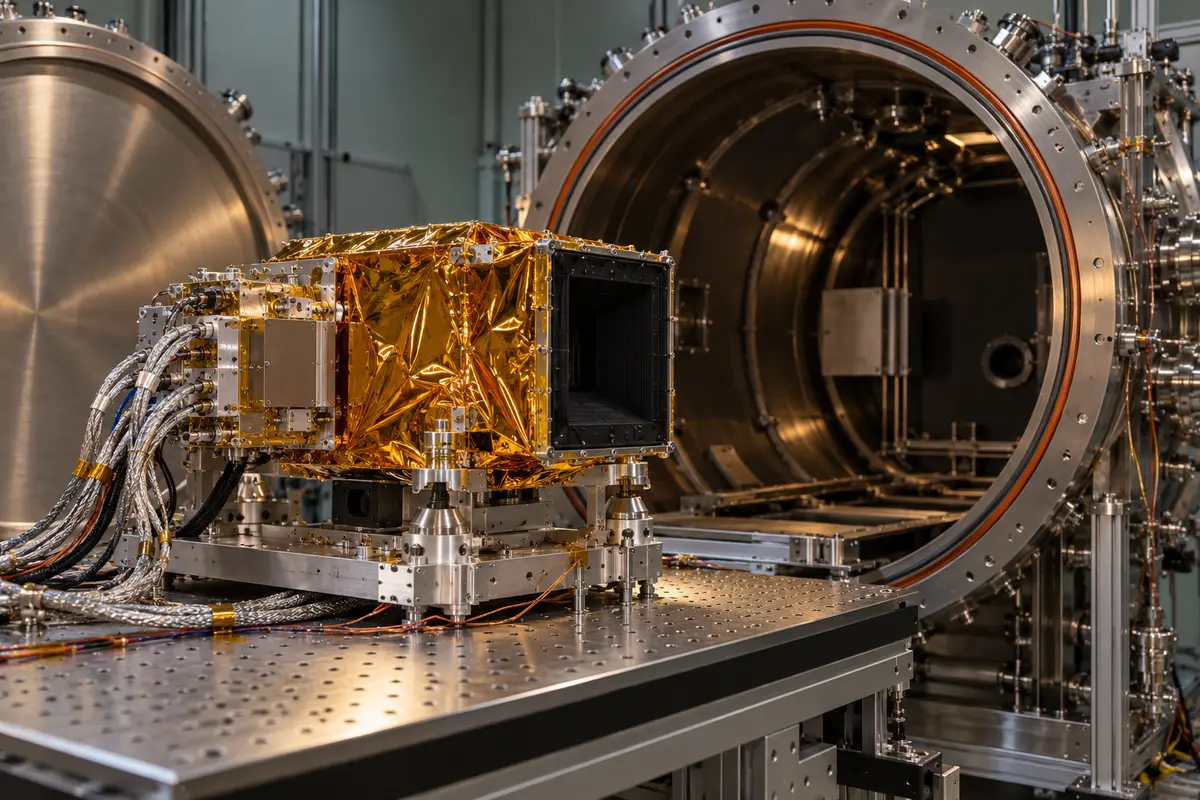
The French instruments ECLAIRs and MXT reached the Shanghai integration site in March 2023. Their computer electronics were tested separately and then connected to the instruments. Mechanical checks established the interfaces with the Payload Interface Module, or PIM. Rehearsals used qualification and structural models before the flight instruments were installed. Alignment measurements checked MXT against the satellite’s optical axis.
Electrical integration connected the instruments to their control boxes through harnesses. Susceptibility tests checked interference between instruments and PIM electronics; later radiated electromagnetic compatibility tests used an anechoic chamber. Closing the panels and joining the payload module to the platform brought the spacecraft into its flight configuration. Between June and October 2023, vibration, shock, acoustic and thermal-vacuum tests exercised the assembled satellite.

Thermal-vacuum preparation included temperature probes, heating elements and removal of protective covers from instruments and radiators. Instruments operated inside the chamber during testing. On 10 May 2024, SVOM arrived at Xichang from Shanghai in two parts: platform and payload. Reassembly and functional tests preceded the final ECLAIRs and MXT inspections, flight configuration and launch rehearsals.
Lightweight optics for a rapid search
Leicester’s contribution to MXT was its built and tested X-ray optical assembly. The university’s experience also extended to BepiColombo, while Einstein Probe had carried Leicester-supported optics into space earlier in 2024. MXT uses micropore optics: many small optical elements are arranged on a curved frame and work together to collect X-rays across a wider field. Individual tubes about 40 microns across are stacked and formed so that their channels direct incoming radiation towards a common focus.
The arrangement takes inspiration from crustacean eyes, whose many channels gather light. Its small optical elements form a lightweight assembly. A wide search field is particularly useful when gravitational-wave detectors identify a region of sky rather than one precisely located object. The Leicester team planned to use SVOM alongside Swift and the James Webb Space Telescope in studies of distant bursts and their environments. A burst advocate coordinates follow-up observations and keeps track of data arriving from spacecraft and ground telescopes.

Refining the position in soft X-rays
MXT follows an initial ECLAIRs alert with soft X-ray observations. The French space agency CNES and CEA-Irfu developed it with Leicester and the Max Planck institute in Garching. The telescope’s nominal observing range is 0.2–10 kiloelectronvolts. Its microchannel optical assembly feeds an X-ray-sensitive CCD camera, producing images and spectra. Calibration established an energy resolution of 75 electronvolts at 1.5 kiloelectronvolts, within a field measuring 1.1 degrees on each side.
The design aims for positions more precise than one arcminute, reaching about 20 arcseconds for a very bright burst. Such precision depends on the available signal. MXT’s refined position, combined with visible images from SVOM’s VT telescope, guides subsequent observations. Its automatically calculated coordinates also travel through the VHF alert network. The instrument was designed to follow a burst’s fading X-ray afterglow for up to a day after the prompt emission and to measure the shape of its energy distribution, a quantity used to investigate the energetic particles producing that radiation.
From launch to instrument activation
A Long March 2C launched SVOM at 07:00 UTC on 22 June 2024. Separation followed within minutes; the solar panels deployed 40 seconds after separation. The payload computer started during the twelfth orbit, alongside adjustments to attitude-control parameters. On 23 June, during orbit sixteen, the VHF transmitter was switched on and Lhasa received its first packets. VT and GRM were powered up on 24 June, followed by ECLAIRs and MXT on 25 June. The ECLAIRs camera started on 1 July. Powering electronics, activating detection software and recording a celestial burst were separate steps in bringing the observatory into use.

Two routes to an ECLAIRs alert
ECLAIRs detection software was activated on 11 July 2024. Two days later, GRB 240713A triggered it at approximately 02:02 UTC. Prompt transmission of alerts and automatic slewing were not yet enabled, so the information reached the ground after a delay. The initial GCN circular described a probable burst and noted a disturbed particle environment associated with solar activity. The camera’s reconstructed images nevertheless supported the interpretation as a real transient source.
The trigger software analyses detector data through two parallel methods. The count-rate algorithm searches intervals from 10 milliseconds to 20 seconds for an excess above a background model, then reconstructs a sky image. The image algorithm reconstructs maps every 20 seconds and combines them into exposures extending to 20 minutes. Both search for point sources outside the onboard catalogue of known objects. Their complementary inputs are:
- Count-rate trigger: a change in detected events.
- Image trigger: a new source in reconstructed sky maps.
A robotic telescope on the ground
COLIBRI supplied first images at its inauguration on 7 September 2024 at the San Pedro Mártir National Astronomical Observatory in Mexico. The site stands around 2,800 metres above sea level. Designed for SVOM follow-up and other transient phenomena, the telescope has a 1.30-metre mirror. Its structure stands four metres high and weighs eight tonnes. It can point to a sky region in under 20 seconds, with robotic observations controlled by an observing programme.
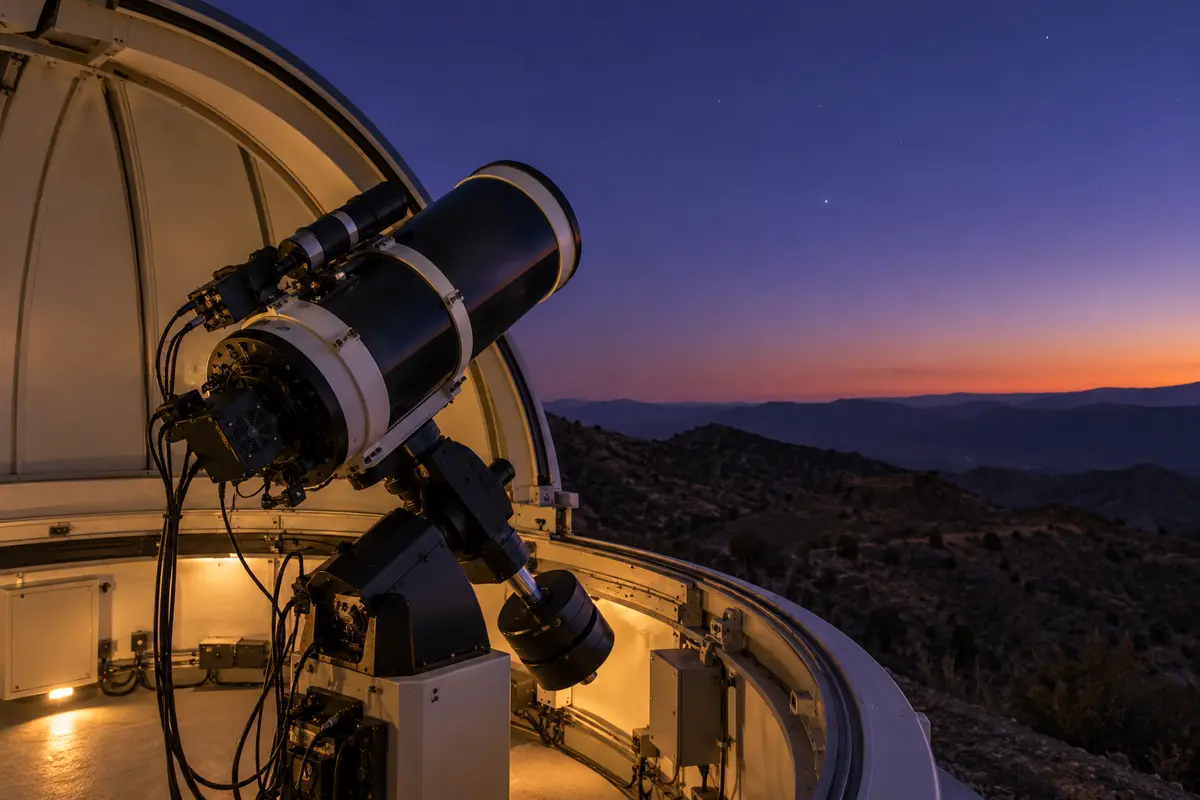
Development began in 2016 and involved approximately 120 people. The Marseille Astrophysics Laboratory, Institut Pythéas and UNAM’s Astronomy Institute led the work, with contributions from other participating laboratories. COLIBRI was assembled at the Observatoire de Haute-Provence and underwent more than a year of field testing before shipment. CNRS, CNES, Aix-Marseille University, UNAM and Mexico’s science council supported the project. Its September 2024 design provided for simultaneous observations with visible and infrared cameras, extending follow-up beyond the satellite’s instruments.
An X-ray-rich flash and its supernova
On 1 October 2024 at 17:08 UT, ECLAIRs detected XRF 241001A, a flash whose emission was concentrated at lower X-ray energies. Swift’s XRT searched for the fading X-ray counterpart, while GRANDMA and Las Cumbres Observatory telescopes obtained optical observations and improved the position. The Very Large Telescope’s X-shooter spectrum contained absorption features and emission lines from the host galaxy at the same redshift, 0.57. Those measurements linked the transient and its host through spectroscopy.
JWST observed the counterpart with NIRSpec on 23 October, according to the observing team’s original circular. A 1.7-hour integration covered wavelengths from 0.5 to 5.5 microns. Broad absorption and emission features resembled those of broad-lined type Ic supernovae associated with long gamma-ray bursts. VT revisited the field as the afterglow faded and the supernova became visible. The relationship between X-ray-rich flashes, viewing geometry and different explosion mechanisms remained an open scientific question.

Following GRB 250205A across observatories
GRB 250205A activated the satellite’s observing sequence on 5 February 2025. Scientists on duty organised an urgent videoconference and examined the ECLAIRs sky image arriving through the VHF network. The initial ECLAIRs position was supplemented within minutes by a more precise MXT location. A public circular followed 53 minutes after the trigger. VT then supplied a position accurate to approximately one arcsecond, while its images already showed the source fading.
Ground follow-up included the T193 telescope at Haute-Provence, Liverpool Telescope and Gran Telescopio Canarias on La Palma, and COLIBRI at San Pedro Mártir. Swift and Einstein Probe also observed the target. Optical and near-infrared measurements followed the declining flux rather than a stationary source. A spectrum from the 10.4-metre Gran Telescopio Canarias, obtained one hour and 45 minutes after the trigger, measured a redshift of 3.55. The coordinated sequence provided high-energy detections, a refined position, optical observations and a spectroscopic distance indicator for the same event.
A weak alert from the early Universe
ECLAIRs detected GRB 250314A at 12:56 UTC on 14 March 2025. SVOM was over a Pacific region without VHF coverage, limiting receipt of the alert data. The signal was also below the threshold for an automatic international notice. GRM’s simultaneous detection strengthened confidence in the event. By 13:23 UTC, the team decided to notify other observatories. MXT and VT did not detect a counterpart, leaving the international follow-up campaign to refine its location and characterise its light.

Approximately 17 hours after the alert, a VLT X-shooter spectrum indicated a redshift near 7.3. Near-infrared observations also showed a sharp change between filters: the counterpart was absent in the z band but appeared at longer wavelengths in Y, J and H. Such measurements placed the explosion at an epoch when the Universe was roughly 730 million years old. The mission team distinguished its spectroscopic distance estimate from less precise photometric estimates for other distant bursts. At that time it ranked third among gamma-ray bursts with spectroscopically determined redshifts.
Later infrared observations of the distant burst
JWST returned to the position of GRB 250314A 110 days after SVOM’s detection. NIRCam found infrared emission in the redder filters. In the December 2025 analysis, researchers interpreted that emission as a combination of the host galaxy and an emerging supernova. The earlier follow-up had separated different observing roles: Swift located an X-ray counterpart, the Nordic Optical Telescope found near-infrared emission, and Einstein Probe confirmed variability in X-rays. These observations supplied targets for deeper spectroscopy and later imaging.

The supernova interpretation rested on photometric measurements and comparison with models, including the nearby GRB-associated supernova SN 1998bw. A planned later observation, described as nine months away in the December account, was intended to test whether the additional emission faded. Similarity to a local supernova was an interpretation of the available data, while the detailed properties of the distant explosion and its environment remained subjects for analysis.
A trigger on the fading emission
GRB 250706B began with a roughly 40-second flash detected by Konus-Wind at 16:45:22 UTC on 6 July 2025. Fermi’s LAT observed its afterglow after the source rose above Earth’s horizon, recording photons up to 21 billion electronvolts. ECLAIRs triggered at 17:06:04 UTC when the afterglow entered SVOM’s view. Its image-trigger mode and four-kiloelectronvolt lower threshold enabled a detection of the fading emission rather than the initial flash. SVOM slewed in less than three minutes, and MXT and VT observed the source. VLT X-shooter spectroscopy measured a redshift of 0.942. On 5 August, after the afterglow had faded, JWST’s NIRSpec found a broad-lined type Ic supernova signature at the position. The mission team identified this as its first ECLAIRs trigger on a gamma-ray burst afterglow.

The first year’s observing record
By its first anniversary in June 2025, SVOM had detected 132 bursts: 111 appeared in GRM detections and 47 were detected and localised by ECLAIRs. The instrument samples overlapped. Eighty-nine bursts were also detected by other missions, including Einstein Probe, Swift and Fermi. Redshifts had been measured for 26 events through follow-up observations. SVOM devoted 35% of its available time to targets of opportunity; about half of that allocation revisited bursts to build VT light curves, and more than two-thirds of those revisits concerned SVOM detections. General-programme pointings monitored predefined sky areas while the instruments awaited new bursts. Targets of opportunity instead directed observations towards known sources of current scientific interest. Exposure maps based on VHF telemetry showed which regions received observing time, rather than measuring the telescope’s sensitivity across the sky. The most exposed regions lay around the Galactic poles, following SVOM’s planned attitude law.
Counts, follow-up and remaining candidates
As of 12 June 2026, the cumulative total reached 318 gamma-ray bursts, including 270 detected by GRM and 107 detected and localised by ECLAIRs. These overlapping counts describe instrument contributions rather than separate populations to add together. Among the 107 ECLAIRs-localised events, 79 received soft X-ray observations, 66 optical observations and 40 redshift measurements. The general programme accumulated approximately eight million seconds of scientifically useful data through more than 1,170 pointings at 130 different astrophysical targets. During the second year, automatic burst triggering and follow-up took 7% of useful observing time, the general programme 60%, and targets of opportunity 33%. About 40% of the latter allocation revisited SVOM bursts. Eight additional high-redshift candidates still lacked sufficiently robust distance measurements. Rapid near-infrared follow-up remained important for distinguishing truly distant events from other causes of faint optical emission; the collaboration anticipated installing COLIBRI’s CAGIRE camera at the end of 2026.
Leave a comment