
SMILE’s route from instrument benches to Earth’s magnetic shield
SMILE combines X-ray and auroral imaging with local plasma measurements. Instrument delivery, spacecraft tests and commissioning trace a view of Earth’s shield.
A joint mission to watch Earth’s response
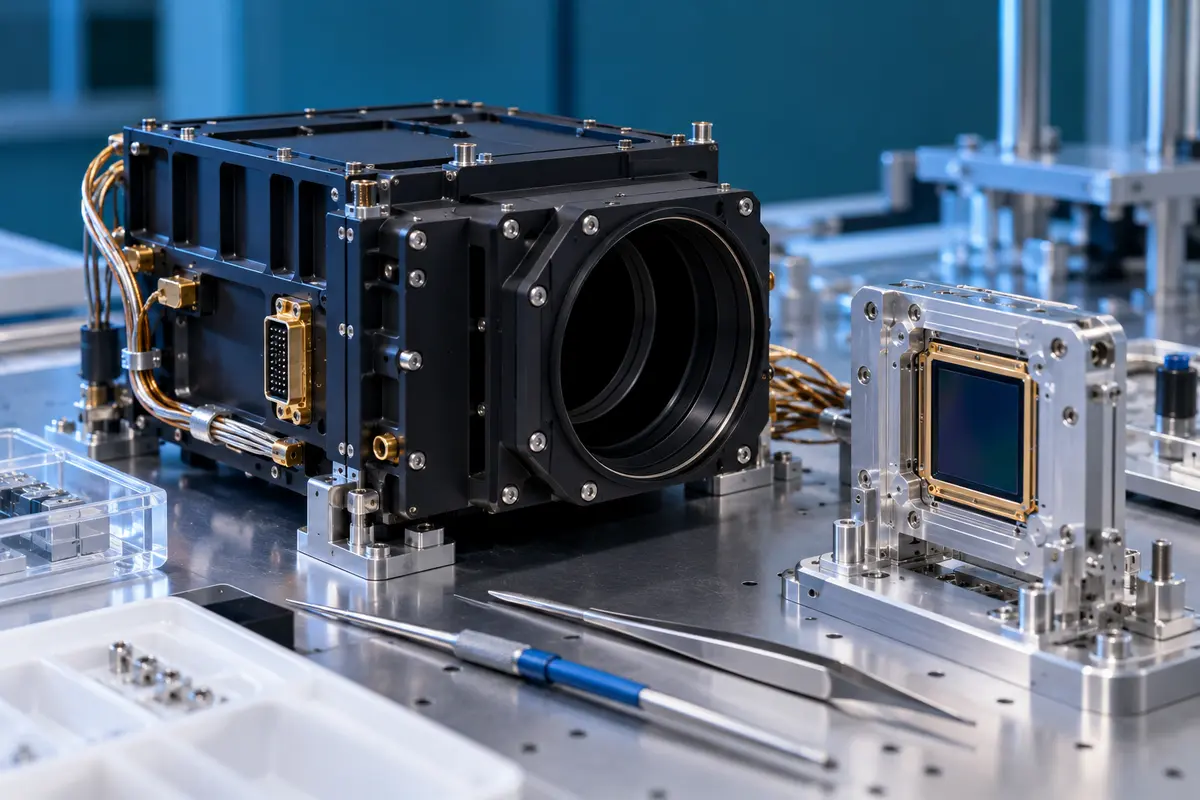
The Solar Wind Magnetosphere Ionosphere Link Explorer, or SMILE, combines four instruments to investigate the interaction between the solar wind and Earth’s magnetic environment. The European Space Agency and the Chinese Academy of Sciences developed the 2,300-kilogram spacecraft together. Its light ion analyser, magnetometer, soft X-ray imager and ultraviolet aurora imager connect particle measurements with images of the surrounding environment. At ESA’s annual briefing on 9 January 2025, director general Josef Aschbacher anticipated a launch in early 2026, with spacecraft readiness expected by the end of 2025. SMILE had been selected in 2015 from 13 European–Chinese proposals. Its original 2021 launch target slipped amid technical difficulties and pandemic disruption. Subsequent assembly, testing and flight operations established the mission’s actual timetable.
The boundary between solar wind and magnetosphere
The solar wind carries charged particles and the interplanetary magnetic field outward from the Sun. Earth’s magnetic environment presents an obstacle to that flow. A bow shock slows and heats incoming plasma; behind it lies the magnetosheath, bounded on its Earthward side by the magnetopause. This boundary separates the shocked solar wind from the magnetosphere. SMILE’s scientific targets include the position and movement of this boundary and the polar cusps, where solar wind particles can enter near the poles.
Soft X-rays provide a way to map this environment remotely. Highly charged ions capture electrons from neutral hydrogen in Earth’s extended atmosphere, producing X-ray emission through solar wind charge exchange. Auroral observations follow energy entering the atmosphere. The scientific questions concern how dayside magnetic reconnection behaves, what controls the substorm cycle, and how storms driven by coronal mass ejections relate to substorms. These are investigations of changing magnetic and plasma conditions across connected regions, rather than measurements of a single boundary crossing alone.

From local probes to a wider view
ESA’s four-spacecraft Cluster mission, which ended science operations in 2024, measured charged particles and magnetic conditions at individual locations. Combining those observations into a global account remained difficult. SMILE’s remote cameras complement that approach: ultraviolet images follow the northern auroras while X-ray images follow the outer magnetosphere and polar cusps. Comparing the two sets connects changes at the boundary with activity closer to Earth. Cluster observations and computer models also helped determine SMILE’s instrument designs and their placement on the spacecraft.
XMM-Newton supplied another useful preparation dataset. The observatory studies distant energetic objects, but its sightlines pass through Earth’s magnetic environment. Its astronomical targets include black holes and supernova explosions, viewed from an orbit around Earth. Foreground X-rays from solar wind interactions can interfere with astronomical observations; plasma researchers instead used them to investigate the magnetosphere. Those studies supported methods for reconstructing the magnetopause from images. Cluster data also helped predict where energetic protons might affect SMILE’s X-ray detector during operation and calibration. The combination links remote imaging with earlier local measurements and the modelling needed to interpret a projected image of a three-dimensional boundary.
A telescope assembled in Leicester
The University of Leicester announced completion and handover of the Soft X-ray Imager, or SXI, on 5 August 2024. Engineers assembled its flight subsystems in a purpose-built cleanroom at Space Park Leicester. Earlier models had undergone environmental tests before the final flight instrument was delivered to Airbus Defence and Space in Madrid for integration with the payload module. The telescope was the first instrument delivered using the Space Park facilities.
Leicester led the instrument with Mullard Space Science Laboratory, the Open University and institutions across Europe. The British engineering contributions included the telescope assembly, X-ray optics module, detector system and readout electronics. The UK Space Agency supported instrument delivery with approximately £13 million. Size, mass and the space environment constrained the compact telescope’s design. Following handover, the instrument and the rest of the payload still needed combined systems tests, followed by integration of the complete spacecraft at ESA’s ESTEC centre in the Netherlands.
Optics, cooling and supporting hardware
SXI focuses X-rays using lightweight optical technology inspired by lobster eyes. Its large charge-coupled detectors operate at minus 120 degrees Celsius. The thermal subsystem involved the University of Applied Sciences Northwestern Switzerland, Koegl Space and Space Acoustics. Teledyne UK supplied the CCDs; the Open University tested them. Mullard Space Science Laboratory contributed front-end electronics, while the University of Bergen supplied the radiation shutter mechanism and electronics. Thales Alenia Space UK provided the baffle, Terma the electronics-box power supply, and the University of Vienna software.
The European payload module carries three instruments, their control equipment and the science downlink. Airbus built the module, with a structure from Euro-Composites, an extended control unit from Airbus Crisa, an antenna from Sener and a transmitter from Syrlinks. CAS supplied the platform and led the ion analyser, magnetometer and ultraviolet imager, with significant ESA contributions to the latter. ESA supplied SXI, integration and test facilities, and the Vega-C launch. Both partners participated throughout development and operations.

Measuring the arriving ions
The Light Ion Analyser, or LIA, measures ion velocity distributions over energies from 5 electronvolts to 25 kiloelectronvolts. Two identical sensor heads sit on opposite sides of the spacecraft platform. Each covers a hemisphere of directions, or two pi steradians, providing a combined full-sky field of view of four pi steradians. The arrangement measures the plasma around the spacecraft as it moves through the solar wind and magnetosheath, supplying local conditions alongside the remote images.
Each head contains a top-hat electrostatic analyser, electrostatic aperture deflectors and a microchannel plate detector. These components analyse the energy, arrival direction and flux of ions. The instrument has several operating modes: elevation resolution ranges from 22.5 to 5.625 degrees, azimuth resolution from 30 to 7.5 degrees, and time resolution from 0.25 to two seconds. Velocity distributions return to the ground for calculation of plasma moments. The instrument’s measurements provide an upstream description of the solar wind input against which scientists can compare the magnetosphere and ionosphere’s response.
A magnetic sensor pair on a folding boom
SMILE’s magnetometer flight model passed its acceptance review in Shanghai on 14 March 2024. A joint inspection involved the Chinese Academy of Sciences’ Innovation Academy for Microsatellites, ESA’s ESTEC, Airbus Defence and Space, and the National Space Science Center. Developed by the centre’s Key Laboratory of Solar Activity and Space Weather, MAG was delivered for integration with the European payload module. Its two independent, three-axis fluxgate sensor heads sit at the outer end of a deployable three-metre boom.

The delivery specification described sampling at 20 magnetic vectors per second, with dynamic ranges spanning 512 to 65,536 nanoteslas. Its 24-bit quantisation corresponded to 0.008 nanotesla in the most sensitive range, with accuracy better than 0.05 percent. Those figures describe the delivered instrument specification. The measurements establish the strength and direction of the local solar wind magnetic field. Together with local plasma measurements, they support investigation of interactions at the magnetopause and magnetic reconnection in the surrounding magnetosheath.
Following the complete northern auroral oval
The ultraviolet imager, UVI, observes the entire northern auroral oval in the nitrogen Lyman–Birge–Hopfield band between 160 and 180 nanometres. Its design suppresses contamination from ultraviolet dayglow, allowing observation beyond the night-side views familiar from visible-light photographs. The instrument team’s March 2025 conference abstract specified a spatial resolution of approximately 100 kilometres or better. That is a design description, rather than a report of resolution achieved after launch. A highly eccentric orbit with a period of roughly 50 hours supports extended northern auroral observations. Changes in auroral light reflect large-scale magnetospheric dynamics, including convection and interactions between waves and particles. UVI’s scientific programme follows the movement of mass and energy through the coupled solar wind and magnetosphere system, including deposition in the ionosphere and upper atmosphere. Instrument preparation included laboratory calibration and plans for in-flight calibration and data products.
Joining hardware from Europe and China
The payload module reached ESTEC in September 2024. During a boom test on 21 November, a stiff, incorrectly mounted cable bundle prevented the magnetometer boom from locking open. Engineers loosened and repositioned the bundle; the next day’s deployment succeeded. The Chinese platform arrived from Shanghai on 9 December with 15 engineers and managers. Its shipment required special authorisations, including arrangements for ammonia in heat pipes classified as dangerous goods.

Engineers connected the platform and payload module on 21 January 2025 using 120 bolts. Cables obstructed some fastening positions, so the team revised the sequence and installed certain bolts before lifting the module. A hoist moved it at roughly a centimetre per second. An Airbus engineer controlled its passage above the platform; with a 20-centimetre gap remaining, CAS handled the final attachment. Engineers on elevated platforms monitored alignment as the module descended into position. The operation produced a complete spacecraft ready for combined testing.
Electronic, mechanical and thermal checks
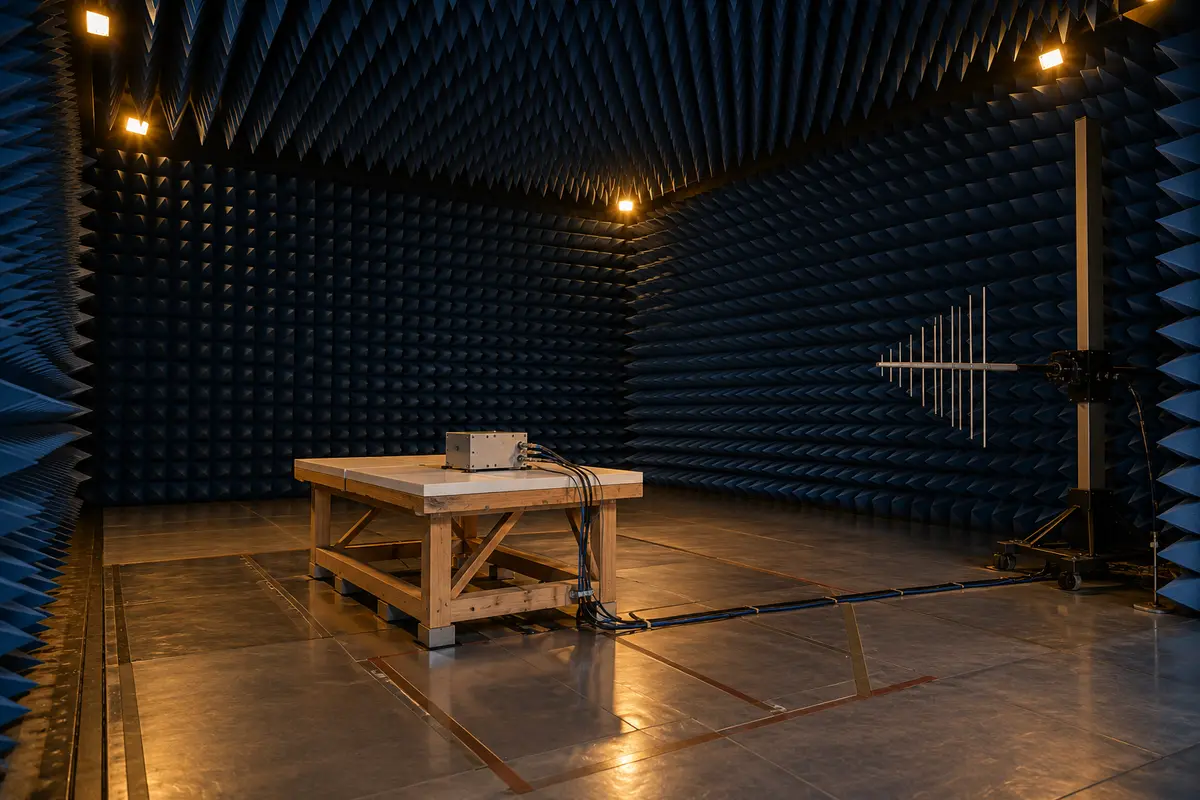
Complete-spacecraft environmental testing began in March 2025. At ESTEC’s Maxwell chamber, absorbent walls helped engineers test electromagnetic compatibility between sensitive instruments and the spacecraft’s transmitting electronics. The campaign also checked compatibility with Vega-C’s electronics. Four days of mass and centre-of-gravity measurements supplied information needed for launch compatibility and subsequent manoeuvring. At the end of April, the assembled spacecraft underwent shaker testing to simulate launch vibration.
The two solar-array wings were tested for deployment on 15 May. They would stay folded for launch and unfold in orbit. At the end of June, SMILE entered the Large Space Simulator for vacuum and thermal testing, including simulated sunlight and the temperature differences between illuminated and shaded surfaces. The thermal campaign ran around the clock, with teams from ESA, CAS, Airbus and European Test Services. That campaign finished successfully in early July. Engineers then planned repeat checks of the magnetometer boom and ultraviolet-camera cover, followed by software and operational tests before shipment to French Guiana.

Qualification and the launch campaign
By 20 November 2025, SMILE had passed its qualification and flight acceptance review. The complete assembly, integration and testing phase had run from November 2024 to September 2025 at ESTEC. The review confirmed that the spacecraft met launch requirements and could proceed to launch preparation. At that stage, the planned launch window extended from 8 April to 7 May 2026, with the exact day still to be selected amid other missions’ campaign schedules.
The November preparation plan
- Departure from ESTEC in February, followed by shipment from the Port of Amsterdam to French Guiana.
- A scheduled twelve-day sea journey before final preparations at Europe’s Spaceport.
- Launch aboard Vega-C, a roughly 35-metre rocket weighing 210 tonnes on the pad.
- Three solid-propellant stages followed by a liquid-propellant fourth stage for precise orbital placement.
These were the campaign arrangements described after qualification. The spring launch window subsequently changed before the mission’s actual departure in May.
Launch and the journey to the observing orbit
SMILE lifted off from French Guiana on Vega-C at 05:52 Central European Summer Time on 19 May 2026, or 00:52 local time. Avio, Vega-C’s prime contractor and design authority, acted as launch service operator for the first time. ESA’s New Norcia station in Australia received the first signal at 06:48 CEST; the solar arrays deployed at 06:49. The mission’s orbit-raising plan called for eleven engine burns during the following month, taking the spacecraft from its initial orbit to its distant observing path around Earth.
The operational trajectory reaches 121,000 kilometres above the North Pole for observations, then descends to about 5,000 kilometres above the South Pole for efficient data delivery. The payload module and X-ray camera involved institutions and companies in fourteen European countries, with Spain and the United Kingdom providing the largest contributions. ESA’s contribution was €130 million, covering more than 25 procurement contracts with over forty companies and institutes. That figure represents ESA’s financial contribution to the collaboration, rather than the total cost of the combined European–Chinese mission.
First observations and remaining adjustments
The spacecraft reached its target science orbit on 20 June 2026 and received authorisation to begin science operations on 23 September. Commissioning included mechanism deployment, instrument activation and communications checks. UVI footage recorded on 24 July showed an auroral substorm; by September the camera was recording the northern auroras for 45 hours at a time. SXI also switched on and took test images of supernova remnants, checking its response to astronomical X-ray sources. These targets included Cassiopeia A and a supernova remnant in the Large Magellanic Cloud.
Pointing SXI towards Earth exposed a separate difficulty: too much stray light reached the detector. European and Chinese teams were adjusting settings and onboard software. ESA’s 30 September account also described a natural reduction as the spacecraft pointed farther from Earth and northern winter approached. A minimum was expected in mid-October, potentially enabling good magnetopause or polar-cusp images. That expectation remained a forecast in the September account. Science authorisation and successful stellar test images therefore accompanied continuing work on the instrument’s Earth-facing observations.
Leave a comment