
Inside Project Silica: glass media, readers and archival libraries
Project Silica combines laser-written glass with optical readers and archival libraries. Separate experiments trace its media, robotics and preservation requirements.
Two glass-writing regimes
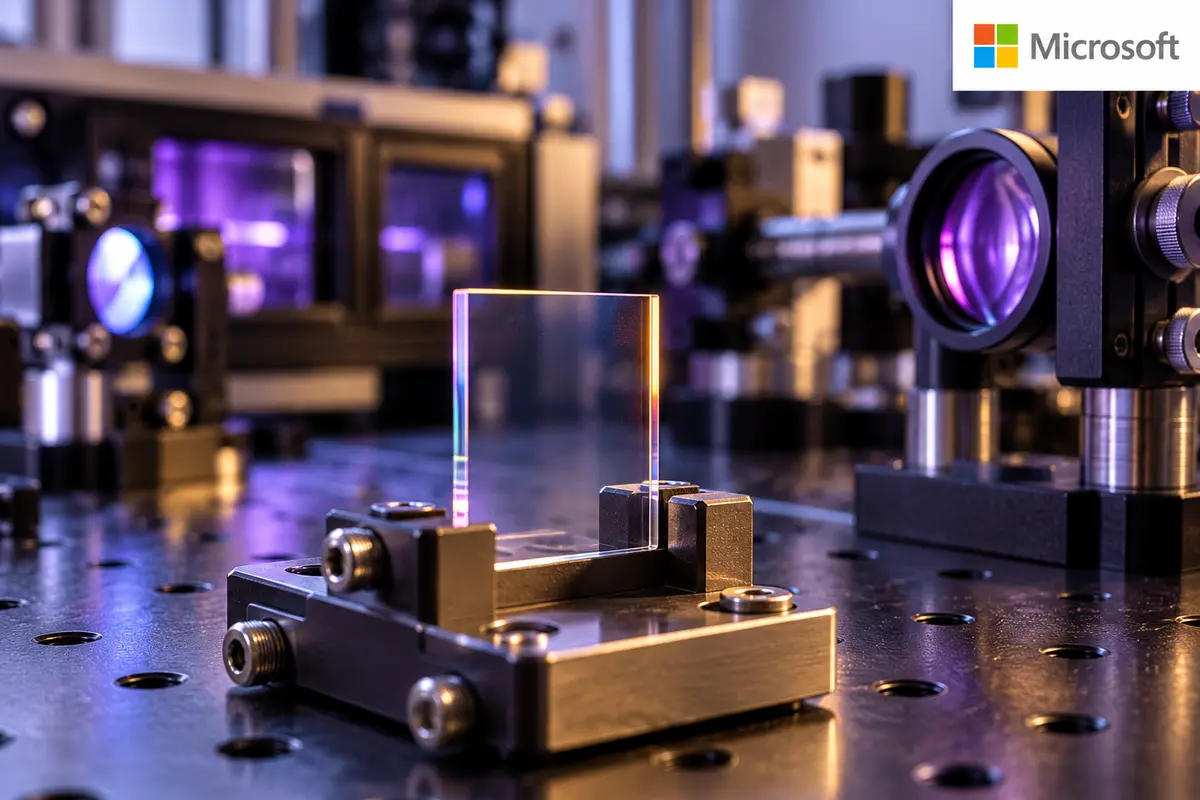
Microsoft Research’s Project Silica stores archival data inside glass. Its February 2026 research results distinguish birefringent voxels in fused silica from phase voxels in borosilicate glass. Birefringent voxels encode optical orientation; phase voxels encode refractive-index changes. For 120-by-120-millimetre platters, two millimetres thick, the respective usable capacities reached 4.84 and 2.02 terabytes. Single-beam writing reached 25.6 and 18.4 megabits per second respectively; four phase-writing beams achieved 65.9 megabits per second.
Accelerated ageing and Arrhenius modelling projected phase-voxel retention beyond 10,000 years at room temperature. That estimate concerns thermal stability, excluding mechanical stress and chemical corrosion. It is not an elapsed-duration test. Microsoft described the research phase as complete on February 18, 2026, without announcing commercial availability. The results follow earlier experiments in glass writing, optical reading and complete archival systems.
What five dimensions describe
At the University of Southampton, five-dimensional storage combined three spatial coordinates with two properties of laser-written nanostructures: their size and orientation. The extra dimensions described optical encoding rather than additional directions in physical space. Femtosecond pulses produced structures inside fused quartz, changing how polarized light travelled through it. Reading combined an optical microscope with a polarizer. The position of a structure located it within the material, while its other characteristics provided additional information that could be distinguished optically.

By February 2016, the Southampton team had recorded copies of the Universal Declaration of Human Rights, Magna Carta, Opticks and the King James Bible. A declaration copy was also presented to UNESCO in Mexico. Its document-writing description used three layers of nanostructured dots separated by five micrometres. The university also traced the experimental work to a text-file demonstration in 2013. Its much larger capacity and lifetime claims described the technology’s prospective properties, rather than the size of those document files. The researchers were seeking industrial partners to develop and commercialize the approach; the document demonstrations themselves were research results.
Recovering symbols from optical images
Microsoft Research and Southampton’s 2018 glass-storage work separated the equipment for writing from the equipment for reading. The writer used femtosecond pulses; the reader used microscopy and polarization control. Birefringent structures affected polarized light differently according to its direction. Measuring their optical response could distinguish encoded values. However, scattered light from neighbouring layers and variations between structures complicated that measurement. Reducing the spacing between voxels or adding layers increased the difficulty of recovering their individual values.
The team’s prototype decoder used a convolutional neural network to infer symbols directly from measurement images. This replaced intermediate calculations of retardance and polarization-angle changes. Training examples allowed the model to learn variations and noise patterns without requiring separate background images during reading. Across a ten-layer experiment, the prototype achieved 99.47% decoding accuracy. That was a raw experimental result, rather than a claim of perfect recovery of every user file. At that stage, the researchers had not built a complete end-to-end storage system and were developing prototype read and write heads.
A film becomes a storage demonstration
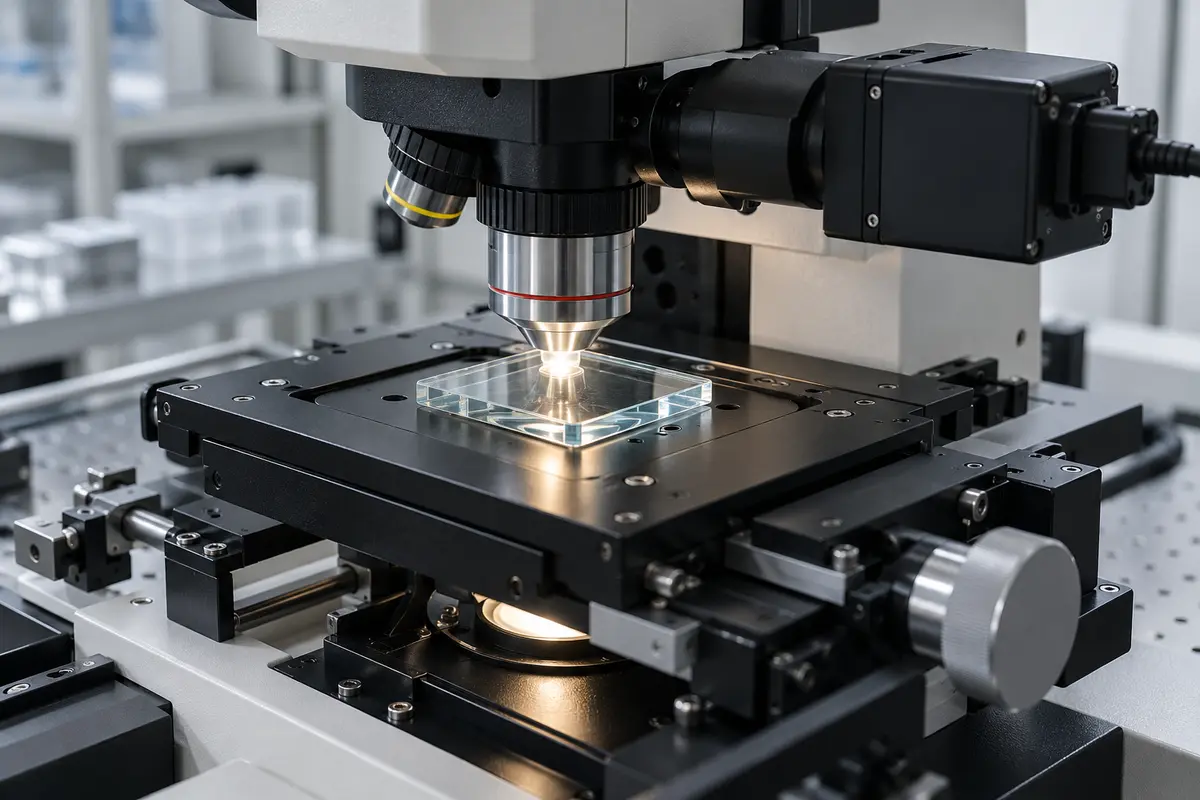
On November 4, 2019, Microsoft and Warner Bros. announced that they had stored and retrieved the complete 1978 film Superman using a glass square measuring 75 by 75 by two millimetres. The proof of concept contained 75.6 gigabytes plus error-redundancy codes. Microsoft’s Cambridge research laboratory in the United Kingdom collaborated with Southampton on the technology. The demonstration concerned cloud-scale archival storage, rather than a movie player or a household replacement for an optical disc.
Warner Bros.’ preservation practices supplied a specific application. In 2019, the studio aimed to keep three archival copies of an asset in different locations. Digitally shot theatrical films could receive a physical copy by separating the images into cyan, magenta and yellow components and recording them on black-and-white film negatives. Those copies required controlled vault conditions and a reverse conversion to retrieve the images. Glass offered a different experimental route: retaining the digital representation on a physical object. The partners still identified further work on writing speed, reading speed and density before scaling the approach.
Designing around cloud service requirements
In July 2020, Microsoft researchers examined how cloud storage changes the relationship between a service and its underlying media. Customers purchase a service-level agreement covering access and other requirements, rather than necessarily selecting a particular physical technology. Providers can therefore change the mixture of hardware behind a service while preserving its interface. The researchers argued that this creates room for storage designed specifically for cloud workloads, instead of equipment constrained by requirements for home computers, offices or portable devices.

Their design position extended beyond separating compute servers from storage servers. They distinguished infrastructure disaggregation from pooling drives and other hardware, then proposed co-designing the media, controllers, interfaces and software together. This could let individual resources match workloads rather than remaining tied together inside a conventional device. The team also identified maintenance and periodic media replacement as costs that accumulate over a data archive’s lifetime. These were motivations for investigating alternatives such as glass. The discussion presented a research direction and possible technological changes, rather than a verified prediction that existing storage media would disappear.
Transparent structures for layered reading
A separate Southampton study published in February 2020 investigated the optical loss associated with laser-written birefringent structures. Conventional nanogratings scattered light, reducing transmission through the modified glass. The researchers produced a different modification, designated type X, involving randomly distributed elongated nanopores. Its measured transmission reached 99% in visible and near-infrared light and exceeded 90% down to a wavelength of 330 nanometres. These percentages measured optical transmission, not the accuracy of recovered storage data or the proportion of files preserved.
Electron-microscope observations showed pores elongated perpendicular to the writing light’s polarization. Measurements and simulations connected the pores’ shape with birefringence and reduced scattering. The authors proposed a formation mechanism involving laser-generated defects, oxygen and nanocavitation; they did not establish every part of that mechanism as settled. Increasing pulse density could turn low-loss modifications into more strongly scattering structures, making them visible in transmitted light. The low-loss material’s optical response could be patterned spatially by changing the polarization of the writing light. Their demonstrations included optical elements such as a prism, lens and polarization converter. They also identified transparent, spatially controlled birefringence as useful for multilayer data storage.

Writing speed and read accuracy
A 2021 Southampton conference experiment used type-X modifications to record The Hitchhiker’s Guide to the Galaxy across 42 layers plus three additional layers. Eight orientation levels and two distinguishable retardance levels provided four bits per voxel. The writing rate reached eight kilobytes per second. The experiment used a one-megahertz femtosecond laser and tighter focusing to increase writing speed while retaining high read accuracy. The reported accuracy was 100% for the top layer and 99.9% for the bottom layer, distinguishing the two measured positions within the sample.
Those figures described experimental readout, rather than a guarantee that an entire archival system would recover every file without further protection. Recorded voxels were separated laterally by two micrometres and vertically by 17.5 micrometres. The authors considered increasing the writing rate to about 40 kilobytes per second and reaching a potential 1.4-terabyte disc capacity by reducing voxel spacing and pulse counts. Those were proposed improvements. They separately discussed another pulse-energy-modulation approach associated with higher writing rates and a much larger potential capacity, noting that additional error correction was necessary for complete readout accuracy. The alternatives therefore had different operating conditions and recovery requirements.
A faster nanostructure-writing experiment
In October 2021, an Optica publication introduced a different high-speed writing approach from the Southampton team. It used near-field enhancement around an initial nanovoid to form an elongated structure with subsequent weak pulses. The structures measured approximately 500 by 50 nanometres. Controlling polarization and intensity controlled optical properties used to encode information. The method reached one million voxels per second, equivalent to approximately 230 kilobytes per second. Localized modification reduced the thermal damage associated with other approaches using high-repetition-rate lasers.

The team wrote five gigabytes of text data with nearly 100% readout accuracy. Four bits were stored in each voxel, with two voxels representing a text character. From the demonstrated writing density, the researchers estimated that a disc could hold 500 terabytes. They also projected that parallel-writing upgrades could make writing that quantity feasible in about 60 days. Neither estimate meant that the experiment had already filled a 500-terabyte disc. The researchers were still pursuing faster writing and practical operation outside the laboratory, and identified faster data reading as another requirement for usable storage applications.
A trial for music preservation
Elire Group and Global Music Vault announced a collaboration with Microsoft in June 2022 to test glass storage for music collections. Their proof-of-concept platter measured 75 by 75 by two millimetres and held 100 gigabytes. The proposed contents combined music with associated digital files, which could be encrypted or unencrypted. The initiative concerned selected preservation material, rather than an announcement that the world’s music catalogue had moved to glass. Its stated aim was to create durable physical storage for recordings and related information.
The planned contributors included the Polar Music Prize, Alexander Turnbull Library and International Library of African Music. The International Music Council helped include additional contributors. Global Music Vault associated the work with a dedicated preservation vault planned on Svalbard in Norway. It also launched Project ARV, a campaign to gather musical expressions from different regions. These were the trial’s announced scope and collection plans in 2022. The organizations’ claims about very long retention did not constitute elapsed testing over thousands of years or evidence that every planned deposit had occurred.

From media to an archival system
Microsoft’s October 2023 system study combined a prototype library with a discrete-event simulator. Its workload analysis covered six months of user-generated operations in a cloud archival service during 2022. Files of four mebibytes or less represented 58.7% of read requests but only 1.2% of bytes read. Files above 256 mebibytes accounted for approximately 85% of bytes while representing fewer than 2% of requests. Small requests and large transfers therefore imposed different demands on the proposed library.
The design placed glass on passive shelves while powered shuttles moved platters to readers. Writing equipment, reading equipment and storage capacity could be provisioned separately. Every written platter had to be read for verification before the corresponding staged data could be deleted. Customer reads took priority over verification work, using otherwise available reader time. The system combined error correction within sectors with redundancy across sectors and platters. Its performance evaluation used measured prototype mechanical delays and simulated workloads; it did not establish that a commercial cloud service was already operating entirely on glass.
Robots for passive shelving
The 2024 RASCAL robot research addressed retrieving small objects from densely arranged storage shelves, including Silica platters. The design used horizontal rails attached to the shelf fronts. A robot could travel along a pair of rails or move vertically by pivoting around one rail and attaching to another. Its wheels and rail geometry held it in place through gravity. The rails themselves required no powered movement system. Battery-powered robots contained the active mechanisms, allowing storage shelving and retrieval equipment to have different service and replacement requirements.

The proof-of-concept robot used three motors for its horizontal and climbing motion, with a separate picker interface for handling objects. RFID tags, a rotary encoder and an accelerometer supported positioning and orientation checks. Its supervisory software used ROS 2, with custom task scheduling and Wi-Fi communication. The prototype weighed approximately 3.5 kilograms including its picker and battery. Controlled tests covered horizontal motion up to two metres per second, with movements ending within half a millimetre of their targets. Those results concerned the tested prototype and experimental conditions. Large-scale fleet evaluation remained future work, and the prototype did not yet implement a production charging or battery-swapping mechanism.
Preserving the means to read
The Avenues Golden Record 2.0 project supplied another application for Silica. Students curated images, sounds and other material to represent Earth and humanity, inspired by the records carried by the Voyager spacecraft. Microsoft produced two sample glass platters for the collaboration. One contained digital material; another carried visible descriptions explaining concepts needed to read the information. In September 2024, the project still lacked a fixed completion or launch timetable. Preparing a message for possible space transport was distinct from securing a flight or demonstrating that a recipient could decode it.
The collaboration addressed preservation beyond retaining bits. The students’ instruction platter concerned future reading. Their team divided work between selecting content and investigating its physical medium. Glass could carry both information and explanatory markings, but the project still required choices about content, interpretation and transport. Microsoft’s researchers distinguished three tasks:
- Keep the stored bits intact.
- Maintain an index recording the contents and their location.
- Preserve knowledge of how to read the medium.
Leave a comment