
PLATO: camera calibration and spacecraft testing
PLATO has completed its electronics tests. Camera calibration, onboard processing and stellar catalogues prepare the mission to measure planetary transits.
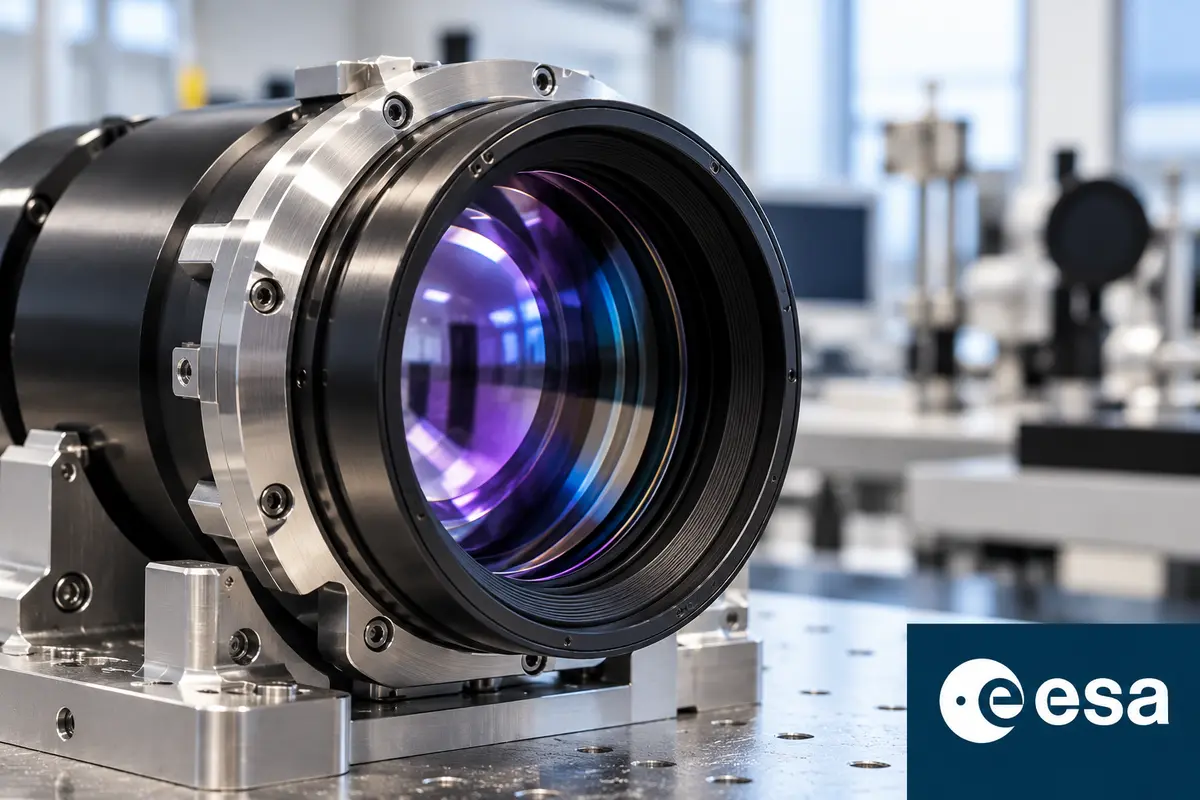
Electronics tested together
PLATO has completed electromagnetic compatibility tests at the European Space Research and Technology Centre in the Netherlands. Inside the Maxwell Test Chamber, engineers remotely commanded the spacecraft's electronics and checked that its instruments, modules and communications equipment could operate together without unwanted interference. The enclosure's conductive walls, floor and ceiling shield the test from external electromagnetic signals, while its interior lining absorbs signals and limits reflections.
The European Space Agency's planet hunter has now cleared the last major examination in its spacecraft qualification campaign. Vibration and acoustic testing began in January 2026, followed by thermal-vacuum testing and then the electronics checks. The July schedule envisages an Ariane 6 launch in March 2027. That remains a planned flight; the completed work concerns preparations on the ground.
Temperature, vacuum and camera focus
The separate Large Space Simulator campaign exposed PLATO to vacuum and controlled heating and cooling. After the chamber closed in early March, pumps reduced the gas pressure to a billionth of standard atmospheric pressure. Liquid nitrogen circulated through the chamber walls, while heating elements reproduced sunlight reaching the solar panels and sunshield. During the hot phase, the solar-panel side reached 150 °C, while the shielded cameras stayed between −70 and −90 °C.
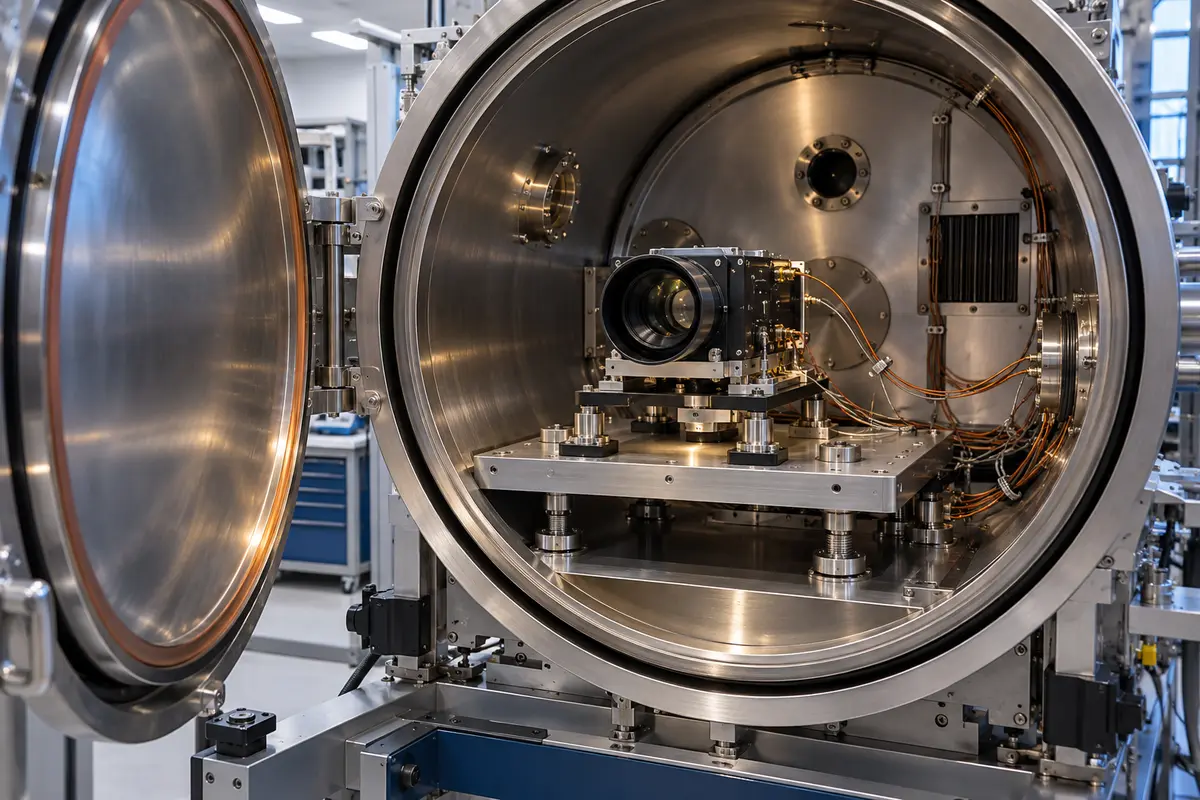
PLATO's optical tubes permit fine adjustment of camera focus through temperature control. Dedicated tests checked the precision of that control and the response of the complete spacecraft. In the cold phase, heaters prevented excessive camera cooling. The April completion announcement left further analysis of the measurements under way: engineers would refine thermal models and predictions of camera behaviour in flight. The Maxwell electronics campaign and these thermal-vacuum exercises therefore involved different facilities and different operating conditions.
Measuring planets and their stars
PLATO, short for PLAnetary Transits and Oscillations of stars, combines 26 cameras with apertures of 12 centimetres each. The mission design couples transit photometry with asteroseismology: changes in a star's brightness contain information both about planets crossing its face and about oscillations of the star itself. Its observing programme calls for at least four years of high-precision photometric measurements, with small planets around bright stars among its central targets.
The mission's characterisation objectives extend beyond detecting a dip in brightness. Ground-based radial-velocity observations complement the space measurements. For an Earth–Sun combination, the design objectives are uncertainties of 5% in planetary radius, 10% in mass and 10% in age. These are performance goals, rather than achieved measurements of a newly discovered Earth analogue. Stellar properties derived through asteroseismology form part of that characterisation, alongside the search for planets smaller than twice Earth's radius around stars brighter than magnitude 11.

Calibrating a fleet of cameras
The camera calibration programme extends beyond the instruments destined to fly. Its 2021 plan covered 26 flight models, three flight spares, two qualification models and an engineering model. Each camera shares a six-lens optical design with a 120-millimetre entrance pupil and a field of view exceeding 1,000 square degrees. The programme includes geometric calibration for fine guidance and measurements needed to establish the best focus. Those tasks belong to the preparation of individual cameras as well as the assembled payload.
Ground and orbital calibration have different responsibilities. Measurements that can be made in orbit were assigned to that phase rather than all being repeated on the ground. The orbital plan has no dedicated onboard calibration targets or sources. Instead, it uses stars, spacecraft pointing capabilities and data processing to characterise the cameras after launch. The preparation therefore includes both measurements in controlled facilities and procedures for using the sky itself during commissioning and later operation. The 2021 allocation describes a calibration strategy, not a claim that orbital calibration has already happened.
Testing the fast-camera signal chain
The fast cameras also supply fine-guidance measurements to the spacecraft's attitude control system. Their front-end electronics were tested first with simulated CCD signals from an arbitrary signal generator. This allowed separate investigation of crosstalk, linearity, gain and noise at board and unit level, and adjustment of the analogue-to-digital converter configuration. The two flight electronics units subsequently underwent tests with four flight-model CCD270 detectors, using uniform illumination and light directed at individual pixels.

In those thermal-vacuum measurements, the CCDs stayed at −55 °C while the electronics temperature ranged from −40 to +25 °C, with intermediate settings in 10-degree increments. Changing exposure times under uniform illumination supported measurements of gain, non-linearity, read noise, dark current, offset, pixel-response variation and full-well capacity. Individual-pixel illumination probed crosstalk and signal overshoot and undershoot. The fast cameras use frame-transfer detectors: each has 4,510 by 2,255 pixels overall, including a light-sensitive region of 4,490 by 2,245 pixels. Their electronics test results preceded the assembled spacecraft campaign.
Following light into digital data
PINE, the PLATO Instrument Noise Estimator, models the physical path from a target star's signal to a camera's digital output. Its principal performance quantity is the noise-to-signal ratio. The simulator supports the definition, breakdown and verification of requirements for the instrument, including its normal and fast cameras. Its coarse mode provides rapid analyses at instrument level. These calculations concern expected performance and engineering requirements; they are distinct from the measurements made during camera qualification and from future observations in space.
Simulating complete observations
PlatoSim produces simulated sequences of CCD images and stellar light curves for PLATO's more complex observing configuration. Its modelling runs from incoming photons to the final measurements in digital units. The software accommodates the mission's multiple telescopes rather than treating the instrument as one camera. This permits expected observations to be generated during preparation, when the consortium needs to assess the payload and develop processing methods before actual flight data exist.

The simulator supports several distinct activities within that preparation: mechanical integration and alignment, assessments of payload performance, development of the data pipeline and investigations of scientific objectives. These applications use a common representation of the observation process, while addressing different engineering or scientific questions. Simulated images and simulated light curves remain model outputs. They provide test material for the systems and algorithms that will process observations, rather than a catalogue of planets already measured by PLATO. The April 2026 version describes use during the preparatory phases and prospective use after launch.
Choosing which pixels to retain
Telemetry limits constrain how much image data PLATO can send to the ground. Onboard aperture photometry reduces selected stellar measurements to light curves, integrating signals from chosen sets of pixels. A 2019 simulation study compared three ways to define those sets: a binary mask, a weighted Gaussian mask and a weighted gradient mask calculated to minimise the noise-to-signal ratio. The comparison assessed sensitivity to both legitimate planetary transits and false signals produced by contaminating stars.
Binary masks had a noise-to-signal ratio a few percent higher than weighted masks in the simulations, yet their efficiency for detecting genuine transits was similar. They collected less contaminating light and produced up to approximately 30% fewer false transit signatures at the study's 7.1-sigma threshold. The comparison concerns the simulated alternatives and their selection criterion; it is not a measured rejection rate for all future PLATO candidates. The preferred mask therefore followed a compromise between sensitivity and contamination, rather than selection solely by the lowest calculated noise.

Reference stars for commissioning and guidance
PLATO's calibration Input Catalog, or cPIC, contains 71,671 unique stellar targets across the instrument's full field of view. Its separate samples serve specific technical calibration tasks. The commissioning plan expects instrument verification, calibration and configuration to begin a few weeks after launch and finish within the mission's first three months. Reference stars are also required during later spacecraft rotations and changes of pointing, so their role extends beyond initial commissioning.
The fine-guidance catalogue, fgPIC, has a different purpose and footprint. It contains 2,640 particularly bright stars in the central region covered by the two fast cameras. About 30 guide stars are intended to be used at any given time by the onboard Fine Guidance System. The catalogue is thus a pool from which active guidance targets can be drawn, rather than a list observed simultaneously in its entirety. Neither catalogue counts planets: these are stellar references selected to calibrate the instrument and maintain its pointing while scientific observations proceed.
The first long observation field
LOPS2 is the southern field selected for PLATO's first long-duration observation, planned to continue for at least two uninterrupted years. It is a slightly adjusted version of an earlier proposed southern field. Its astronomical contents include known planetary systems, bright and variable stars, binaries and star clusters, alongside opportunities for coordinated work with other facilities. Across the mission lifetime, an average of 8% of the science data rate is allocated to Guest Observer programmes chosen through public ESA calls. The field's selection therefore concerns both the core planetary search and other approved observing programmes sharing the instrument's data capacity.

A target list built before flight
The April 2026 release of the target PLATO Input Catalogue, tPIC2.2, identifies 217,741 stars for the core programme in LOPS2. Its listed populations comprise 202,315 FGK dwarfs and subgiants, 15,037 M dwarfs and 789 known planet-host stars. The host-star category includes systems with confirmed planets or candidates. These are pre-existing targets, rather than discoveries made by the spacecraft. Telemetry constraints require the selection to be performed before observations begin.
The catalogue combines Gaia Data Release 3 astrometry and photometry with three-dimensional maps of the local interstellar medium. Its processing estimates reddening for almost all targets and derives effective temperatures, radii and masses from the observational quantities using a homogeneous method. The FGK sample has a median distance of 512 parsecs, compared with 133 parsecs for the M-dwarf sample. Those different stellar populations and distances are properties of the selected target lists; they are not planetary orbital distances or measurements of PLATO's eventual detection range.
The limits of a magnitude-selected sample
The earlier PIC2.1.0.1 catalogue's P4 sample contains M dwarfs in LOPS2 with visual magnitudes below 16. Its characterisation includes the selection of targets, estimates of fundamental stellar properties and assessments of both photometric and volume completeness. Statistical classification also uses the stars' Galactic spatial velocities. These details describe how the stellar sample was assembled and checked, rather than observations of planets around every listed star.

The magnitude limit affects the sample's coverage with distance. Beyond 30 parsecs, volume completeness decreases and progressively fewer late-type targets are included. The large spread in the colour–magnitude diagram likely reflects a combination of metallicity, age, binarity and stellar activity. Radius estimates were compared with independent methods from the literature, with consistent results. These properties belong to the December 2025 analysis of that catalogue version. They retain their own selection context when considered alongside the later target release, rather than turning a magnitude-limited list into a complete census of nearby M dwarfs.
Earlier observations of the same sky
TESS has already provided observations relevant to the future PLATO field. A 2024 field study projected that, by 2025, stars in LOPS2 would have an average of 330 days of TESS monitoring, with more than 1,000 days for a subset in its continuous viewing zone. Its inventory at the time included the following populations:
- 101 known transiting exoplanets, of which 36 were in multiple-planet systems;
- more than 500 TESS planet-candidate systems and 64 planets found only through radial velocities;
- more than 1,000 eclipsing binaries brighter than visual magnitude 13, seven transiting brown-dwarf systems and two white dwarfs brighter than Gaia magnitude 13.
Those are dated counts and projections, not a current discovery tally. The study's sensitivity calculations expected PLATO to improve on TESS for planets between one and four Earth radii. The calculated advantage concerns those smaller planets and the assumed observations; it does not mean every TESS candidate will be confirmed or every target will yield a planet.

A possible return to Kepler systems
A different simulation examined a possible two-year northern observing field overlapping the original Kepler field. Such a programme could revisit known systems with a photometric baseline exceeding 20 years. It remains a possible observing scenario, separate from the selected first southern field. The calculations modelled 152 Kepler host stars containing 361 transiting planets, selected because at least one planet in each system already had detected transit-timing variations.
The simulated CCD observations included stellar variability and real contaminating stars, and compared aperture extraction with point-spread-function fitting. PLATO's smaller collecting area and larger pixel scale limited precision for individual transits relative to Kepler. A subset of systems nevertheless offered particular potential for complementary dynamical constraints from timing variations. These are forecasts for selected known systems under an observing scenario. They complement the mission's planned radial-velocity measurements without constituting new mass determinations or a commitment to observe that northern field.
Leave a comment