
OSCAR-QUBE: diamond sensing, flight tests and magnetic calibration
OSCAR-QUBE mapped Earth's magnetic field from the ISS. Diamond readouts, launch qualification and calibration explain the flight and future engineering options.
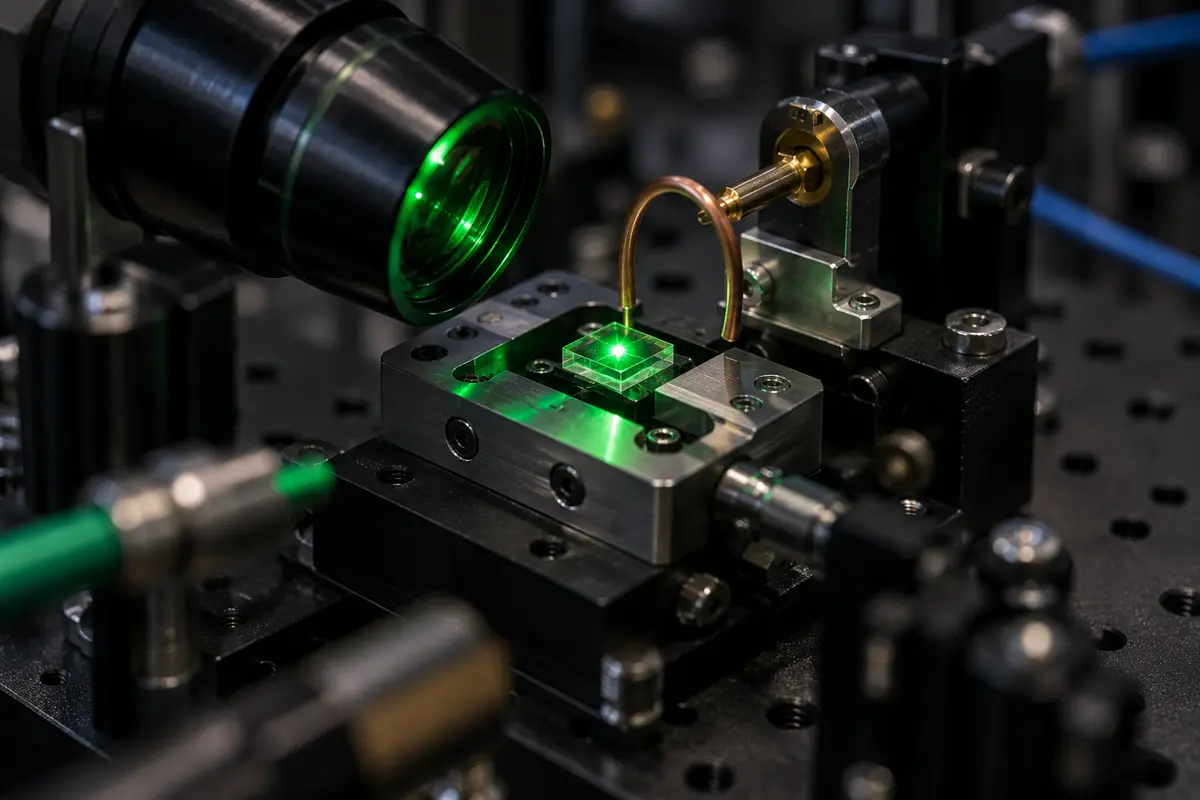
A diamond sensor inside the space station
OSCAR-QUBE used defects in a diamond to map Earth’s magnetic field from inside the International Space Station. The ten-centimetre cube collected data for ten months in 2021–22. Jaroslav Hruby of Hasselt University in Belgium and colleagues published the flight results on 7th May 2026. The 420-gram instrument consumed five watts at peak power. Its performance did not surpass the best conventional magnetometers. Magnetic maps contain signals from the outer core, crust, space weather and ocean tides; Hruby identified navigation without GPS as one potential application.
The flight measurements required substantial filtering and calibration: 32.3% of acquired magnetic data remained usable. Axis offsets were fitted against the International Geomagnetic Reference Field; subsequent agreement with CHAOS-7 therefore involves model-assisted calibration. The ground-characterised sensitivity was approximately 300 nanoteslas per square-root hertz. OSCAR-QUBE’s hardware supported photoelectric detection, but its mission used fluorescence readout. Internal station fields limited the experiment, while more advanced hardware and measurements outside the station remained future work.

From design reviews to flight acceptance
The Hasselt student team developed its experiment through ESA Academy’s Orbit Your Thesis! programme, following simplified European Cooperation for Space Standardization project phases. The work extended from defining requirements to preparing for the experiment’s eventual recovery. A review board examined documentation at successive milestones. Columbus compatibility and scientific requirements both entered the Preliminary Design Review.
The preliminary review package
- Design options for the experimental requirements.
- Management plans and a preliminary safety assessment.
- Subsystem assembly and testing plans.
Critical Design Review discussions addressed structural finite-element analysis and inconsistencies in the software architecture. After iterations with the board, that review passed in February 2021. Assembly and verification then covered both individual subsystems and the complete experiment. Electromagnetic compatibility tests checked interference with other experiments and critical Columbus equipment. The Flight Acceptance Review cleared shipment to logistics contractor Altec in Turin, Italy. ESA Academy, ESA’s technology directorate, Space Applications Services and the European Low Gravity Research Association contributed expertise to the reviews.
Three axes on the shaker
Mechanical qualification took the team to the CubeSat Support Facility at ESA’s European Space Security and Education Centre from 6th to 8th April 2021. Two students brought the cube to a custom test setup prepared for the campaign. The facility’s 20-kilonewton shaker subjected the experiment to random vibration along each of its three axes. The input levels represented the vibrations expected while the packaged payload travelled aboard the cargo spacecraft carrying supplies and scientific equipment to the station.
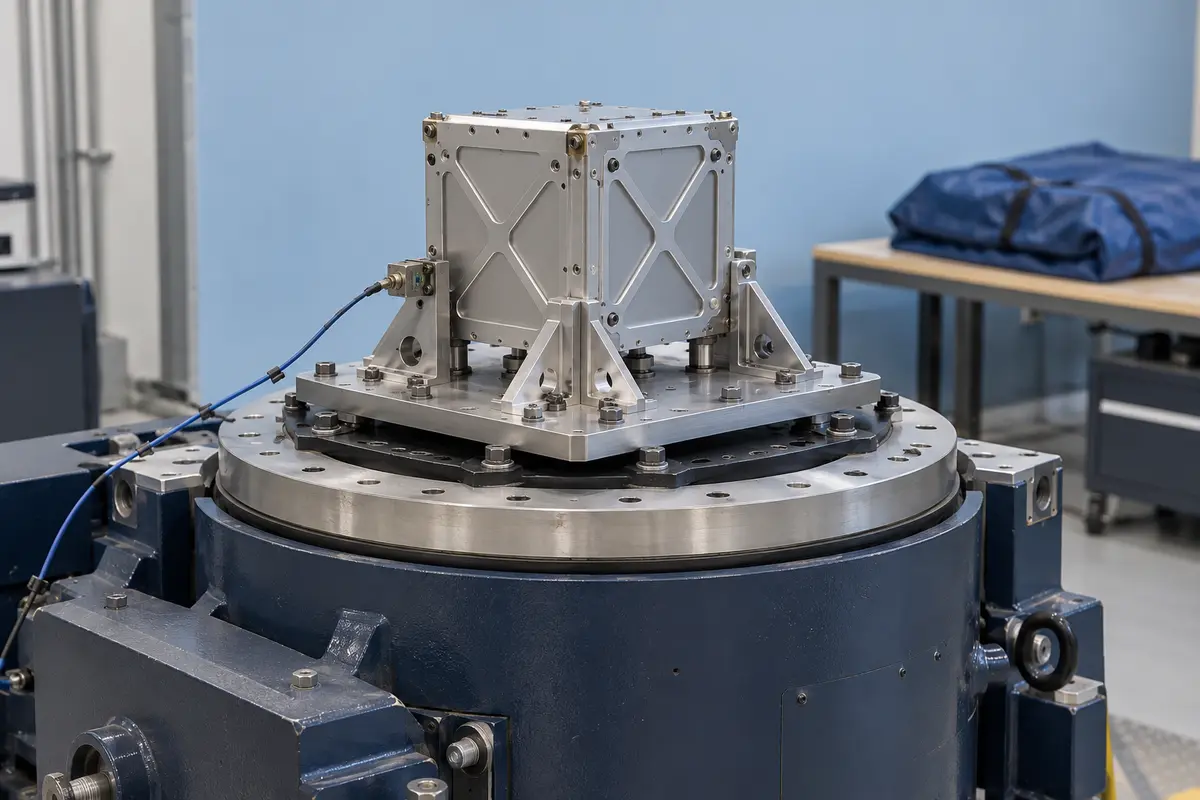
Pre-vibration functional checks accompanied the mechanical work. ESA Education staff supported the students through preparation and execution, their first vibration campaign. COVID restrictions added distancing requirements to the laboratory procedures. The campaign concluded with the vibration test completed successfully. The April account still anticipated a four-month stay on the station; that was an early mission plan. At this stage, the documented milestone concerned survival of the transport environment before delivery to orbit, with scientific operations still ahead.
Installation before collection mode
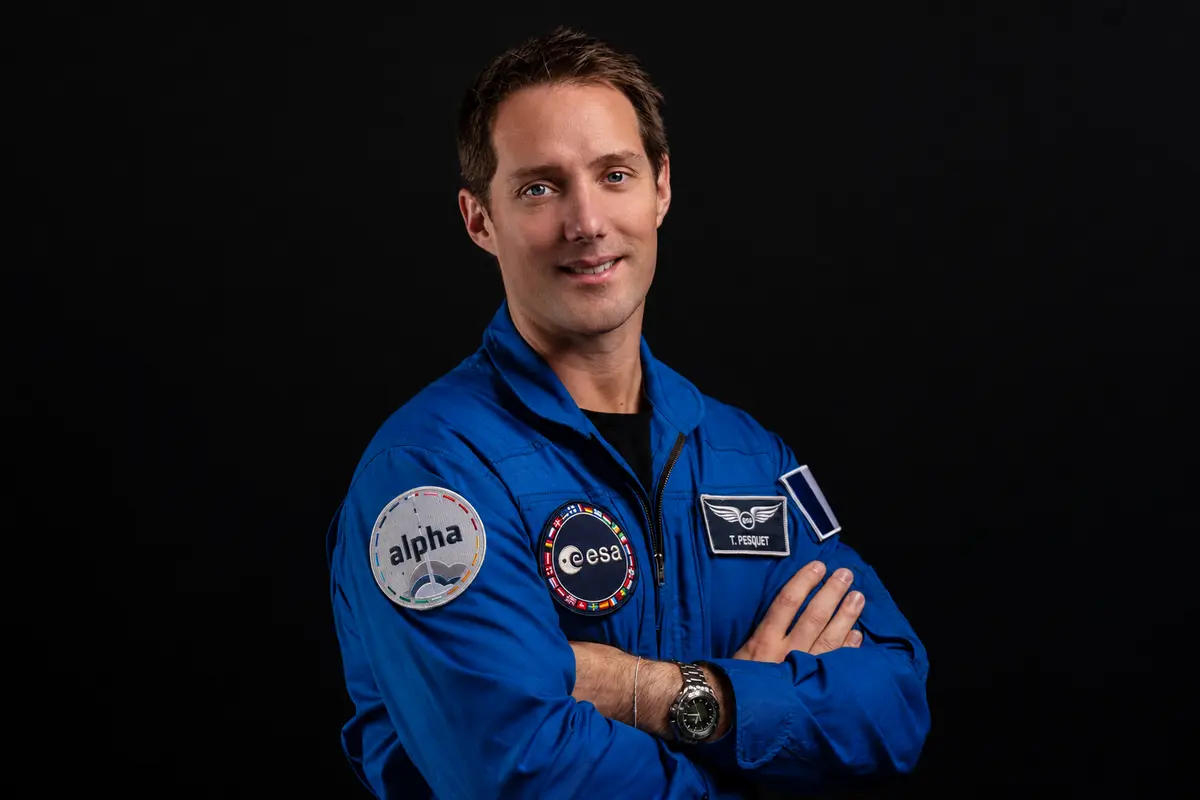
ESA astronaut Thomas Pesquet installed OSCAR-QUBE in the station’s ICE Cubes facility on 2nd September 2021. Students followed the milestone from the Belgian User Support and Operations Centre. Their next task was to run test routines after the journey into space, checking that the experiment’s functions had survived transport before switching it to data collection.
At installation, the team expected the facility to host the experiment for eight months. That expectation belonged to the commissioning announcement, rather than the eventual duration of the measurement campaign. The operational sequence placed an astronaut’s hardware installation first, followed by the student team’s functional testing and collection of magnetic measurements for analysis on the ground.
The services around the cube
ICE Cubes had opened for business in June 2018, with its initial installation in the European Physiology Module inside Columbus. The facility drew power, temperature regulation and communications from the station’s laboratory. Its experiment format used ten-centimetre cubes, called one-unit or 1U packages, and combinations of that volume. The original arrangement provided twelve cube positions on top and two rows of four below. The host supplied a common interface around which individual experiments could be designed.
Space Applications Services operated the commercial research service in partnership with ESA. A dedicated control centre at Sint-Stevens-Woluwe provided internet access for users to read data and send commands from their own locations. The service offered round-the-clock access to experiments. ICE Cubes also supported experiments communicating wirelessly within Columbus. These arrangements placed communications, hosting and ground access around the payload, while its designers remained responsible for meeting station requirements. They also located the research inside a crewed laboratory rather than on an independently flying spacecraft.

Reconstructing a magnetic vector
A nitrogen-vacancy centre combines a nitrogen atom replacing carbon with an adjacent vacancy in diamond. Ensembles in a single crystal have four possible orientations fixed by the lattice. Magnetic fields shift their spin-resonance frequencies; laser excitation and microwave interrogation make those shifts observable in fluorescence. Eight resonance features can arise from the four orientations. Reconstructing three Cartesian field components requires information from several orientations, together with a calibrated relationship between resonance shifts and the applied field.
Jennifer Schloss, John Barry, Matthew Turner and Ronald Walsworth demonstrated simultaneous vector sensing in 2018. Four microwave signals carried distinct modulation frequencies, allowing software lock-in detection to separate their contributions on one optical detector. The laboratory instrument achieved sensitivities of 57, 46 and 45 picoteslas per square-root hertz along its three axes, with a 203-hertz equivalent noise bandwidth. Its setup included a 3.3-watt green excitation beam and a silicon-carbide heat spreader. Those conditions belong to that laboratory apparatus, rather than to the small ISS payload.

Temperature also moves the resonances
Diamond resonance frequencies respond to temperature as well as magnetic fields. V. M. Acosta and colleagues measured four diamond samples between 280 and 330 kelvin for research published in 2010. The axial zero-field splitting, the separation between spin states without an applied field, decreased by an average 74.2 kilohertz per kelvin, with an uncertainty of 0.7 kilohertz per kelvin. The temperature dependence appeared across samples prepared differently and containing different concentrations of nitrogen-vacancy centres.
Temperature shifts affect the common resonance position. Measuring the separation between the two relevant spin resonances offers a way to reject slow changes in that common position. Acosta’s team proposed monitoring both resonances as part of a feedback approach, alongside monitoring fluctuations in laser intensity. Heating associated with optical excitation also entered their analysis of possible magnetic noise. Local lattice expansion was a proposed explanation for the temperature response, but a calculation using bulk diamond expansion did not reproduce its measured magnitude. These measurements establish a thermal dependence of the sensing material; they do not constitute an in-orbit temperature correction for OSCAR-QUBE.
What fits inside an integrated sensor head
A 2024 experiment led by Jens Pogorzelski used a green LED instead of a laser to excite diamond microcrystals. Three stacked circuit boards carried the LED, microwave antenna and photodiode. A long-pass filter separated red fluorescence from the 525-nanometre excitation light. The roughly 0.42-cubic-centimetre head presented an electrical interface, while microwave generation, amplification and lock-in readout remained in external equipment. Its LED consumed approximately 0.1 watt; that figure did not describe the consumption of the complete measurement system.

The measured noise-based sensitivity averaged 28.32 nanoteslas per square-root hertz over averaging times from 0.1 to three seconds. A calculated photon shot-noise limit of 2.87 nanoteslas per square-root hertz was lower than the measured value. Tests following applied square-wave and sinusoidal magnetic signals gave approximately 147.5 and 187.44 nanoteslas per square-root hertz, respectively. The reference coil’s current fluctuations contributed to those conditions. LED noise and heating also remained engineering considerations. Sensitivity, sensor-head dimensions and supporting electronics thus refer to different parts of the experimental specification.
Reading current instead of collected light
Another branch of diamond sensing research changes the detected signal. Emilie Bourgeois and colleagues demonstrated photoelectric detection of nitrogen-vacancy spin resonances in 2015. Green illumination promoted charge carriers into diamond’s conduction band through a two-photon ionisation process. Electrodes collected the resulting current. The researchers recorded optical fluorescence and photocurrent simultaneously while sweeping microwave frequency; resonance minima appeared at matching frequencies. The experiment concerned ensembles of defects, with single-defect detection identified as a possible later development.
The samples carried coplanar interdigitated titanium and aluminium electrodes separated by gaps of fifteen or one hundred micrometres. An applied electric field drove the photogenerated carriers toward the contacts. Substitutional nitrogen contributed a background photocurrent, whereas the nitrogen-vacancy contribution had a different dependence on light power. Comparisons between the two diamond types consequently involved their impurity populations as well as their resonances. The photoelectric method still required green illumination and microwaves: it changed electrical detection of the response, rather than removing optical excitation. Its proposed integration on a diamond chip concerned a readout route distinct from collecting fluorescence with a photodetector.

Separating instruments from spacecraft fields
Dedicated magnetic missions organise the spacecraft around measurement quality. Swarm’s design placed magnetometers and star-tracker cameras on a deployable boom, away from the main body’s magnetic noise. The Vector Field Magnetometer shared a mechanically stable optical bench with three star-tracker cameras. An Absolute Scalar Magnetometer at the boom’s tip used helium magnetic resonance to supply a field-strength reference for daily vector-instrument calibration. The two instruments had different roles within the same measurement package.
ESA system and instrument manager Abderrazak Bouridah described the qualification procedures during commissioning in December 2013. Observatory tests established transformations between the optical bench and camera orientations and checked thermo-mechanical stability. Components underwent magnetic characterisation before integration, within a spacecraft magnetic budget. Further assembly and test stages characterised disturbances in a controlled facility at Ottobrunn, Germany. The attitude-control system also used small steps in magnetorquer currents to reduce magnetic effects. Instrument orientation, reference measurements and the spacecraft’s own electrical behaviour therefore each received specific design and verification work.
Model calibration and an independent comparison
CryoSat-2 supplied another route to scientific magnetic measurements, using three platform magnetometers originally carried for spacecraft functions. Nils Olsen and colleagues calibrated observations from August 2010 to December 2018 against the CHAOS-6 field model. Monthly parameters represented offsets, scale values, axis non-orthogonality and alignment. Additional terms accounted for temperature, solar-array and battery currents, magnetorquer currents and nonlinear sensor behaviour. The calibration used nonpolar observations because the reference model omitted important polar current systems.

An independent comparison used nearby measurements from Swarm Bravo. During close encounters, the researchers compared residual magnetic vectors after subtracting the appropriate model values at each satellite. The spacecraft occupied different altitudes and positions; the test was not a comparison of colocated instruments. Quiet, nonpolar conjunctions in August 2018 produced differences below approximately ten nanoteslas in the illustrated components. The study also provided calibrated data with a robust twenty-second average from available sensors. Its treatment distinguished fitting to a reference model from checking the resulting observations against another spacecraft’s measurements.
The weak-field region over the South Atlantic
One prominent feature in orbital magnetic observations is the South Atlantic Anomaly, the region of reduced field strength stretching between South America and Africa. Earth’s magnetic field is largely generated by motion in its liquid-iron outer core. Its strength and direction vary across the planet and change over time. Swarm observations help separate the contributing signals and follow the evolution of weak-field regions alongside other changes in the field.
ESA’s May 2020 assessment placed the anomaly’s minimum at around 22,000 nanoteslas, compared with approximately 24,000 nanoteslas in 1970. It described expansion and westward movement, together with a newer secondary minimum southwest of Africa. Those figures describe that historical assessment rather than a fresh estimate from OSCAR-QUBE. The weaker field allows charged particles to penetrate to spacecraft altitudes more readily, increasing the likelihood of electronic disturbances. ESA characterised the intensity decrease as within normal fluctuations and identified the underlying core processes as an open research question. The anomaly’s appearance in a magnetic map and the performance of the instrument producing that map remain separate quantities.

A smaller, pulsed follow-on design
Hasselt’s OSCAR-PINQ project set out a further engineering programme in December 2024. Its proposed sensor combined on-chip miniaturisation with pulsed nitrogen-vacancy measurement protocols. The stated targets included a 0.2U package, mass below 250 grams and sub-nanotesla sensitivity. The team intended to measure static and dynamic magnetic fields and investigate space-weather applications. These were design objectives, distinct from the completed continuous-wave flight experiment and its measured specifications.
Planned validation aboard ESA’s Space Rider would examine operation under rapid temperature changes and cosmic radiation. Eighteen students brought backgrounds in physics, electronics, software, mechanics and outreach, with faculty and former OSCAR participants providing mentorship. The team proposed dynamically filtering magnetic signals through pulsed protocols while reducing the sensor’s size. Further Earth-observation and CubeSat uses depended on development and validation of that hardware. The programme therefore combined a defined miniaturisation target, a different measurement approach and an intended environmental test platform, with the sensitivity and robustness goals still to be demonstrated in the proposed configuration.
Leave a comment