
Cooling paint: moisture, heat transfer and evidence from buildings
NTU's cooling paint combines reflection, heat emission and evaporation. Other experiments explain moisture, durability and the scale of building-energy savings.

A coating that releases water
Hong Li, Jipeng Fei and See Wee Koh at Nanyang Technological University developed a cement-based cooling paint for humid Singapore. Its porous structure combines sunlight reflection, infrared heat emission and evaporation. Water stored in the coating gradually escapes, carrying heat away. Their study appeared in Science on June 5, 2025.
The paint reflects 88–92% of sunlight, including when wet. Nanoparticles support reflectivity and strength; small polymer and salt additions retain moisture and limit cracking. Humidity complicates radiative cooling because atmospheric water vapor restricts heat escaping from surfaces.

Three small test houses carried ordinary white paint, commercial radiative cooling paint and the new coating. After two years outdoors, the comparison coatings had yellowed while the new paint remained white. The new-paint house used 30–40% less air-conditioning electricity than the comparison houses. These were model-house results, rather than a measured reduction across Singapore’s buildings.
Where building energy goes
Buildings account for around 30% of global energy demand, with homes responsible for about 70% of energy consumed within the building sector. The International Energy Agency’s November 20, 2025 assessment distinguishes that global picture from regional differences in energy services. In advanced economies, space heating and water heating together absorb about 70% of household energy. Cooling remains a smaller share there, although its demand is expected to rise. Existing buildings often have poor insulation, while the number of buildings grows relatively slowly.
Emerging and developing economies have less than one-quarter of advanced economies’ per-capita space- and water-heating energy use. Warmer climates and limited access to affordable energy services both contribute. Population growth, higher incomes and hotter summers increase cooling demand. Buildings in emerging economies are growing almost twice as quickly as in advanced economies, making efficient new construction especially relevant. Building energy codes cover roughly half of their new floor area. The IEA’s priorities include better air conditioners, efficient building design and urban planning, alongside retrofits and improved heating systems where those measures match local demand.

Recycled polymers and reflective particles
A separate NTU coating program used discarded acrylic, old PVC pipes and polystyrene foam with barium sulphate. Two preparation methods produced different structures. A sol-gel formulation reflected about 97.7% of sunlight. During a 24-hour rooftop test in Singapore, its surface reached 1.2°C below surrounding air temperature in sunlight and 3°C below ambient at night. These measurements concerned a recycled-plastic coating, distinct from the later cement-based paint and its model-house electricity experiment.
The second method, phase inversion, introduced tiny air-filled pores into the recycled polymers. Those pores scatter sunlight across its spectrum. Surfaces treated with this version nearly matched ambient temperature at noon and reached 2.5°C below it at night. Experiments also used unsorted mixtures of the three plastic wastes, obtaining results comparable to coatings made from a single waste type. That finding suggested scope to reduce sorting requirements. The work, publicized on June 3, 2024, explored waste-derived materials as well as cooling performance; the two formulations retained separate temperature results and preparation methods.
Glass particles and outdoor durability
A glass-based coating developed at the University of Maryland takes another materials route. Finely ground glass particles serve as a binder in a layer that can reflect up to 99% of incoming sunlight while releasing heat through infrared radiation. Particle size is important to its optical behavior. The coating can be applied to surfaces including tiles, bricks and metal, extending the research beyond a single roof substrate. Its glass formulation avoids the polymer components used in many other radiative-cooling materials.
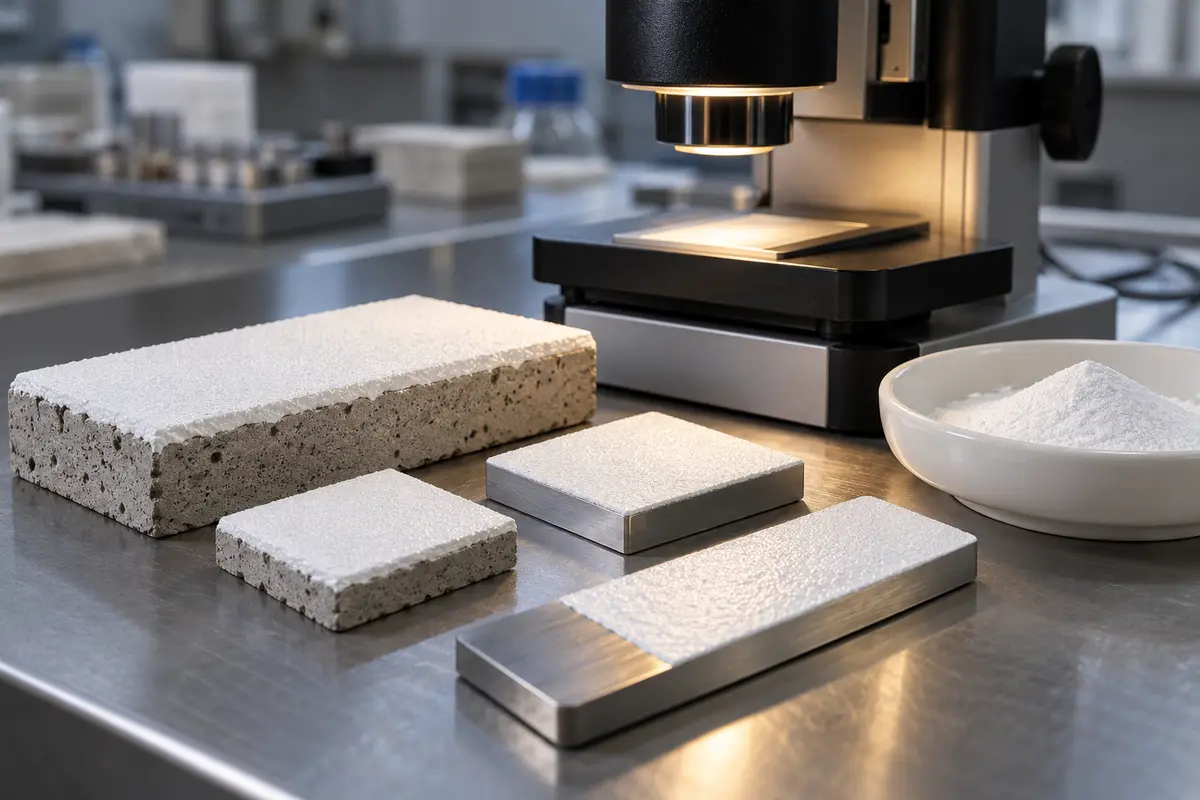
The Maryland team connected that choice with resistance to outdoor conditions and the durability problems facing cooling coatings. Researchers tested the material’s performance under demanding conditions and pursued commercialization through the startup CeraCool. The November 13, 2023 announcement presented that business as a route toward bringing the material into use. Laboratory resistance and material testing are distinct from a long operating history on occupied buildings. The formulation’s reported sunlight reflectance also measures a different property from air-conditioning electricity savings: it concerns incoming radiation at the coating, rather than the combined energy use of a building and its equipment.
Color with an infrared-reflective layer
Stanford researchers developed paints in eight colors using two layers: an infrared-reflective aluminum bottom layer and an upper layer of colored, infrared-transparent nanoparticles. The arrangement separates visible color from part of the material’s behavior at infrared wavelengths. In artificially cold conditions, the paint reduced energy used for heating by about 36%. Under artificially warm conditions, cooling energy fell by almost 21%. Those controlled tests were separate from simulations of a mid-rise apartment building in different climates across the United States.
The building simulations produced an average 7.4% reduction in annual heating, ventilation and air-conditioning energy. Cooling demand increased slightly in some cities, even though combined annual HVAC demand fell. The coatings were water-repellent and underwent week-long exposure tests involving heat, cold and acidic conditions. Dirt could be removed by washing. Such tests assessed material behavior over their stated periods. The August 14, 2023 research used organic solvents, with water-based formulations identified as further work. Its infrared-reflective design, colors and seasonal energy balance differ from a porous coating intended to release stored water.

Walls see more than the sky
Heat exchange around a wall differs from that around an exposed roof. Roofs largely face the sky, while walls and windows also face the ground and neighboring buildings. Those nearby surfaces exchange thermal radiation over a broader range of wavelengths than the atmospheric window through which heat can escape to space. Princeton researchers investigated materials that selectively exchange radiation within that window while limiting exchange with terrestrial surroundings. Common plastics, including polyvinyl fluoride and polypropylene, supplied relevant optical properties.
The June 27, 2024 work examined passive temperature regulation across seasons. In summer, a surface can release heat toward the sky while reducing heat gained from warm surroundings. In winter, its interaction with the cold environment also matters to heat retention. Material choices concerned spectral selectivity and radiation direction. A wall’s view of nearby surfaces therefore forms part of the physical setting, unlike an unobstructed rooftop.
A surface that changes its thermal state
A University of Chicago material can switch between states that release or retain thermal radiation. A small electrical input moves copper between a deposited film and an aqueous solution. The copper film has low infrared emission; removing it exposes a state with much higher emission. Once changed, the surface holds its state without a continuous electrical supply. Researchers demonstrated repeated switching through 1,800 cycles and produced a prototype about six centimeters across, with larger versions remaining a development objective.

Computer simulations across 15 American cities estimated an average 8.4% saving in annual heating and cooling energy for a commercial building using the material. The electricity needed for switching was estimated at less than 0.2% of the building’s total electricity consumption. Those percentages have different denominators: one concerns heating and cooling, the other all building electricity. The April 17, 2023 project combined materials testing with building-energy modeling. Its adjustable surface uses electricity to change states, distinguishing it from a coating whose reflection, radiation and evaporation proceed without electrical switching equipment.
Moisture absorbed at night
KAUST researchers developed a hydrogel for the back of photovoltaic panels that absorbs atmospheric moisture overnight and releases it through evaporation during daytime heating. Lithium chloride attracts water, while sodium polyacrylate forms the water-holding polymer network. Micropores support moisture movement, and carboxylate groups help bind water within the material. The application places that moisture cycle behind a solar panel, where cooling can improve electrical conversion, rather than on a building wall or roof as paint.
Outdoor experiments lasted 21 days, with ambient temperatures ranging from 25°C to 41°C and relative humidity from 31% to 91%. The research connected the hydrogel structure with repeated water uptake and release, examining both cooling and the material’s durability. Its August 21, 2025 announcement concerned solar-panel performance, so the experiment’s electrical output belongs to photovoltaic conversion rather than reduced air-conditioning consumption. Both applications involve evaporation, but the hydrogel’s rear-panel placement, water-attracting salt and measured operating environment define a separate system from NTU’s cementitious coating.

Coatings across an industrial neighborhood
NTU researchers coated roofs, walls and road pavements in an industrial area of Singapore, then compared the treated environment with an adjacent uncoated area. The coated location was up to 2°C cooler during the afternoon. The work extended cooling-coating research into a real urban setting in the tropics, beyond laboratory simulations and scaled-down structures. Reflective additives in the coatings reduced the surfaces’ absorption of solar heat. The March 25, 2024 announcement concerned that neighborhood intervention, preceding the cement-based paint study.
Pedestrian thermal comfort improved by up to 1.5°C on the Universal Thermal Climate Index. That index combines air temperature, relative humidity, thermal radiation and wind speed to represent outdoor temperature sensation. Its change is a comfort measure incorporating several environmental conditions, rather than a reading of skin temperature. The field experiment thus involved two distinct indicators:
- A temperature difference of up to 2°C between coated and uncoated environments in the afternoon.
- An improvement of up to 1.5°C in the index representing pedestrian thermal comfort under the measured conditions.
Where reflected sunlight travels
A reflective surface can send sunlight toward another wall or a pedestrian instead of out of an urban street. Princeton researchers investigated retro-reflective materials, which return incoming light toward its source. Their April 16, 2024 project compared that behavior with diffuse reflection, in which reflected light scatters in multiple directions. Retro-reflectors are familiar from road signs and visibility-enhancing paint; the research examined their possible use on building surfaces to change the path of sunlight through cities.

Street geometry shaped the modeled effects. Building height relative to street width, orientation and latitude influenced how much radiation could leave an urban canyon and how much could reach surrounding surfaces. The simulations examined several outcomes, including surface temperature, air temperature and human skin temperature. Those indicators concern different parts of the urban thermal environment. The work investigated potential building applications rather than announcing a completed neighborhood installation. Returning light toward its source offered a particular optical mechanism, with the modeled cooling effects dependent on placement and geometry rather than reflectance alone.
City-wide roof scenarios in London
A three-dimensional urban climate model tested cooling interventions across London during the two hottest days of summer 2018. UCL researchers compared theoretically widespread deployment of cool roofs, vegetation, solar panels and air conditioning. Cool roofs reduced modeled city-wide outdoor temperature by about 1.2°C on average, with reductions reaching 2°C in some locations. The July 4, 2024 study concerned a city-scale scenario in the United Kingdom, rather than temperatures measured after a city-wide roof conversion.
Air conditioning cooled interiors but discharged heat outdoors. In the modeled widespread-use scenario, that release raised outdoor temperature by roughly 0.15°C across London and by as much as 1°C in central areas. Green roofs reduced daytime temperatures, but their nighttime heat release offset much of that effect in the daily average. Vegetation also provides benefits outside the temperature comparison examined here. The model kept these interventions and their physical effects distinct. Roof reflectance, vegetation and heat rejected by cooling equipment entered a shared urban environment, producing results at a different scale from a coating’s laboratory temperature.

Reflective roofs alongside irrigated trees
A UNSW-led study modeled heat mitigation in Riyadh’s Al Masiaf district using data covering 3,323 buildings. Eight scenarios combined measures including reflective materials and urban greenery. A combination of cool roofs and more than twice as many irrigated trees could lower summer outdoor temperature by nearly 4.5°C and reduce cooling energy needs by up to 16%, according to the researchers’ January 12, 2024 announcement. These were projected changes for the studied district and proposed interventions, rather than results from an already completed retrofit.
Combining urban heat mitigation with improvements to building envelopes increased the projected reduction in cooling energy demand to as much as 35%. That larger figure included changes to the buildings themselves, extending beyond reflective roofs and trees. The district’s buildings and local environmental conditions supplied the basis for the simulations. Irrigated planting formed part of the modeled combination, so its cooling effect belonged to a strategy involving vegetation and water as well as reflective surfaces. The study’s energy projections and outdoor temperature changes retained separate units and comparison bases, with building-envelope upgrades contributing an additional component.
Passive measures within a wider cooling system
Cooling demand extends beyond comfortable rooms to food storage, medicine and industrial processes. UNEP’s Global Cooling Watch 2025 placed those services within a growing international demand for equipment and energy. Under its business-as-usual projection, installed cooling capacity would rise from 22 terawatts in 2022 to 68 terawatts in 2050. Capacity in that projection measures the scale of cooling equipment, rather than electricity consumed or a temperature change. The underlying assessment was issued in November 2025, after the Singapore cement-paint study.

UNEP’s proposed approach combines passive cooling, low-energy hybrid systems and more efficient appliances with a transition away from highly warming refrigerants. Building design and measures that limit heat entering occupied spaces belong to the passive part of that approach. More efficient equipment addresses the energy needed for the remaining cooling load, while refrigerant choices address another source of climate impact. These measures apply across an expanding range of cooling services. Paint research concerns the behavior of treated surfaces within that larger system; the forecast covers cooling access and technology across whole sectors, with several measures contributing to the proposed changes.
Leave a comment