
Lucy’s asteroid encounters: navigation, instruments and Donaldjohanson
Lucy’s Donaldjohanson flyby joins autonomous tracking, infrared measurements and image analysis. Earlier engineering tests and later findings trace the mission’s work.
A rehearsal at Donaldjohanson
NASA’s Lucy spacecraft flew past asteroid 52246 Donaldjohanson on Apr 20, 2025, at a separation of roughly 1,000 kilometres. Its returning images revealed an elongated body with two lobes connected by a narrow neck. Preliminary measurements put its length at about 8 kilometres and maximum width at 3.5 kilometres. The apparent rotation in the early image sequence came from Lucy’s changing viewpoint during the flyby; the asteroid itself rotates slowly.
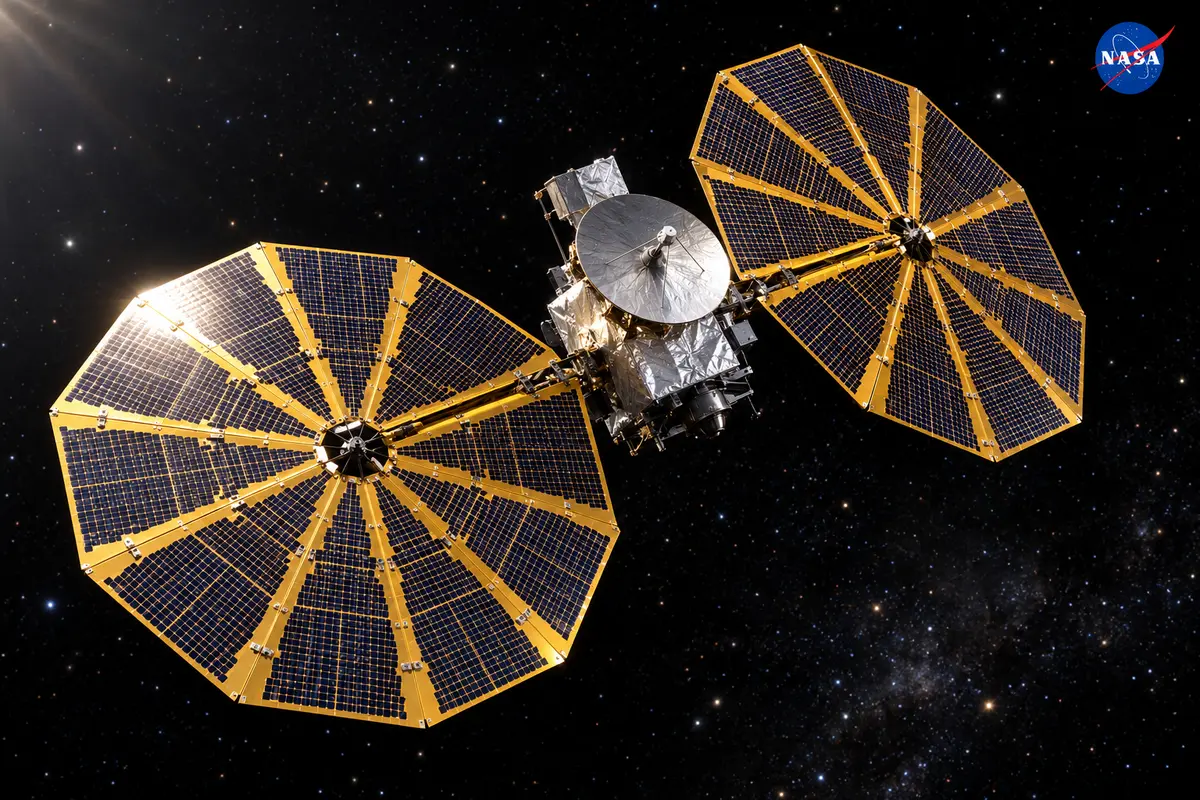
Lucy launched in 2021 on a twelve-year mission to Jupiter’s Trojan asteroids, which share the planet’s orbit around the Sun. Donaldjohanson, in the main asteroid belt, was a rehearsal target. NASA’s Goddard Space Flight Center in Greenbelt, Maryland, manages the mission in the United States. The encounter combined navigation, autonomous pointing and scientific observations.
Operating with an unlatched solar array
One of Lucy’s two solar arrays had failed to unfurl and latch properly after launch. Deployment activities during 2022 brought it into a tensioned but unlatched state. On Jan 19, 2023, NASA suspended further deployment attempts. Engineering models calibrated with spacecraft data placed deployment above 98%. The mission team considered the remaining risk acceptable and expected sufficient electrical power for the baseline mission, with margin.

The decision followed a Dec 13, 2022, attempt that produced only slight movement. Ground tests indicated that attempts had worked best when the spacecraft was warmer and nearer the Sun. Lucy was moving outward, reducing the expected benefit of further attempts under those conditions. Its behaviour during the first Earth flyby had supported the team’s assessment of array stability. Engineers planned continued monitoring, including during main-engine operations and the subsequent return toward Earth.
A small correction ahead of a fast encounter
On May 9, 2023, Lucy changed its velocity by about 3.4 metres per second to adjust its approach to Dinkinesh. NASA projected that this correction would bring the spacecraft roughly 65,000 kilometres closer to the asteroid at the planned November encounter. Lucy’s overall travel speed at the time was about 19.4 kilometres per second, while the planned speed relative to Dinkinesh during the flyby was 4.5 kilometres per second. The team retained opportunities for further trajectory adjustments and was analysing its spring instrument-calibration campaign while preparing the encounter procedures.
Tracking without continuous instructions from Earth
The Nov 1, 2023, Dinkinesh encounter tested Lucy’s terminal tracking system in flight. The planned sequence would turn the high-gain antenna away from Earth as the spacecraft and its instrument pointing platform entered encounter configuration. Terminal Tracking Cameras, or T2Cam, repeatedly imaged the target. Their observations allowed the spacecraft and platform to adjust their orientation autonomously, keeping the asteroid in view as Lucy passed. This pointing test was the encounter’s principal engineering objective.
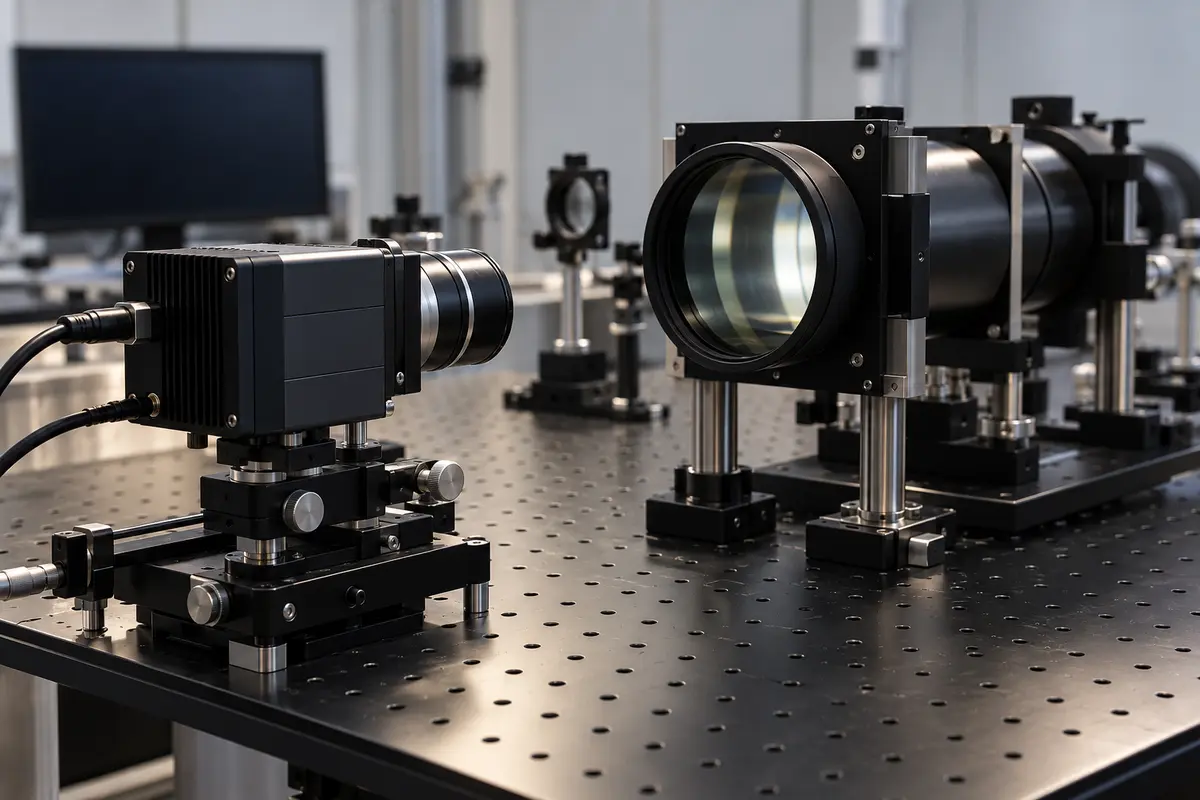
The observation schedule called for L’LORRI images at fifteen-minute intervals during approach and every fifteen seconds near closest approach, using three exposure times. After the closest observations, a slow pitchback manoeuvre returned the solar arrays toward the Sun while the instrument platform continued tracking. Its deliberately slow movement limited vibrations from the large arrays. Once Lucy pointed its antenna toward Earth again, engineers could assess spacecraft health and request the science data. Returning the full encounter dataset through NASA’s Deep Space Network was expected to take up to a week.
A moon with two touching lobes
The data returned after the Dinkinesh flyby revealed an unexpected satellite, and additional viewing angles exposed a further detail. The satellite was itself a contact binary: two smaller bodies touching each other. In the first images sent to Earth, one lobe lay behind the other along Lucy’s line of sight. A view captured about six minutes after closest approach, from approximately 1,630 kilometres away, separated the outlines of the two lobes. NASA announced this result on Nov 7, 2023. The tracking system had kept the target within the cameras’ view across these changing geometries. The Dinkinesh encounter had been added in January 2023 primarily as an engineering test, before the mission’s Trojan observations.
Colour, spectra and surface temperature
By Nov 29, 2023, the Dinkinesh encounter data had finished reaching Earth. The International Astronomical Union had approved the moon’s name, Selam, two days earlier. L’Ralph’s two components, the Multi-spectral Visible Imaging Camera and Linear Etalon Imaging Spectral Array, had scanned the bodies during the flyby. These measurements supported colour images and spatially resolved spectra. An early false-colour image assigned orange, green and violet camera filters to red, green and blue display channels.

Reconstructing the images required compensation for spacecraft motion using Lucy’s pointing information. L’TES, the thermal infrared spectrometer supplied by Arizona State University, also detected the system and measured its temperature for about nine minutes. Dinkinesh and Selam occupied only a small fraction of that instrument’s field of view. The scientists expected the measurements to describe mainly the larger body’s surface. Different particle sizes heat and cool differently, so the temperature measurements offered a way to investigate the surface material’s physical properties.
Interpreting Dinkinesh’s trough and ridge
Images examined in research published on May 29, 2024, showed a trough and ridge on Dinkinesh, alongside its contact-binary moon. The Lucy science team proposed that the asteroid’s response to rotational stress recorded part of its history. Thermal radiation leaving the Sun-warmed surface produces a small recoil force. Over long periods, the resulting torque could increase rotation and build centrifugal stress. In the team’s reconstruction, a substantial section shifted abruptly, changing the asteroid’s shape and releasing material into nearby orbit.
Some of that material could have fallen back to build the ridge, while some supplied the moon. The trough’s form supported an interpretation of sudden failure after stress accumulated. The researchers contrasted this behaviour with the gradual movement expected from a much weaker, fluid-like collection of particles. They inferred internal strength, although the strength required for such a small asteroid remains tiny compared with most terrestrial rocks. The detailed formation of Selam’s two joined components remained unresolved. These were interpretations of observed landforms and structure, rather than direct observations of the ancient disruption itself.

Main-engine burns reshape the route
Lucy’s trajectory changes grew substantially in early 2024. On Jan 31, the spacecraft operated its main engines in space for the first time, with a burn lasting almost six minutes. Earlier manoeuvres had been small enough for less powerful thrusters, changing velocity by only a few metres per second. The first main-engine firing allowed engineers to examine the returned telemetry before proceeding with the larger scheduled manoeuvre.
On Feb 3, the main engines operated for more than thirty-six minutes in the mission’s largest planned engine burn. The paired manoeuvres were designed to change Lucy’s velocity by approximately 900 metres per second and consume roughly half its onboard fuel. Those figures described the manoeuvre design; the completed burns had the separately recorded durations. The sequence prepared Lucy for its next Earth encounter and the route through the main asteroid belt toward the leading Trojan swarm.
Earth changes Lucy’s solar orbit
Lucy completed its second Earth gravity assist on Dec 12, 2024. Communications resumed late that day in US Eastern time after the planned interruption around closest approach. NASA’s collision-assessment operators determined that no manoeuvre was needed to avoid satellites or debris. The first Earth assist in October 2022 had changed Lucy’s roughly one-year solar orbit into a two-year orbit. The second assist was designed to place it on a six-year solar orbit extending through the main belt and into the leading Trojan population.

The planned Earth encounter would increase Lucy’s speed relative to the Sun by about 7.31 kilometres per second. The route approached from the Sun’s direction and passed below the altitude of the International Space Station. Collision-avoidance planning allowed for a small correction twelve hours beforehand, if required, to change arrival timing by one or two seconds. No such correction proved necessary. Lucy’s science instruments remained off during this Earth pass because further calibration was not needed. The spacecraft was travelling toward the Trojans while moving away from Jupiter itself.
The Donaldjohanson observing sequence
For the Apr 20, 2025, encounter, Lucy’s team planned a more demanding sequence than the Dinkinesh test. About thirty minutes before closest approach, the spacecraft would turn to track Donaldjohanson, moving its antenna away from Earth. L’LORRI, L’Ralph and L’TES were all assigned sequences resembling those intended for the Trojan encounters. The instruments were designed for objects illuminated by sunlight twenty-five times dimmer than at Earth, making protection from direct solar glare a particular constraint. The scheduled measurements comprised:
- L’LORRI: high-resolution greyscale images.
- L’Ralph: colour images and infrared spectra.
- L’TES: far-infrared spectra.
Lucy was instructed to stop tracking Donaldjohanson forty seconds before closest approach to protect its sensitive instruments. A subsequent pitchback would turn its solar arrays toward the Sun again, followed by restored Earth communications approximately an hour after closest approach. At that encounter distance, a signal took about 12.5 minutes to travel between Earth and Lucy in one direction. A request and response therefore required about twenty-five minutes before data transmission could even begin reaching the ground. Engineers would first check spacecraft health, then request the recorded science data over several days.
A complete image and its viewing conditions
On Jul 2, 2025, NASA released a full view of Donaldjohanson taken from about 2,700 kilometres away, roughly 3.2 minutes before closest approach. The smallest visible features were approximately forty metres across. Sunlight arriving almost from behind Lucy reduced the contrast of topographic details. This frame captured the whole asteroid just before it overfilled L’LORRI’s field of view. A stereo pair combined that complete image with a partly cropped image taken seventy-two seconds later. Contrast enhancement compensated for lighting differences and made features easier to distinguish. The spacecraft was then cruising through the main asteroid belt, moving away from the Sun at over 50,000 kilometres per hour. Its team continued monitoring the spacecraft as the surrounding environment became cooler and dimmer. The planned first passage through the Trojan swarm comprised four encounters with at least six asteroids, including two satellites, in less than fifteen months.
Names for the two lobes and their neck
By Sep 16, 2025, the International Astronomical Union had approved feature names and a coordinate system for Donaldjohanson. The smaller lobe became Afar Lobus, after a fossil-bearing region of Ethiopia; the larger became Olduvai Lobus, after the gorge in Tanzania. Windover Collum names the connecting neck after an archaeological site near Cape Canaveral in Florida. Two smoother neck areas became Hadar Regio and Minatogawa Regio, the latter referring to a hominin discovery site in Japan. Selected boulders and craters also received names associated with significant fossils. The Lucy science and engineering team had proposed the naming theme after seeing the surface in detail. As of Sep 9, Lucy had required no trajectory correction since the Donaldjohanson encounter. It was about 480 million kilometres from the Sun, roughly three quarters of the way through the main belt.
Rotation and mineral findings in 2026
On Jun 18, 2026, Lucy’s science team described Donaldjohanson’s more complicated rotation. The asteroid turns end over end in about 10.5 Earth days while wobbling around its long axis over approximately 26.5 days. The researchers inferred that two collision fragments had joined gently under their mutual gravity after a disruption about 155 million years ago. They estimated that its spin had slowed substantially over the past twenty to sixty million years, with solar-heating recoil, known as the YORP effect, a likely mechanism.

Lucy’s infrared measurements also recorded signatures of iron-rich clay minerals. The scientists interpreted these as evidence that liquid water had briefly acted on the material in its distant past. Longer exposure would tend to replace iron with other elements, including magnesium. Magnesium-rich clays found at Bennu and Ryugu supported different water-exposure histories for those bodies.
Another observing opportunity during cruise
Lucy also used L’LORRI to observe interstellar comet 3I/ATLAS on Sep 15–17, 2025, from about 240 million miles away. NASA described the observations on Nov 19. Engineers oriented the spacecraft so its body shielded sensitive components while the instruments pointed inward toward the comet and Sun. Some sunlight still scattered into the camera, producing a faint arc of blurred features beneath the comet. A stacked image showed its coma and tail. Astronomers at Las Cumbres Observatory in Cerro Tololo, Chile, observed at the same time from a different viewpoint, separated from Lucy by about 390 million miles. The teams were comparing the observations to investigate the comet’s three-dimensional structure and how its dust scattered sunlight.
Preparing camera settings for the Trojans
In spring 2026, Lucy imaged four future Trojan targets: Eurybates, Polymele, Leucus and Orus. Downlinking and processing finished in July, ahead of NASA’s Aug 6 account. From hundreds of millions of miles away, the targets remained points of light. Lucy saw them from viewing angles different from the nearly fully illuminated views usually available from Earth. Those observations would help engineers choose camera settings for partly shadowed surfaces during the planned flybys between August 2027 and November 2028. The images also contained identifiable artefacts: light from the nearby star 28 Hydrae affected the Leucus sequence, while scattered sunlight produced a faint arc in the Orus images. Further observations remained available as Lucy continued outward toward its first Trojan encounters.
Leave a comment