
KM3NeT’s record neutrino: the signal, the calibration and the unanswered origin
KM3NeT’s extraordinary neutrino observation links deep-sea optical measurements with a search for cosmic origins that remains open after one exceptional event.
An exceptional particle, an unresolved birthplace
KM3NeT’s cosmic neutrino entered public view in February 2025, nearly two years after its Mediterranean detection. Its estimated energy was about twenty times the previous record. Physicist Luigi Antonio Fusco of the University of Salerno described the observation as startling. The detector was far smaller than its intended final configuration.
Independent reactions combined excitement with caution. IceCube physicist Francis Halzen noted that his larger instrument had not recorded such an event in a decade. University of Maryland physicist Erik Blaufuss initially doubted the interpretation but found the case convincing. Penn State theorist Kohta Murase warned against firm conclusions about origins from one event. Those reactions do not establish which astronomical object produced it.
What the optical signal measured
The KM3NeT event analysis dates the signal to 13 February 2023 at 01:16:47 UTC. ARCA, off Sicily in Italy, then had 21 detection strings. Its photomultipliers recorded 28,086 hits along a nearly horizontal muon track, with several large showers. The inferred muon energy was 120 petaelectronvolts, with substantial uncertainty. The parent neutrino’s often quoted 220-PeV energy is a different quantity: a simulated median assuming an energy spectrum proportional to inverse energy squared.

Under that assumption, the central 68% interval for the neutrino energy extended from 110 to 790 PeV. The event’s directional uncertainty was also broader than the instrument’s intrinsic statistical precision. Absolute detector orientation dominated the reported 1.5-degree, 68%-confidence uncertainty, compared with an intrinsic median statistical uncertainty of 0.12 degrees. The distinction matters when searching the sky: excellent fitting of a track within the detector does not eliminate uncertainty in the detector’s absolute alignment.
Electronics built for an inaccessible workplace
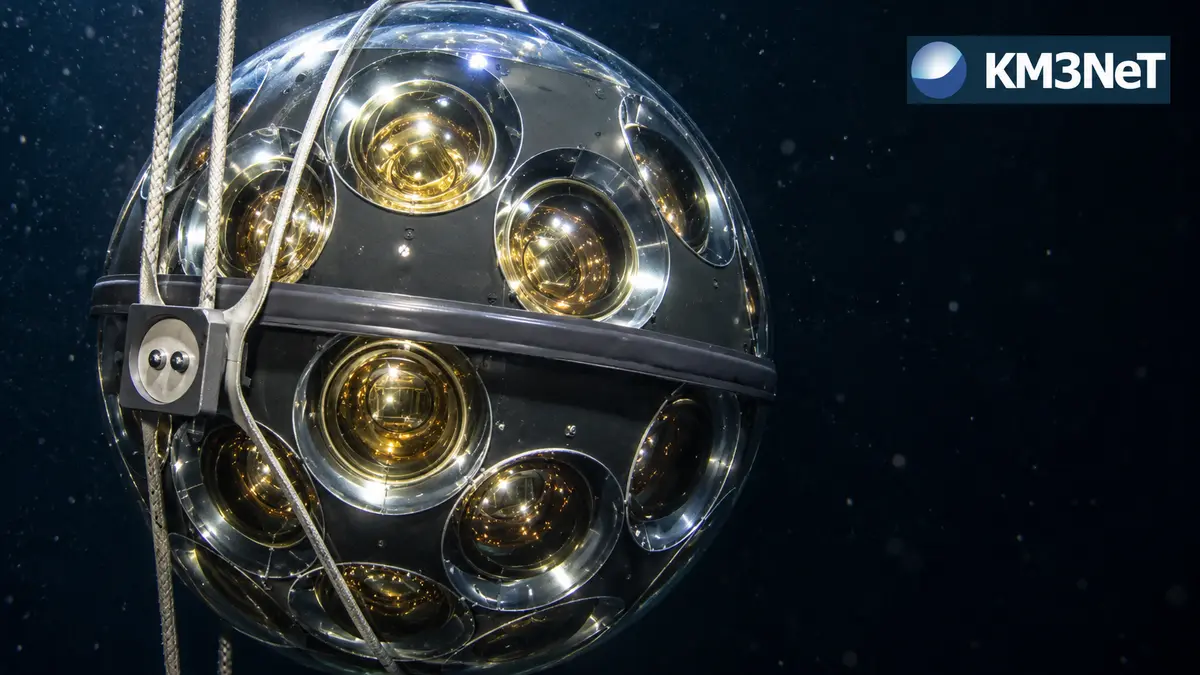
Each optical module needs more than sensitive light detectors. A dedicated power board supplies the readout electronics, photomultiplier systems and calibration instruments inside the glass sphere. Its architecture separates the power circuits from the central logic board to reduce noise and improve reliability. The board controls the startup sequence required by the programmable electronics and monitors its voltage rails, currents and temperature. These functions operate in a location where maintenance involves complex, costly marine operations, making low consumption and reliability central design requirements.
The power board occupies a shielded part of an aluminium cooling frame. Contact with the glass helps conduct heat towards the surrounding seawater, which is approximately 13 degrees Celsius. A November 2023 engineering paper described an upgraded design that reduced acquisition-electronics consumption by more than one watt. Reliability assessment combined component-based modelling with accelerated stress tests on six boards. The modelling predicted improved reliability, while the tests exposed hardware to extreme temperatures. Neither calculation nor laboratory stress testing constitutes a measured guarantee of trouble-free service throughout the telescope’s lifetime.

The water column is part of the measurement
Acoustic positioning depends on how sound travels through seawater. KM3NeT’s dedicated ARCA calibration-unit design therefore combines a seabed calibration base with a separate oceanographic instrumentation unit. A 700-metre electrical interlink connects the two; the instrumentation unit itself supports a 750-metre vertical inductive line. These are different dimensions serving different purposes. The base adds an acoustic beacon and hydrophone to the positioning network, while the instrument line samples environmental conditions through the water column. Its buoy keeps that line upright above its anchor.
The specified instruments include two conductivity-temperature-depth probes with dissolved-oxygen sensors, two direct sound-velocity sensors and two Doppler current sensors. An absolute pressure gauge provides a depth reference. Conductivity, temperature and pressure allow an independent calculation of sound speed, while current measurements inform the model of the detector strings’ movement. The 2023 design paper anticipated deployment in 2024 and described remaining integration and software work. That schedule is a plan in the source, rather than evidence that deployment occurred. These acoustic instruments locate optical sensors; the neutrino event itself was detected through light.
A telescope whose geometry moves
Deep-sea currents bend the strings carrying the optical modules, so the reconstruction cannot rely permanently on their nominal deployment coordinates. KM3NeT’s positioning method fits acoustic signals within ten-minute windows, treating motion during each window as small. The fitted geometry combines fixed parameters, such as anchor locations, with changing tilt and stretching parameters. Mechanical modelling accounts for buoyancy and drag; additional corrections accommodate features that the simplified string model misses. Separate compasses record orientation information, with magnetometer and accelerometer data sampled every ten seconds.

A calibration study showed coherent movement among ORCA strings and corresponding changes in measured current direction. ARCA strings reached tilts of about 5.7 degrees during an illustrated high-current period. Acoustic-fit residuals broadened during strong tilting, especially near the tops of strings, while quieter periods produced narrower distributions. The paper specified better-than-20-centimetre positioning and approximately three-degree module-orientation accuracy as requirements for the intended performance. Those requirements describe the calibration task. They should not be substituted for the independently evaluated directional uncertainty of the record neutrino event.
- Fixed geometry: anchors and seabed emitters.
- Changing geometry: string tilt and stretching.
- Orientation: module compass measurements.
Background particles provide a cross-check
Atmospheric muons usually complicate the search for cosmic neutrinos. Cosmic rays striking the atmosphere produce showers, and sufficiently energetic muons can reach the submerged detectors. Their abundance also makes them useful calibration signals. A track-quality method reconstructs the same data under different assumptions about a string’s timing, position or orientation, then compares the likelihood of the resulting tracks. The preferred parameters improve agreement between the observed photon hits and the track model. Another method compares measured hit times with those predicted from a reconstructed muon trajectory.
In an ARCA example spanning 86 hours of unusually strong currents, static geometry left apparent position offsets of several metres. Updating positions dynamically brought the muon-derived offsets close to zero and made them much steadier. This offers an independent check on acoustic positioning. Its reach has a clear boundary: the track-quality method measures relative calibration. Moving every string together could shift reconstructed tracks without changing their quality. It therefore cannot, by itself, determine every absolute position or orientation error affecting an astronomical pointing measurement.

From seabed sensors to shore computers
KM3NeT sends its photomultiplier and acoustic data to shore before applying the main software selection. Optical fibres carry detector data and distribute timing information through the White Rabbit synchronisation system. Onshore programs assemble packets into common time frames, filter optical and acoustic streams and write selected data to files. The modular acquisition system can expand by adding computing resources and additional processing instances as more strings enter operation. A control system configures runs and records ancillary monitoring data, connecting the scientific selection to the detector’s operating state.
A 2025 proceedings paper explains a network change introduced with three ARCA strings deployed in October 2024. Earlier strings used a broadcast architecture with customised timing; the newer design put White Rabbit switches offshore and used the standard protocol. Limited submarine fibre capacity drove the change, which also incorporated redundant connections. The paper described the two sectors taking data separately and anticipated a merged acquisition system after commissioning. That expected transition should retain its prospective status; the paper alone does not demonstrate that the combined system subsequently entered operation.
Shared hardware, a different physics programme
KM3NeT’s ORCA detector near Toulon, France, uses the same basic optical-module concept with a denser arrangement. Its design places strings about 20 metres apart and modules roughly nine metres apart vertically, targeting lower-energy atmospheric neutrinos. A 2024 analysis of the first six detection units selected 5,828 neutrino candidates from an exposure of 433 kilotonne-years. Rather than seeking an isolated extreme-energy particle, that analysis examined the energy- and direction-dependent pattern of neutrino oscillations. The six-string configuration represented a small portion of ORCA’s planned 115 strings.

The oscillation result constrained mixing parameters while leaving the ordering of neutrino masses unresolved. The analysis found an inverted-ordering p-value of 0.25, rather than a decisive rejection. Statistical limitations remained important, while energy-scale uncertainties linked to photomultiplier efficiency and water properties affected the mass-splitting measurement. The authors also identified improvements needed in energy reconstruction and track-versus-shower classification. ORCA demonstrates another scientific use of the observatory’s detector technology; its atmospheric-neutrino sample supplies neither a source identification nor a replacement energy measurement for the ARCA event.
A separate search that found no coincidence
KM3NeT also searches for neutrinos accompanying transient astronomical events. One such target was GRB 221009A, the exceptionally bright gamma-ray burst detected on 9 October 2022. Spacecraft and ground-based observatories followed its radiation across a wide range of wavelengths. A KM3NeT study released in 2024 examined possible neutrino emission using both ARCA and ORCA, spanning searches from megaelectronvolt energies to a few petaelectronvolts. No neutrino candidate coincided with the burst’s direction in those searches. The result was a set of upper limits, rather than an identified neutrino counterpart.
Only about a tenth of the planned KM3NeT configuration was operating at the time of the burst. The study projected that expansion could improve sensitivity by roughly an order of magnitude, while emphasising the value of continuous monitoring and complementary sky coverage. That projected improvement depends on the larger detector; it is not a measured gain from the small configuration. The burst search also concerns a different event and date from KM3-230213A. Its nondetection illustrates how the observatory tests possible associations, without linking the October burst to the February neutrino.

One observation alongside other experiments’ limits
The record event must also fit a wider observational picture in which other instruments have not seen comparable signals. A joint ultrahigh-energy analysis compared KM3NeT with IceCube and the Pierre Auger Observatory. Assuming an isotropic neutrino flux with an inverse-energy-squared spectrum, the researchers found tension at approximately 2.5 to 3 standard deviations between the KM3NeT observation and the other experiments’ nondetections. That tension depends on the flux model and datasets used; it does not identify a malfunction or establish a new neutrino population.
The comparison also tested whether a broken power-law spectrum improved agreement relative to a single power law. With the ultrahigh-energy limits included, only one of the examined IceCube samples showed a slight, statistically insignificant preference for a break. Removing those limits strengthened hints in some comparisons but sacrificed agreement with the nondetections. The researchers highlighted approximations associated with public datasets, background treatment, systematic uncertainties and simplified spectral forms. More observations are needed to distinguish a fluctuation from a genuinely different high-energy component; one exceptional event cannot settle the population’s shape.
A possible signal of cosmic-ray propagation
One possible origin does not require the neutrino to emerge directly from a compact source. Extremely energetic cosmic rays can interact with background photons during their journey through space. Those interactions produce particles, including pions, whose decays generate neutrinos. The resulting cosmogenic flux depends strongly on the cosmic rays’ composition, their maximum acceleration energy and how their sources evolved over cosmic history. Different assumptions can change the predicted flux by orders of magnitude. A neutrino in the observed energy range is therefore a candidate for this process, rather than proof of it.

A companion study examined how cosmogenic models could accommodate the event alongside cosmic-ray measurements. Models restricted to nearby populations can face difficulty, while populations extending to higher redshift and containing a subdominant proton component can produce additional neutrinos. Heavy nuclei and protons distribute their energy differently among the particles available for subsequent interactions, changing the predicted spectrum. The proposed reconciliation remains conditional on composition, acceleration and source-evolution assumptions. It does not measure a particular source’s proton fraction, identify the neutrino’s birthplace or exclude a contribution produced inside astrophysical accelerators.
Why nearby candidates face difficulties
The direction of the event also motivated a search for possible sources within the Milky Way. A Galactic-origin study considered diffuse emission, molecular material and potential accelerators. The Monoceros R2 molecular cloud lies within the broad 99%-confidence region and could, in principle, supply target material for energetic particles. However, the expected diffuse Galactic neutrino flux was insufficient to explain the observation. The analysis also examined unidentified gamma-ray sources in the region, looking for evidence that would support particle interactions capable of producing such an energetic neutrino.
Gamma-ray limits from HAWC, together with the absence of corresponding detections by HAWC and LHAASO, placed substantial pressure on the examined source explanations. For the scenarios tested, the gamma-ray upper limits lay well below the flux associated with explaining the neutrino as persistent point-source emission. An unusually hard source with absorbed gamma rays remained a possible exception. The authors favoured an extragalactic interpretation because known Galactic accelerators struggled to satisfy the constraints. That conclusion narrows plausible explanations under the tested assumptions; it does not establish an absolute exclusion of every Galactic scenario.

Candidate blazars remain candidates
Blazars offer another possibility: active galaxies whose relativistic jets point towards the observer. A counterpart study combined radio, infrared, X-ray and gamma-ray information to characterise objects near the reconstructed direction. The original event paper considered twelve candidates; the companion analysis expanded the selection to seventeen with additional Very Long Baseline Array observations. These are overlapping selections assembled through different methods, rather than seventeen independently established neutrino sources. Combining wavelengths helps assess activity and jet properties, but positional proximity alone does not demonstrate an association.
Several objects attracted attention for different reasons. MRC 0614-083 was the closest candidate and showed a possible X-ray flare. The bright radio source 0605-085 had experienced a prolonged gamma-ray flare before the event. PMN J0606-0724 reached a radio peak within five days of the neutrino. None supplied conclusive evidence of a connection. An unresolved population of faint sources also remained possible. The observation has therefore opened a demanding counterpart search, while the distinction between a detected particle, its inferred properties and its still-unidentified origin remains essential.
Leave a comment