
Juice’s instruments: calibrating a Jupiter observatory in flight
Juice tested cameras, radar and spectrometers during its cruise, linking spacecraft deployment with lunar, terrestrial and comet observations.
A science camera looks back at home
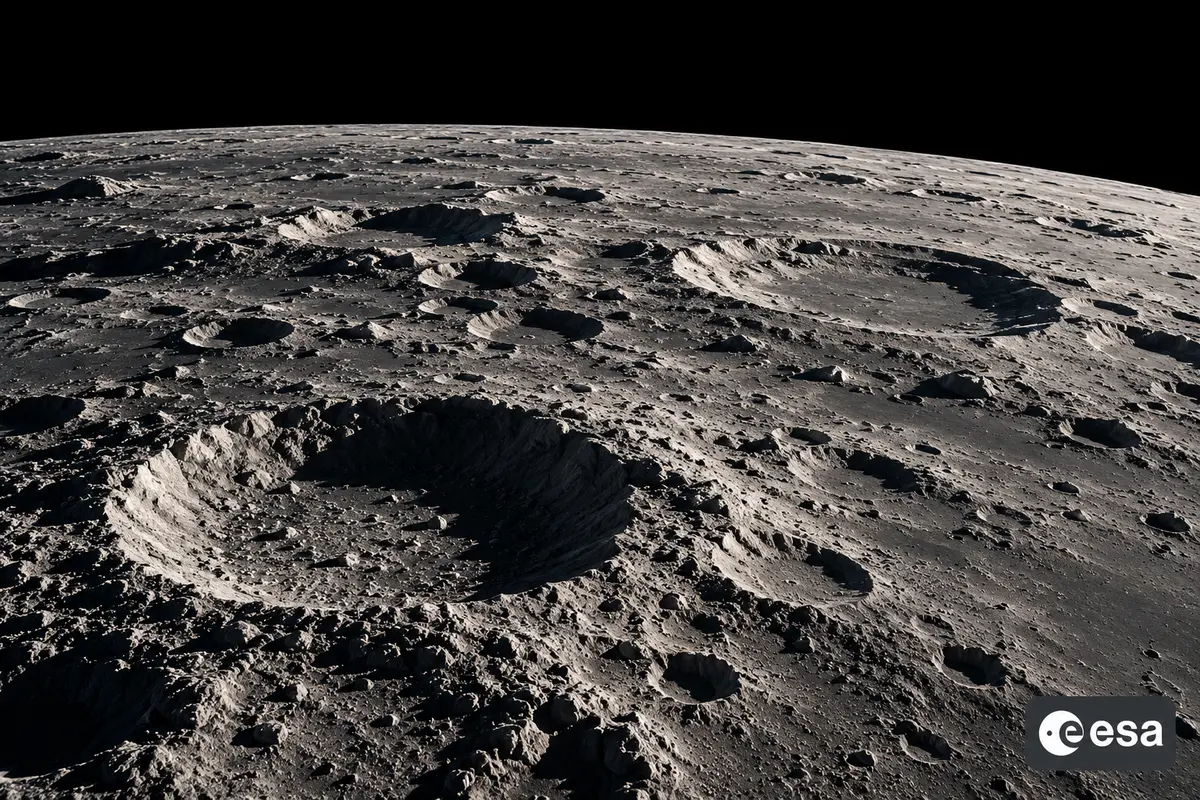
The JANUS camera aboard ESA’s Juice spacecraft photographed lunar craters and terrestrial clouds during the August 2024 lunar–Earth flyby. The images, released before August 26, tested the instrument intended to map Jupiter’s icy moons and observe the giant planet’s atmosphere. Researchers deliberately blurred some exposures to examine resolution-recovery algorithms and partly saturated others to investigate effects on neighbouring unsaturated areas. JANUS also varied its settings and exposure intervals. These were preliminary instrument tests, rather than calibrated scientific measurements of Earth or the Moon. Its planned capabilities at Jupiter include detail down to 2.4 metres per pixel on Ganymede and approximately 10 kilometres per pixel in Jupiter’s atmosphere. A dawn view of Luzon in the Philippines provided one terrestrial target.
A magnetic record of a boom opening
Juice’s measurements began shortly after its April 14, 2023 launch. The 10.6-metre J-MAG magnetometer boom deployed on April 21, approximately 1.7 million kilometres from Earth. Two sensors on its outer segment, separated by about three metres, recorded the magnetic field before and during the movement. Before deployment, they were close to the spacecraft, with the outboard sensor near two magnetic thrusters. Their different readings reflected those different positions beside the spacecraft. As the boom extended, the traces changed and then settled towards similar values in the ambient solar-wind field.
The deployment began just after 14:29:38 UTC and took approximately two seconds. The published traces used preliminary calibration; detailed commissioning and more sensitive measurement ranges were still ahead. A third sensor, intended to measure magnetic-field magnitude, had not yet been switched on for that sequence. J-MAG’s intended Jovian investigations include Jupiter’s magnetic field, its interaction with Ganymede and the icy moons’ subsurface oceans. Instrument commissioning continued after deployment.

Freeing a sixteen-metre radar antenna
The Radar for Icy Moon Exploration, RIME, encountered a different deployment problem. By April 28, 2023, its 16-metre antenna was only partly extended, approximately one-third of its intended length. Controllers suspected a small pin was preventing release from its mounting bracket. They tried thruster movements and sunlight warming, but the antenna remained caught. On May 12, a non-explosive actuator delivered a mechanical shock inside the bracket, moving the pin by millimetres and releasing a stuck section. Another actuator released the final folded part, allowing the antenna to extend fully. The radar’s future task is to investigate the structure beneath the surfaces of Europa, Ganymede and Callisto, with a design objective reaching depths of nine kilometres. That depth describes its intended investigation of icy moons, rather than a measurement achieved during deployment. The release operation restored the antenna’s mechanical configuration; radar commissioning and later interference checks remained separate tasks for the instrument and spacecraft teams at ESA’s mission control centre in Darmstadt, Germany.
Probes, radio antennas and a stable camera
All external deployments were complete by May 26, 2023. The final work involved the Radio & Plasma Wave Investigation, RPWI. Seven deployed elements form part of its ten-sensor package. They are intended to measure electric and magnetic variations, radio waves and cold plasma around Jupiter. Positioning sensors away from the spacecraft reduces their exposure to its own fields. The RPWI team measured the effect of each deployment. Its deployment sequence comprised:
- Four Langmuir probes extending from the spacecraft.
- Three radio-wave antennas for RPWI’s measurements.
JANUS is fixed to an optical bench alongside the other remote-sensing instruments. In May 2023, at about eight million kilometres from Earth, it underwent its first in-space hardware checks and photographed a star field in Cygnus. Principal investigator Pasquale Palumbo described the instrument as fully commissioned after those tests. JANUS can image in thirteen colours, extending from violet into the near infrared. Its intended targets include icy surfaces, Jupiter’s atmosphere, small moons, rings and distant volcanic activity on Io.

Health checks and software changes in flight
The first instrument health check followed in January 2024. All ten instruments passed, while four received planned software updates. Some instrument software had deliberately launched with functionality still to be added before operations at Jupiter. Updating it required patching memory and rebooting the instruments. Claire Vallat, responsible for planning instrument operations at the time, described health checks roughly twice a year, ranging from simple functional checks to interference tests between instruments. These activities allowed teams to exercise hardware during the cruise rather than leaving its first extended operation until arrival.
The spacecraft’s own core software was updated in March 2024. Airbus had agreed to add functions required for the Jupiter phase after launch. Switching between old and new software required a transition through autonomous safe mode, temporarily interrupting the team’s view of the spacecraft. Operations manager Ignacio Tanco recalled a twenty-minute period when telemetry had been expected but had not yet arrived. Contact subsequently returned and the new software operated successfully. Tanco said the update also corrected previously identified bugs, leaving the team with a cleaner system to operate.
Callisto navigation tested on the ground
Juice’s autonomous navigation underwent a demanding ground test announced on April 11, 2024. The engineering model, a terrestrial replica of the spacecraft’s systems, received computer-generated images of Callisto through its navigation camera. Those images changed in response to the model’s actions. The test therefore exercised a closed loop: the software interpreted the approaching moon, adjusted its pointing and received a corresponding new view. Engineer Giulio Pinzan supervised the activity.

The ESA and Airbus teams allocated three days but achieved a successful run on the first attempt. The model kept the intended regions in view through the simulated encounter. The scenario was too complex for the available purely digital spacecraft simulator, so the physical model provided the test environment. It had travelled from Airbus in France to ESA’s control centre in February. A comparable flight test was still needed to establish that the actual spacecraft behaved like its engineering model. The successful ground exercise was not an encounter with Callisto itself.
A quiet interval reserved for radar
The July 15, 2024 flyby plan combined trajectory requirements with instrument scheduling. Juice would approach the Moon on August 19 and Earth on August 20, using the encounter to redirect its path towards Venus. The flight team planned continuous ground contact from August 17 to 22. For the instrument teams, familiar surfaces and environments offered opportunities to test responses before Jupiter. Some measurements would be possible only during a small number of cruise encounters, making the observation schedule an important part of preparation for the eventual icy-moon tour.
RIME needed particular attention because spacecraft electronics were disturbing its measurements. During closest approach to the Moon, it was assigned eight minutes to observe with other instruments switched off or in quiet mode. The radar team intended to use the echoes to understand the interference and develop a correction algorithm. This allocation traded simultaneous operation for a cleaner diagnostic interval. The two monitoring cameras would also record the flyby. Their pictures provided views of the encounter, while the instrument teams pursued different objectives with their own sensors and observing requirements.

Two encounters change the trajectory
The lunar closest approach occurred at 21:15 UTC on August 19, 2024. Earth’s followed at 21:56 UTC on August 20, with Juice passing 6,840 kilometres above Southeast Asia and the Pacific. Relative to the Sun, the Moon increased the spacecraft’s speed by 0.9 kilometres per second; Earth then reduced it by 4.8 kilometres per second. Together, the encounters deflected the path by 100 degrees. The reduction in heliocentric energy sent Juice inward towards Venus, where a later gravity assist would redirect it outward again.
All ten science instruments were switched on during the lunar flyby, and eight operated during the Earth encounter. Small course corrections beforehand had prepared the approach, followed by continuous tracking through the flyby period. Operations manager Ignacio Tanco described the navigation as flawless and said only a small fraction of the reserved propellant had been used. ESA estimated the manoeuvre saved about 100–150 kilograms of fuel. Those savings preserved options for additional science after Jupiter arrival.
Navigation images have a different job
Juice’s Navigation Camera, NavCam, was tested in space during the August 2024 flyby. Its main purpose is to support image-based navigation around the Jovian moons. The spacecraft will process camera images onboard and refine its navigation during close encounters, when ground-based control alone cannot provide the required precision. The Earth flyby allowed the flight-dynamics team to practise using the camera even though it was not needed to navigate around Earth. Its role differs from JANUS’s high-resolution scientific imaging and from the two monitoring cameras’ views of spacecraft hardware.

The released NavCam views were raw, uncalibrated and unprocessed. They showed lunar impact craters and lava fields, including a view of the limb from above a point near the Apollo 11 landing site. Similar limb observations are intended to help navigation at Jupiter’s moons. Another lunar view covered the vicinity of Langrenus crater, while Earth images showed the Pacific. Sodern built NavCam under contract to Airbus, which designed Juice’s image-based navigation system.
Two spectrometers examine a familiar atmosphere
The Moons and Jupiter Imaging Spectrometer, MAJIS, and the Submillimetre Wave Instrument, SWI, also used the August 20 Earth encounter. Results released on September 10, 2024, included MAJIS detections of oxygen, ozone, carbon dioxide and water in Earth’s atmosphere. Its infrared surface images supplied temperature information. SWI searched for molecular signals, including water and compounds associated with carbon, hydrogen, nitrogen, oxygen, phosphorus and sulphur. These elements are commonly grouped as CHNOPS because of their importance to living organisms. Searching for their molecular signatures does not mean every element was independently detected.
Earth supplied an environment whose broad properties were already well understood. Project scientist Olivier Witasse expected the results to help prepare investigations of the icy moons’ potential habitability. That objective concerns environmental conditions, rather than a confirmed detection of life. MAJIS is intended to examine Jupiter’s clouds and atmospheric composition, as well as the moons’ thin atmospheres, surface ices and minerals. SWI will investigate composition and conditions in the Jovian system. The instrument teams could compare terrestrial observations with known atmospheric properties while preparing their analysis methods for less familiar targets.

Lunar echoes become a corrected radargram
RIME’s lunar observations produced a result published on July 18, 2025. Its first radargram traced variations in the Moon’s surface height. The profile agreed with an elevation model from NASA’s Lunar Orbiter Laser Altimeter, LOLA, providing a comparison against independently mapped terrain. The observed region included the landscape photographed by William Anders during Apollo 8’s Earthrise sequence. This was a surface-height test on the rocky Moon; it did not measure an ocean or demonstrate nine kilometres of penetration through an icy moon.
The radar team had spent months developing an algorithm to correct spacecraft-generated electronic interference, using the eight-minute quiet interval during the 2024 encounter. The resulting profile showed the instrument recording echoes from a solid target after those corrections. RIME’s science is led by the University of Trento. A consortium led by Thales Alenia Space Italia built the instrument under the Italian Space Agency’s responsibility, with contributions from NASA’s Jet Propulsion Laboratory. Its future observations will investigate layers beneath the Jovian moons’ icy surfaces, extending beyond the surface mapping exercised at Earth’s Moon.
Recovering communications before Venus
On July 16, 2025, Juice failed to establish its expected ground contact. Attempts through another station also failed, directing attention to the spacecraft rather than the ground equipment. Engineers eventually restored communication by commanding its signal amplifier to switch on. The problem was traced to a software timing bug: if a switching function coincided with the internal timer’s rollover, the amplifier remained off. Recovery took almost twenty hours. At approximately 200 million kilometres from Earth, commands needed eleven minutes to reach Juice, followed by another eleven-minute wait for a response.

Spacecraft operations manager Angela Dietz said waiting for an automatic reset would have delayed Venus preparations. With communications restored, Juice completed the Venus flyby on August 31; ESA confirmed success in a September 1 update. Near the Sun, its high-gain antenna acted as a thermal shield, while the steerable medium-gain antenna handled communications. Thermal constraints prevented remote-sensing observations during the encounter, so no Venus images were planned. The encounter was operational rather than an imaging opportunity.
A comet campaign within thermal limits
Juice observed interstellar comet 3I/ATLAS from November 2 to 25, 2025. JANUS, MAJIS, UVS, SWI and PEP participated, with closest approach on November 4 at approximately 0.4 astronomical units, or sixty million kilometres. The operation was planned on a shorter schedule than a typical nine-month pointing campaign. Dietz described direct coordination with instrument teams to accelerate preparation, supported by increasingly refined trajectory calculations from ESA’s Near-Earth Object Coordination Centre and flight-dynamics team. The spacecraft was still operating under the thermal restrictions of its hot-cruise configuration after Venus.
The instruments received six 45-minute observing slots and a final four-hour slot. They generated 126 science files containing 11.18 gigabits of data. The observations remained in onboard memory until the spacecraft could resume high-rate communications in its colder configuration. Downlinks took place in two eleven-hour passes on February 17 and 20, 2026, through the New Norcia and Malargüe deep-space antennas. Spacecraft operations engineer Federico Giannetto considered the campaign useful preparation for planning complex observations with limited time. Acquisition in November and delivery in February were distinct stages of the same campaign.

Another Earth encounter extends the calibration record
Juice returned to Earth on September 28, 2026. Closest approach occurred at 11:45 UTC, 8,640 kilometres above the Indian Ocean, and the encounter deflected the trajectory by twenty degrees. In the preceding four weeks, operators used just one of six reserved course-correction opportunities. Instrument planning again had to accommodate spacecraft resources. During Earth’s shadow, battery power limited operations, so teams prioritized calibration activities by their relevance to Jupiter and whether another opportunity would occur later. Claire Vallat, identified as project scientist in this update, emphasized those competing requirements.
The spacecraft also spent several days in Earth’s magnetotail, measuring magnetic fields and charged particles far from the planet. The European–Chinese Smile mission supplied complementary observations closer to Earth, including auroral activity and local field and particle measurements. Together, they offered different locations from which to examine the same connected environment. Following this encounter, Juice’s next scheduled Earth flyby remained January 2029, before its planned Jupiter arrival in 2031. By September 2026, its cruise record already included deployed sensors, ground navigation trials, terrestrial calibration, corrected lunar radar echoes and a comet observation campaign.
Leave a comment