
Flamanville 3: commissioning tests, maintenance and the power ramp
Flamanville 3’s start-up links equipment maintenance, regulatory approvals and staged testing, from fuel loading to full thermal power.
Maintenance during the power ramp
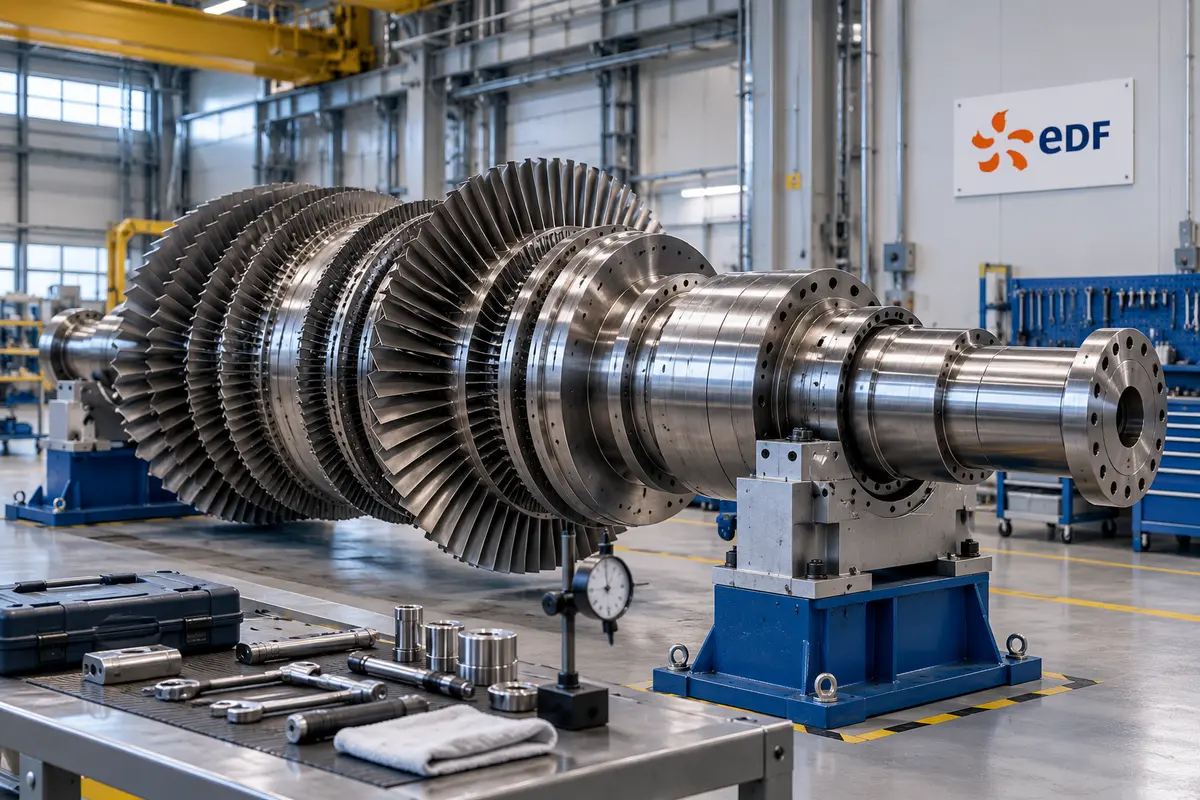
Flamanville 3’s outage was extended by another week in April 2025 for work on three components in the nuclear part of the reactor. EDF did not identify those components or disclose the cost. The extension followed a two-month delay involving the cooling circuit and turbo-alternator rotors. On 11 April, the company maintained its summer target for reaching full power.
EDF cautioned that the turbine work could only be assessed after reconnection, with another shutdown possible if problems emerged. The company characterised repeated shutdowns as part of equipment testing during start-up. Flamanville 3 was EDF’s only completed new French reactor in 25 years. Meanwhile, the heavily indebted utility was seeking financing for six EPR2 reactors proposed by President Emmanuel Macron in 2022.
What the commissioning permission covered
The commissioning authorisation came before that maintenance period. ASN’s resolution of 7 May 2024 permitted EDF to load fuel, perform start-up tests and subsequently operate the reactor. The regulator announced the decision the following day. Its examination, supported by the Institute for Radiological Protection and Nuclear Safety, or IRSN, accompanied construction oversight involving nearly 600 inspections. The permission carried binding technical requirements governing the performance and monitoring of tests after fuel loading.

Those requirements also addressed experience from other EPR reactors, replacement deadlines for heat exchangers between the component cooling and essential service water systems, and replacement of two main secondary-system protection-valve bodies. ASN consulted the public on EDF’s application and the proposed authorisation, sought environmental and regional authorities’ opinions, and heard the local information committee. Following consultation, it added requirements for regular information to that committee and the public about testing. Important subsequent start-up stages still required the regulator’s separate approval. The authorised installation is Basic Nuclear Installation 167, known as Flamanville 3.
A separate timetable for the vessel head
The reactor vessel’s closure head had its own regulatory history. A 2018 authorisation addressed a manufacturing anomaly affecting the vessel bottom and head, while limiting use of the head to 31 December 2024. Reactor start-up was then expected in autumn 2019. By May 2023, EDF’s commissioning forecast had moved to the first quarter of 2024. Framatome was manufacturing a replacement head under ASN oversight, with delivery then planned for the end of summer 2024.
Framatome requested permission to retain the installed head until the first refuelling outage, then envisaged 15–18 months after commissioning. That arrangement would avoid a separate replacement shutdown during 2024, while keeping the expected utilisation period below the period originally contemplated in 2018. ASN accepted the request. Its May 2023 notice also qualified that acceptance: another significant project delay would require EDF to reconsider replacement before commissioning. The forecast delivery date and forecast outage interval belonged to that 2023 decision; neither was a statement that replacement had already occurred.

Weld repairs and emergency-cooling filtration
Earlier construction work included repairs to main steam-line welds. These pipes were subject to break-preclusion requirements: strengthened design, manufacturing and inspection provisions supporting the assumption that a pipe rupture would be extremely improbable. For welds at containment penetrations, EDF’s repair strategy used a Westinghouse-developed robot to work from inside the pipes. Other main steam-line welds were also being repaired to restore conformity. ASN’s August 2023 information letter described hydrotesting among the final checks on the repair work.
A different technical issue concerned the safety injection system’s recirculation filters. In an accident, the system can filter water collected at the bottom of the reactor building and return it to cool the fuel. Tests showed that excessive fibres passing through filters could impair cooling. Finer mesh reduced fibre passage, but subsequent tests identified clogging risks from glue in some fire-protection tapes and sleeves. EDF proposed removing the affected protection systems, requiring revisions to both the fire-risk demonstration and the filtration assessment.
Preparing equipment and operating teams
Hot testing in late 2023 checked systems before fuel loading. ASN’s July 2024 account recorded two one-day inspections of test preparation and a three-day inspection involving eight ASN inspectors and four IRSN experts during test execution. The regulator also reviewed results and checked that earlier results remained valid through periodic tests and equipment-conservation inspections. Operating responsibility was progressively transferred to EDF’s future operating organisation, alongside staff training, operating documentation and development of the tools needed to run the installation.

Fuel loading placed 241 assemblies in the reactor and finished on 15 May 2024. ASN inspected the operation on 10 May and considered it well prepared and executed. Closing the vessel at the end of May enabled cold and hot pre-critical testing. By early June, however, several significant safety events had been reported, including three rated level 1 on the INES scale. EDF temporarily suspended start-up activities to analyse causes, introduce corrective measures and prepare the remaining work. ASN paid particular attention to that root-cause analysis and the lessons applied to subsequent activities.
Permission to begin the chain reaction
ASN authorised the first divergence operations in a resolution dated 2 September 2024 and announced its agreement on 3 September. Divergence means initiating the nuclear chain reaction in the reactor. This was a further permission within the framework established by the May commissioning authorisation. It followed the submission, on 30 August, of EDF’s information supporting the request, including results from installation tests performed since commissioning had been authorised.
The regulator had also inspected the installation, examined significant events reported by EDF and reviewed corrective actions. Its examination found no factor calling into question EDF’s ability to proceed with divergence. That conclusion concerned the requested stage of start-up. The agreement was similar in principle to ASN’s permissions before other nuclear reactors restart after maintenance outages. ASN’s notice explicitly retained oversight of the subsequent stages until rated power, including further agreements before specified power increases. The process therefore separated permission to introduce fuel from permission to initiate the reaction and from the later authorisations needed during the power ramp.

The first electricity delivered to the grid
Flamanville 3 connected to the national electricity grid on 21 December 2024 at 11:48, producing 100 MW of electrical power. The connection followed the first nuclear reaction on 3 September and the ensuing sequence of tests and inspections. Luc Rémont, EDF’s chairman and chief executive at the time, welcomed the connection alongside the EPR reactors already operating in China and Finland. The initial connection was followed by further commissioning work rather than immediate, uninterrupted operation at full power.
EDF’s December announcement envisaged several more months of tests, connections and disconnections under ASN supervision while power increased towards 100%. Its forecast of approximately 14 TWh covered the period from first connection to the first scheduled maintenance and fuel-reloading outage, termed Control Visit No. 1. That was a projected cumulative electricity volume over a period of operation. It was separate from the 100 MW power level at first connection and from any claim about electricity actually generated during a later calendar year.
Tests and outages through 2025
EDF’s 2025 Universal Registration Document, published in 2026, supplies the subsequent operating chronology. An outage from 15 February to 19 April 2025 involved several items of equipment, particularly the turbine. Another outage, from 19 June to 15 October, involved work on the primary circuit’s three protection valves. Those later identified valves should not be substituted for the three components left unnamed in the April Reuters dispatch: the records concern different maintenance periods.

The same annual account dates the BAS 108 test, which deliberately interrupted external power sources, to 23 May. Testing at 60% power began on 29 May, with the remainder of that phase on 12 November. An anti-islanding test took place on 7 November. Tests at 80% started on 12 November, before the December authorisation to advance to full power. EDF described continuing equipment tests at full power, measurements and checks, with power varied as required by the start-up programme. These were successive testing stages, with outages between parts of the programme.
Passing the final regulatory hold point
ASNR approved continuation above 80% of nominal power on 12 December 2025. It had already authorised tests above 25% on 31 January. EDF submitted its later application on 2 December, supplementing it on 8 and 11 December with the information needed for the decision, including results from testing since January. Core physics tests at different power levels checked conformity with the design and safety demonstration and allowed calibration of automatic control and protection systems.
Other tests included a manual reactor shutdown and islanding: separation from the electricity grid while maintaining generation for the installation’s own needs. ASNR also inspected the reactor, examined significant events and checked the resulting corrective actions. Its review identified no issue preventing continuation beyond the 80% threshold. The decision allowed further power increases and completion of the start-up test programme. The authority maintained specific oversight of the remaining stages, rather than treating the approval as the end of commissioning tests or an exemption from subsequent inspections.

Thermal power and electrical output
On 14 December 2025 at 11:37, Flamanville 3 reached 100% nuclear thermal power and generated 1,669 MW of gross electrical power. Thermal power measures heat produced by fission in the reactor core. That heat produces steam to drive a turbine, which drives an alternator to generate electricity. The thermal-power percentage and the electrical megawatt figure describe different quantities at different stages of that conversion. The December milestone followed ASNR’s permission two days earlier to exceed the 80% threshold.
Gross electrical output is also different from power delivered to the national grid. Pumps, ventilation and safety systems consume part of the electricity generated within the plant. Net electrical output is gross output minus those internal needs. Maximum electrical power can vary with cooling-water temperature, environmental constraints and grid settings. EDF said the first attainment of full thermal power enabled equipment checks and measurements. It still planned variations in power for further tests and an intervention on an internal electrical substation in the following weeks.
The regulator’s assessment after the ramp-up
ASNR’s annual assessment of 2025, published in 2026, considered the start-up tests well conducted. Its review covered core tests at different power levels and major transients, including shutdown at power, turbine tripping, islanding and loss of external electrical supplies. A dedicated inspection examined the latter test. Although operating activities had improved, the authority still expected stronger organisational arrangements, particularly before the first maintenance and refuelling outage. Areas requiring improvement included emergency-management premises, deviation handling, incident management and contamination prevention.

The number of significant safety events fell compared with 2024 but remained substantial relative to the operating fleet. ASNR linked many to non-compliance with operating specifications and insufficient control of plant configuration. Other events involved implementation of periodic test rules or incomplete risk analysis for instrumentation-and-control work. The assessment identified relatively few events caused by equipment failure, with exceptions including primary-valve leaks that were corrected and unexpected heat-exchanger clogging associated with unsuitable storage conditions. Inspectors also examined operating feedback, including links with overseas counterparts and experience from other EPR installations. Its conclusions distinguished testing performance from the organisational improvements still required.
A new connection after a long construction period
RTE’s 2024 Electricity Review placed the project within the history of the French generating fleet. Flamanville 3 was the first reactor connected to the grid in France since Civaux 2 in 1999; Civaux 2 entered commercial operation in 2002. RTE’s Flamanville focus used a net installed electrical capacity of 1,620 MWe, based on the operator’s declaration at the end of 2024. That historical net-capacity reference has a different basis from the gross electrical output EDF recorded at the December 2025 full-power milestone.
Construction began in 2007, with grid connection originally scheduled for 2012. RTE identified steam-pipe weld defects and the vessel-cover manufacturing anomaly among the difficulties encountered during construction. Its review also placed Flamanville after the first EPR units at Taishan in China, which entered service in 2018 and 2019, and Olkiluoto in Finland in 2023. Commercial commissioning remained prospective in that account, with testing continuing after the first connection to the grid. The French project’s first grid connection, the earlier reactors’ entry into service and Flamanville’s continuing test phase remain distinct milestones in that sequence.

Cost and the next reactor programme
The Cour des comptes’ January 2025 EPR-sector assessment estimated Flamanville 3’s total construction cost at approximately €23.7 billion in 2023 prices, including interest during construction. The Court calculated projected profitability below EDF’s weighted average cost of capital. It also reported that EDF had not communicated the information requested under its earlier recommendation to calculate and monitor projected profitability for Flamanville 3 and the EPR2 programme. These were the auditor’s estimates and findings, with a specified price basis and financing-cost scope.
- Securing EPR2 financing and advancing detailed design before the final investment decision.
- Ensuring that new international nuclear projects deliver quantified benefits for the French EPR2 programme without delaying it.
The Court’s recommendations above addressed investment and industrial planning. EDF’s reorganisation, effective from April 2024, was intended to clarify responsibilities between project ownership, management, engineering and the supply chain. The recommendations were separate from the regulator’s approvals for Flamanville’s fuel loading, divergence and subsequent power increases, and from the dated equipment tests through which the existing reactor advanced towards full thermal power.
Leave a comment