
How Euclid’s survey reached a record-breaking quasar
Euclid’s distant quasar discovery connects infrared detectors, precise spacecraft pointing, calibrated survey images and confirmation from ground-based telescopes.
Euclid has found a quasar whose light began its journey when the Universe was about 662 million years old. The object, EUCL J1729, moves the distance record for a known supermassive black hole to an epoch approximately 15 million years earlier than the previous record holder, discovered in 2021. A quasar shines as matter falls towards its central black hole. Its remote light carries information about black-hole growth during the Universe’s earliest history.
Daming Yang, an astronomer at Leiden University in the Netherlands, sees the discovery as making the problem of rapid early growth harder to explain. He also considers the enlarged sample important for studying early black holes as a population. Further observations with the James Webb Space Telescope and other observatories are intended to investigate the quasars’ masses and surroundings. Infrared observations are central to the search: expansion stretches light emitted at visible wavelengths into the infrared before it reaches telescopes. Euclid’s broad survey supplies such observations across a large area of sky.

Two instruments behind the survey
Euclid launched on a SpaceX Falcon 9 from Cape Canaveral Space Force Station in the United States on 1 July 2023, at 17:12 CEST. Controllers at ESA’s European Space Operations Centre in Darmstadt received its signal through the New Norcia station at 17:57 CEST. The spacecraft’s destination was an orbit around Sun–Earth Lagrange point 2, approximately 1.5 million kilometres from Earth in the direction away from the Sun.
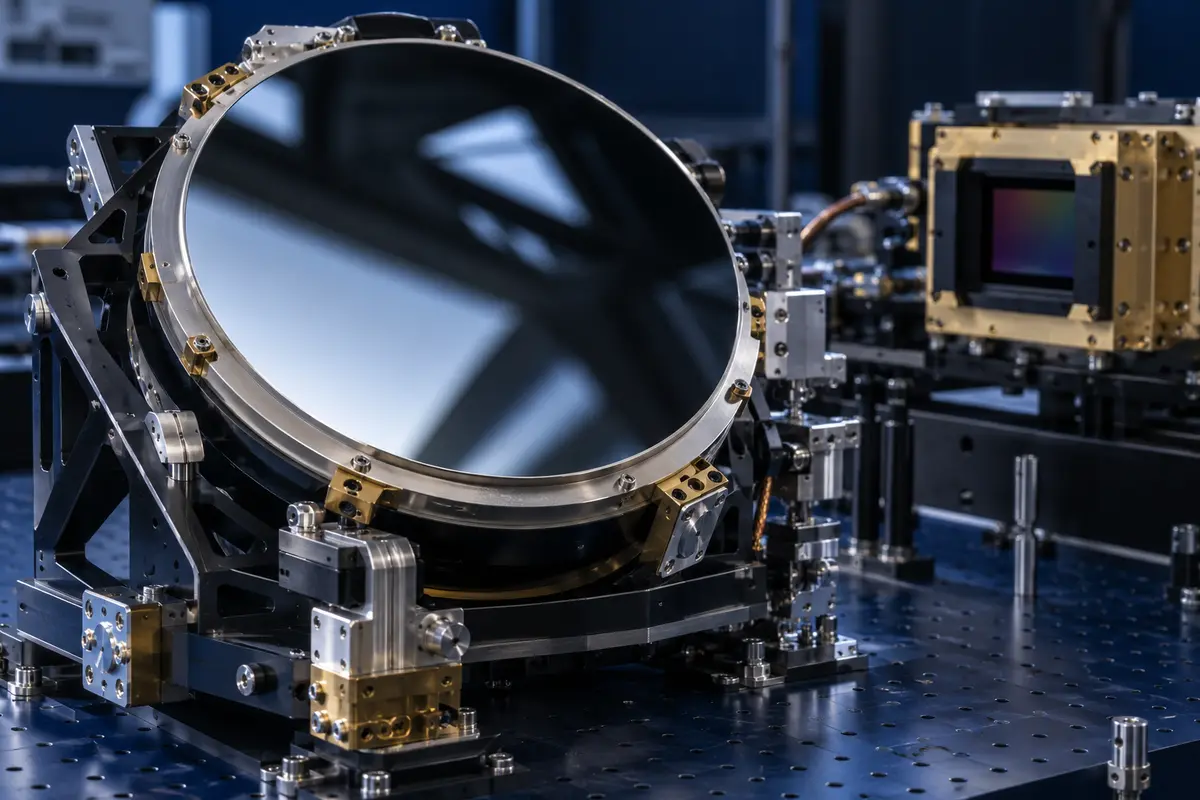
A 1.2-metre reflecting telescope feeds two instruments supplied by the Euclid Consortium. The visible-wavelength camera, VIS, produces sharp galaxy images. The Near-Infrared Spectrometer and Photometer, NISP, separates infrared light by wavelength to help establish galaxy distances. NASA supplied NISP’s detectors. ESA selected Thales Alenia Space to build the satellite and service module, and Airbus Defence and Space for the payload module, including the telescope. The ground infrastructure also required preparation: ESA upgraded its Estrack deep-space antennas to handle the mission’s data, with scientific analysis assigned to the consortium and archive access through the agency’s science centre.
Detector arrays and the cosmology programme
VIS contains 36 CCD detectors in a 4K format, while NISP uses an array of sixteen 2K mercury-cadmium-telluride near-infrared detectors. NASA’s Jet Propulsion Laboratory designed and fabricated the sensor-chip electronics, led detector procurement and delivery, and worked with NASA’s Goddard Space Flight Center, where the detectors were tested. The Euclid NASA Science Center at IPAC supports investigations based in the United States.

The mission’s principal cosmological measurements include weak gravitational lensing and galaxy clustering. Matter bends light from background objects; small changes in galaxy shapes allow astronomers to investigate the distribution of matter. Galaxy clustering supplies another measurement across different cosmic eras. NASA’s Roman telescope was designed to complement Euclid with deeper infrared observations over a smaller region, as well as a survey of type Ia supernovae. In NASA’s June 2023 programme description, the missions’ overlapping surveys were expected to permit corrections derived from Roman’s more detailed observations to be applied across Euclid’s wider coverage. That collaboration was a proposed use of the two surveys, alongside their separate observing programmes.
Keeping a faint field steady
During commissioning, Euclid’s Fine Guidance Sensor sometimes lost the guide-star patterns needed for accurate pointing. Energetic particles produced false signals in its detectors. At times these artefacts outnumbered genuine stars, preventing the sensor from recognising the pattern it needed. Some test exposures contained swirling trails as the spacecraft tried to settle on its target. The guidance sensor observes stars beside VIS’s field of view and sends their positions to the spacecraft’s Attitude and Orbit Control System.
Thales Alenia Space and Leonardo revised the onboard star-identification software. Engineers tested the patch with an electrical spacecraft model and simulator before a ten-day trial in orbit. ESA announced the successful repair on 5 October 2023. Performance verification, interrupted in August, then resumed, with observations operating correctly. Mission-control teams had worked in twelve-hour shifts during commissioning, alongside scientific and industrial specialists. The resumed verification phase tested the spacecraft under conditions representative of scientific observations. Its tasks followed the initial checks of the telescope, instruments and navigation system after arrival at the observing orbit.

A wide field with small details
Euclid’s first full-colour images were released on 7 November 2023. The five targets included the Perseus galaxy cluster, spiral galaxy IC 342, dwarf galaxy NGC 6822, globular cluster NGC 6397 and the Horsehead Nebula. Each image covered a large field while retaining detail in faint objects. In the Perseus exposure, roughly 1,000 cluster members appeared together with more than 100,000 background galaxies. Some background light had travelled for about ten billion years before reaching the telescope.
The targets also spanned very different astronomical distances. NGC 6822 lies approximately 1.6 million light-years away, while NGC 6397 is around 7,800 light-years away. In the globular cluster, the telescope could distinguish faint stars across the whole cluster in one observation. Infrared imaging exposed stellar information in IC 342, nicknamed the Hidden Galaxy. The Horsehead field offered searches for young stars, brown dwarfs and low-mass planets. These initial observations preceded the routine survey: the spacecraft was still undergoing final adjustment before its main programme began in early 2024.
Building coverage one pointing at a time
Euclid began its routine survey on 14 February 2024. Its step-and-stare sequence spends about 70 minutes observing one sky area, collecting images and spectra, followed by approximately four minutes moving to the next. The six-year plan calls for more than 40,000 pointings. Around 50,000 galaxies per pointing were expected to provide shapes accurate enough for the mission’s lensing measurements, within a programme targeting at least 1.5 billion such galaxies.

Unwanted sunlight forced a revision of the observing schedule. A small tilt of the spacecraft’s sunshield reduced the stray light, but restricted the permissible orientations and the sky areas reachable at a given orbital position. Ismael Tereno and João Dinis, working with survey teams, redesigned the sequence. The revised plan required more overlap between neighbouring observations and was slightly less efficient. Spacecraft rotation times and routine calibrations also had to fit within the schedule. Most observing time was assigned to the wide survey; the complementary deep survey was allocated about a tenth of the total. The new arrangement retained access to the necessary sky areas.
Measuring an optical loss
By March 2024, calibration specialists had detected a gradual decline in the starlight reaching VIS. Repeated measurements of stars, including comparison with ESA’s Gaia observations, helped distinguish an instrumental change from stellar variability. Water absorbed during assembly was slowly escaping from spacecraft materials in the vacuum of space. Some molecules froze on cold optical surfaces. The suspected ice layers were only a few to a few tens of nanometres thick.
A post-launch outgassing campaign had removed much of the water near exposed surfaces, but multilayer insulation retained a further supply. Heating the whole spacecraft could clear the optics, yet expansion and subsequent cooling could change its alignment and require weeks of recalibration. Engineers instead prepared selective heating of individual optical components. They planned to begin with two independently heated mirrors in relatively low-risk locations, measuring the recovered light before proceeding to other groups. Laboratory studies of ice on mirrors accompanied the in-orbit calibration work. The procedure announced on 19 March aimed to isolate the contaminated area while limiting thermal disturbance to the mission’s sensitive optical structure.

Recovering light with selective heating
The first stage produced a larger improvement than the team had expected. The coldest mirror behind the main telescope optics was warmed from −147°C to −113°C. Although still extremely cold, that temperature allowed the ice to evaporate in the vacuum. Incoming light increased by 15%. ESA announced the result on 26 March 2024, after about 100 minutes of targeted heating. The operation identified the surface responsible for most of the lost light.
Controllers timed the work to maintain continuous contact through the Malargüe ground station, allowing a response if an anomaly arose. Instrument specialists continued analysing the measurements and monitoring the mirrors. Ralf Kohley coordinated the anomaly review, while calibration scientist Mischa Schirmer helped design the procedure. VIS scientist Reiko Nakajima expected ice to accumulate again and anticipated selective decontamination at intervals of six to twelve months. That interval was an operational expectation, rather than a record of completed repeat treatments. The successful first operation supplied a method for restoring throughput without heating the entire payload and disturbing its calibration.
From exposures to catalogues
Euclid’s Early Release Observations became public on 23 May 2024, together with five new views and ten forthcoming science papers. The programme targeted seventeen objects before the main survey. About 24 hours of observations produced a catalogue containing more than eleven million objects in visible light and another five million in infrared. These early observations covered nearby gas and dust as well as distant galaxy clusters.
The images included Abell 2390, Messier 78, NGC 6744, Abell 2764 and the Dorado galaxy group. Abell 2390 contained more than 50,000 galaxies and prominent gravitationally lensed arcs. Messier 78 exposed a dust-covered star-forming region in the infrared, with over 300,000 newly detected objects in that field. Abell 2764 shared its image with a bright foreground star; the telescope’s limited scattering of starlight allowed faint galaxies to remain visible nearby. Across the Dorado group, extended tidal structures and compact star clusters appeared in the same frame. These were early-release targets and catalogues, separate from the later search for the record quasar in wide-survey images.
Assembling the survey’s first mosaic
A 208-gigapixel mosaic released on 15 October 2024 combined 260 observations taken between 25 March and 8 April. It covered 132 square degrees of the southern sky and contained approximately 100 million sources, including Milky Way stars and more distant galaxies. About fourteen million galaxies were bright enough for the shape measurements used in weak-lensing studies. The mosaic represented around 1% of the intended wide-survey map.
Overall survey progress had reached 12% by the October announcement, a different measure from the area displayed in the mosaic. Fine structure remained visible when individual regions were enlarged, including spiral galaxies and interacting systems. Faint blue-looking clouds between stars belonged to the Milky Way: this galactic cirrus consists of gas and dust reflecting optical light. The same clouds emit in the far infrared, where ESA’s Planck mission observed them. The assembled field therefore included nearby foreground material together with remote objects. ESA presented the mosaic at the International Astronautical Congress in Milan, with Director General Josef Aschbacher and Director of Science Carole Mundell unveiling it.

A public preview of the deep fields
On 19 March 2025, Euclid released observations of three deep-field regions covering 63.1 square degrees. A single pass across these fields revealed around 26 million galaxies, with the most distant galaxy light travelling approximately 10.5 billion years. The six-year plan calls for repeated visits, between thirty and fifty-two for each field, to build greater depth. The wide survey, by comparison, targets approximately 14,000 square degrees.
The release also included a morphological classification catalogue of more than 380,000 galaxies. Nearly 10,000 Galaxy Zoo volunteers helped train and check classifications alongside the Zoobot machine-learning system. A separate catalogue contained 500 strong gravitational-lens candidates. These galaxy-shape and lens searches were distinct from the high-redshift quasar selection. The public preview made a subset of Euclid observations available to researchers while the survey continued. By that announcement, the mission had observed approximately 2,000 square degrees, around 14% of its planned survey. Future repeated deep-field observations and the wide-area programme were intended to enlarge the scientific datasets beyond this first public sample.

Selecting candidates and measuring their spectra
The quasar investigation used approximately 3,000 square degrees of wide-survey images acquired from 14 February 2024 to 11 August 2025. On-the-fly processing supplied the images rather than a public data release. Candidate selection combined optical and infrared measurements, point-like appearance, statistical classifiers, spectral-energy-distribution fitting and visual inspection. Spectroscopy then tested the candidates with six instruments on the Keck, Magellan Baade and Large Binocular telescopes.
- 123 candidates received spectroscopic observations.
- 31 were identified as new quasars; twelve had redshifts of at least seven.
- 45 were contaminants, 25 remained inconclusive and 22 were undetected.
The record object EUCL J172902.75+641018.1 has a redshift near 7.77. Another reaches approximately 7.69; both exceed the previous record near 7.64. The incomplete follow-up and selection process do not yet provide a fully characterised quasar population. Additional spectra are needed to investigate ambiguous faint sources and measure black-hole properties. The discovery enlarges the observed sample while leaving the masses and growth histories of individual objects for further investigation.
Leave a comment