
Dragonfly’s engineering path from test rigs to Titan
Dragonfly enters integration for its mission to Titan. Rotor tests, sample handling and thermal design chart what NASA must verify before a planned 2028 launch.
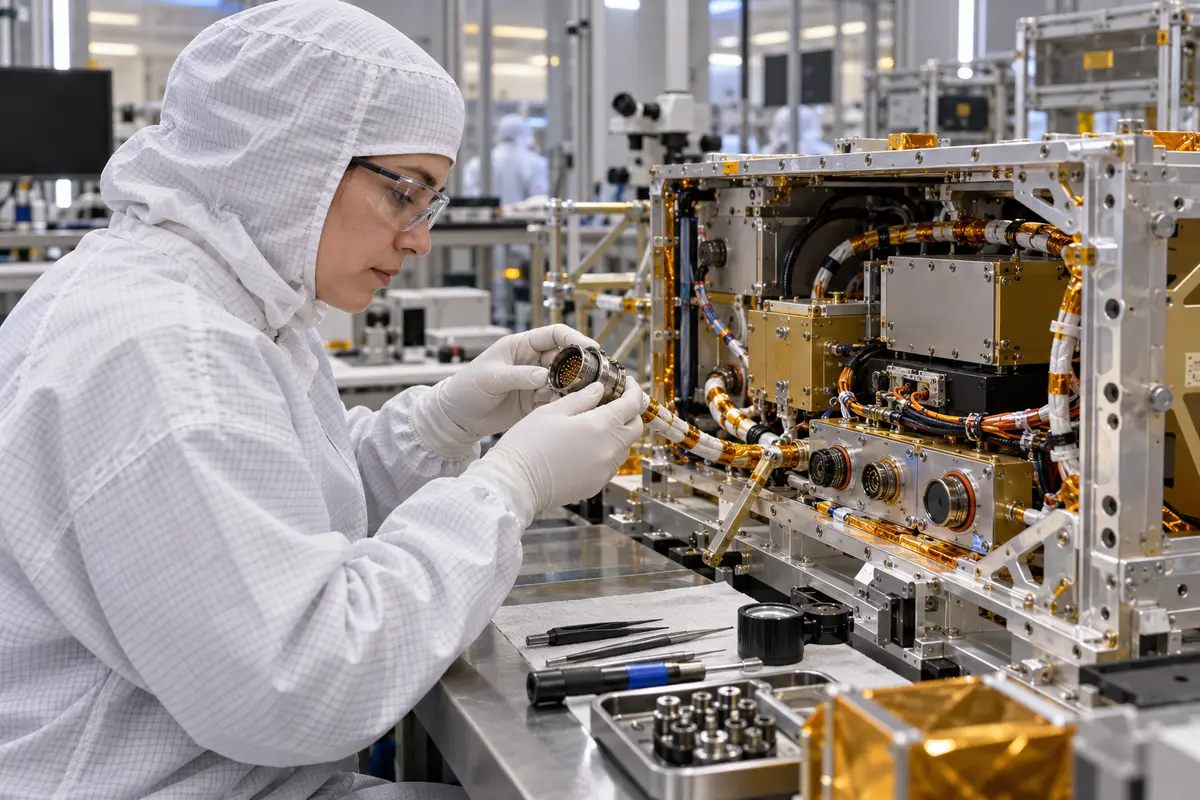
Integration begins
NASA’s Dragonfly has entered integration and testing at Johns Hopkins Applied Physics Laboratory in Maryland. The nuclear-powered rotorcraft is being prepared for a planned 2028 launch toward Saturn’s moon Titan, with arrival expected in 2034. Its central avionics and power equipment mark an early step in assembling a spacecraft that must operate far from Earth.
A landscape worth moving across
Titan has a nitrogen-based atmosphere roughly four times as dense as Earth’s, with surface pressure about 50 percent higher. Methane forms clouds and rain, while other organic compounds develop in the atmosphere and settle onto the ground. The moon orbits Saturn about 1.4 billion kilometers from the Sun, roughly ten times Earth’s distance. Its surface temperature is around minus 179 degrees Celsius. Dragonfly is designed to carry its entire scientific payload between landing sites in this cold, dense atmosphere.
The planned initial landing area lies in the equatorial Shangri-La dune fields. The mission’s proposed traverse continues toward Selk impact crater, where evidence indicates that liquid water, organic compounds and energy existed together in the past. The scientific objectives include investigating the progression of prebiotic chemistry and measuring atmospheric and surface properties. Thirteen years of Cassini observations informed the choice of a calm landing period, an initial landing site and subsequent scientific targets.

From preliminary review to confirmation
Dragonfly passed the success criteria of its preliminary design review in early 2023. NASA then required an updated budget and schedule aligned with available funding. The revised plan received conditional approval in November 2023, pending the fiscal year 2025 budget process. During that interval, the project retained authorization to work on final mission design and fabrication. NASA confirmed the mission in April 2024 following release of the president’s fiscal year 2025 budget request, setting a total lifecycle cost baseline of $3.35 billion and a July 2028 launch date.
Funding constraints in fiscal years 2020 through 2022 had required repeated replanning after the mission’s selection in 2019. NASA attributed additional costs to the pandemic, supply-chain increases and detailed design iteration. The agency provided additional funding for a heavy-lift launch vehicle to shorten the cruise following the delayed departure. Confirmation authorized completion of final design, followed by construction and testing of the complete spacecraft and scientific instruments. The approved departure was more than two years later than the original selection schedule.
An approved design and a distributed team
Dragonfly passed its critical design review in April 2025. Its mission design and fabrication, integration and testing plans received approval, allowing construction of the spacecraft to proceed. The planned surface investigation extends over three years and covers multiple landing sites. Its chemical objectives include studying complex organic compounds and processes associated with the chemistry preceding life on Earth. APL directs the design and construction from Laurel, Maryland, and manages the mission for NASA.
Engineering and science partners
- NASA’s Goddard Space Flight Center in Greenbelt, Ames Research Center in Silicon Valley and Langley Research Center in Hampton.
- Lockheed Martin Space in Littleton, Penn State University in State College and Malin Space Science Systems in San Diego.
- Honeybee Robotics in Pasadena, NASA’s Jet Propulsion Laboratory, Embry Riddle in Daytona Beach, CNES, DLR and JAXA.

Testing paired rotors
Dragonfly’s eight rotors form four coaxial pairs, with one rotor mounted above another. The 2022 vehicle design spanned more than 12 feet from nose to tail and between its widest rotor tips. Engineers from APL and NASA tested a full-scale representative pair in the Transonic Dynamics Tunnel at Langley Research Center in Hampton, Virginia, in the United States. The tunnel’s large working section accommodated the hardware, while heavy gas supplied aerodynamic loading representative of Titan’s atmosphere.
The tests simulated hovering, descent and climbing. Each rotor operated at several wind speeds, shaft angles and throttle settings. One test configuration kept a rotor stationary while the other operated, examining a failure mode. Sensors and accelerometers measured loads and accelerations as the team varied wind conditions, orientation and rotor speed. Preliminary analysis found that computational fluid dynamics predictions of rotor performance and power requirements agreed with the experimental results within expected mission tolerances. APL used the measurements to assess the rotor models supporting predictions for Titan operations.
Machining and testing the rotor hardware
APL machinists began cutting test rotors on November 1, 2024. Waterjet cutting pared down 1,000-pound aluminum blocks before rough machining, cover fitting, vent-hole drilling and thread cutting. Inspection and cleaning preceded welding, after which the parts returned for final finishing. The team adapted tools and equipment to material changes and design revisions, delivering the parts a month early. Engineers mounted the rotors on a full-scale model representing half the lander and spin-tested the assembly at APL before transporting it to Langley in late July 2025.
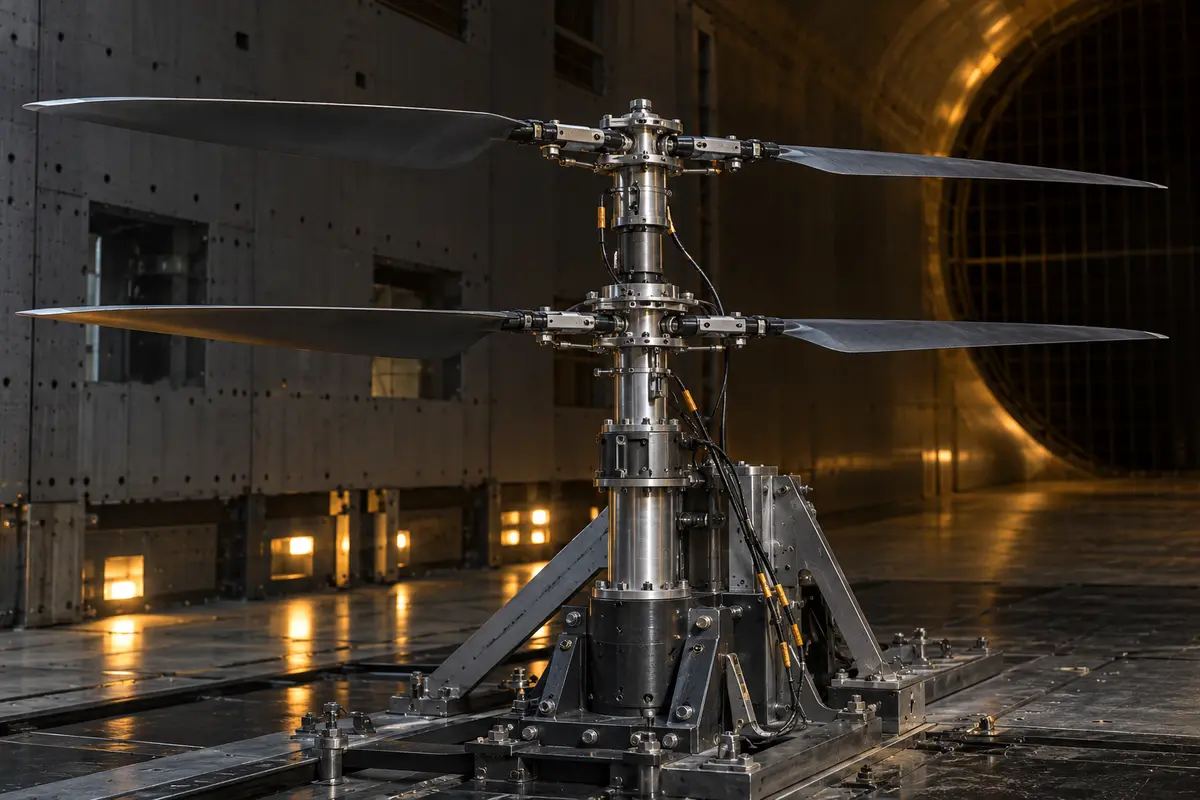
A five-week aeromechanical campaign ran through August and September 2025 in the Transonic Dynamics Tunnel, whose working section measures 16 feet high, 16 feet wide and 20 feet long. Measurements included rotor-arm stresses and vibration affecting blades and the lander body. Smaller-scale rotor models underwent aerodynamic testing there in December. The planned next steps included fatigue and cryogenic trials before fabrication of the actual flight rotors. Penn State supported initial rotor design, aerodynamic modeling and testing; Sikorsky supported aeromechanics, analysis and flight-hardware simulation.
Insulation, communications and entry structures
Dragonfly’s body is designed to carry a three-inch layer of Solimide-based foam over its instruments and other exterior elements. By September 2025, APL engineers had completed structural and thermal testing of the insulation in the laboratory’s Titan-environment chamber and at Langley’s wind tunnel. The tests examined whether the foam would maintain its shape and protect the lander in Titan conditions. Alongside this work, NASA Goddard completed the ion-trap mass spectrometer at the heart of DraMS. The instrument cleared its acceptance review, with space-environment testing and integration with other DraMS components still ahead.
APL also completed and tested the flight radios intended to receive and transmit communications during the journey and surface operations. The Frontier radios use software to configure their operation for specific mission requirements and support transmission and reception across a range of frequencies. Lockheed Martin completed fabrication, curing and thermal-cycle tests of the aeroshell’s heat-shield and backshell structures. The aeroshell is designed to withstand the thermal and structural loads of atmospheric entry. Static structural tests and installation of its thermal-protection system were the next scheduled activities.

Surface samples inside the lander
The Dragonfly Mass Spectrometer, or DraMS, is designed to investigate organic molecules and their distribution across different surface environments. The Drill for Acquisition of Complex Organics, called DrACO, will collect samples weighing less than a gram and deliver them to the lander’s internal instrument compartment, known as the attic. An onboard laser or oven prepares material for measurement. Mass spectrometry ionizes the sample material and analyzes ions according to their mass-to-charge relationships. Scientists on Earth will use the transmitted measurements to investigate Titan’s surface chemistry.
DraMS draws on techniques developed for the Sample Analysis at Mars suite aboard Curiosity. Some of the Goddard team responsible for that instrument also developed DraMS. CNES supplies a gas-chromatograph module that separates constituents after material leaves the oven. The instrument is intended to adapt its analysis to samples from different geological settings as the lander relocates between sites. Its scientific focus includes the organic chemistry associated with prebiotic systems. Organic molecules contain carbon and can arise through both living and nonliving processes; their composition and environmental distribution are among the measurements planned for Titan.
Two analytical routes
DraMS combines a linear ion-trap mass spectrometer with laser-desorption and gas-chromatography modes. Laser desorption surveys surface material, including refractory organic compounds. Ion isolation and tandem mass spectrometry provide structural information about selected molecules. The gas-chromatography mode uses pyrolysis or derivatization to prepare compounds for separation and identification, including measurements of enantiomeric excess where present. DrACO delivers specialized cups to separate analytical ports. For laser analysis, material sits behind a fine mesh covering a window in the sample cup.

Laboratory tests measured how that mesh geometry affected signals from coronene, with signal levels proportional to the sample area visible to the laser. Cryogenic tests of adenine in water ice produced spectra similar to those of the pure molecule at room temperature. The compact THANOS ultraviolet laser operates at 266 nanometers; its engineering model underwent environmental testing and reached technology readiness level six in early 2022. DraMS carries general and chiral chromatography columns. The general-purpose RTX-5 column was selected from four candidates for separating compounds with up to 25 carbon atoms within the available analysis time.
Cold samples beside warm instruments
The sample-delivery carousel has a temperature limit below 170 kelvin to prevent water-ammonia eutectic ice from melting. Titan’s surface atmosphere is about 94 kelvin, while instruments and actuators inside the lander require warmer conditions. A temperature gradient exceeding 100 kelvin crosses the carousel baseplate. Thermal isolation limits heat conduction through its support structures. Double-sided aluminum fins on the carousel cover transfer heat between the sealed sample compartment and a buoyancy-driven flow of Titan atmosphere through the attic.
Titanium cover and support structures limit dimensional changes that could disturb alignment between the sample cups and laser as the assembly cools. The engineering-model support was machined from titanium billet after generative-design studies. Insulation inside the clean sample region combines a thin polymethacrylimide foam layer with a printed PEEK polymer shell. Prototype comparisons favored dense arrays of thin pyramidal fins. The end-to-end engineering-model tests planned in 2024 would adjust chamber pressure to match relevant convection conditions despite the difference between Earth’s and Titan’s gravity.

Elemental measurements beneath the lander
The Dragonfly Gamma-Ray and Neutron Spectrometer, or DraGNS, is designed to measure bulk elemental composition beneath the lander to a depth of about ten centimeters. A pulsed neutron generator stimulates interactions in the surface material. The resulting gamma rays have energies characteristic of particular elements, while their intensities depend on abundance. A neutron spectrometer measures scattered neutrons. Together, these measurements are intended to provide geochemical context and help the team select locations for further study with DraMS. The principal target elements are carbon, hydrogen, nitrogen, oxygen, phosphorus and sulfur.
Ground experiments at NASA Goddard used commercial surrogate instruments because flight units were unavailable. A germanium gamma-ray spectrometer and two helium-3 neutron detectors operated above containers of water-based mixtures representing possible icy materials. Polyethylene plates and melamine-loaded resin layers represented overlying organic deposits. Measured spectra included phosphorus, nitrogen and sulfur lines. Planned analysis compared elemental estimates and their uncertainties with known experimental compositions, supported by GEANT simulations. Additional layered-material experiments addressed how accurately the instrument could determine the depth of buried water. The work concerned laboratory analogs and surrogate equipment.
Microscopic textures in laboratory analogs
DragonCam’s microscopic imaging supports examination of Titan’s surface textures, including sites where images can be obtained but samples cannot be collected. Laboratory work at the Jet Propulsion Laboratory investigated acetylene and butane at cryogenic temperatures, before and after contact with liquid ethane. Pure acetylene imaged at 90 kelvin formed connected, branching crystals. Darker areas were attributed mainly to thickness differences under the microscope’s illumination. After ethane condensed and evaporated, the sample developed irregular polygonal cracks. The researchers proposed partial dissolution in ethane as a possible explanation.

Pure butane imaged at 94 kelvin appeared porous, with an amorphous texture and areas of negative relief. Ethane exposure followed by evaporation produced more crystalline, partly branching structures. The team associated these changes with butane’s high solubility in ethane. Images were collected before condensation, after condensation and after evaporation; warming accelerated the evaporation stage. Planned follow-up work included additional mixtures, methane condensation, feature-size measurements, Raman spectroscopy and ultraviolet fluorescence studies. A benchtop microscopic imager using DragonCam wavelengths at APL was intended for comparisons with the laboratory microscope observations.
The launch service and mission program
NASA selected SpaceX to launch Dragonfly in November 2024 under a firm-fixed-price contract worth approximately $256.6 million, including launch services and other mission-related costs. The targeted departure period runs from July 5 through July 25, 2028, using Falcon Heavy from Launch Complex 39A at Kennedy Space Center in Florida. NASA’s Launch Services Program at Kennedy manages the launch service. APL manages the spacecraft mission, whose team includes specialists in rotorcraft, autonomous flight and space systems alongside scientists, engineers, technologists and managers.
Dragonfly is the fourth mission in NASA’s New Frontiers Program. Marshall Space Flight Center in Huntsville, Alabama, manages that program for the Science Mission Directorate in Washington. The lander’s payload is designed to characterize Titan’s habitability, investigate prebiotic chemistry and search for chemical indications of past water-based or hydrocarbon-based life. Its planned sampling campaign covers different geological settings, including areas where carbon-rich material and liquid water may have mixed for an extended period. The mission combines those surface investigations with the ability to travel between sampling sites.
Leave a comment