
CONUS+: germanium recoils, reactor backgrounds and calibration
CONUS+ detects reactor antineutrinos through germanium nuclear recoils. Background studies and calibration separate its first result from later precision work.
A small target registers reactor antineutrinos
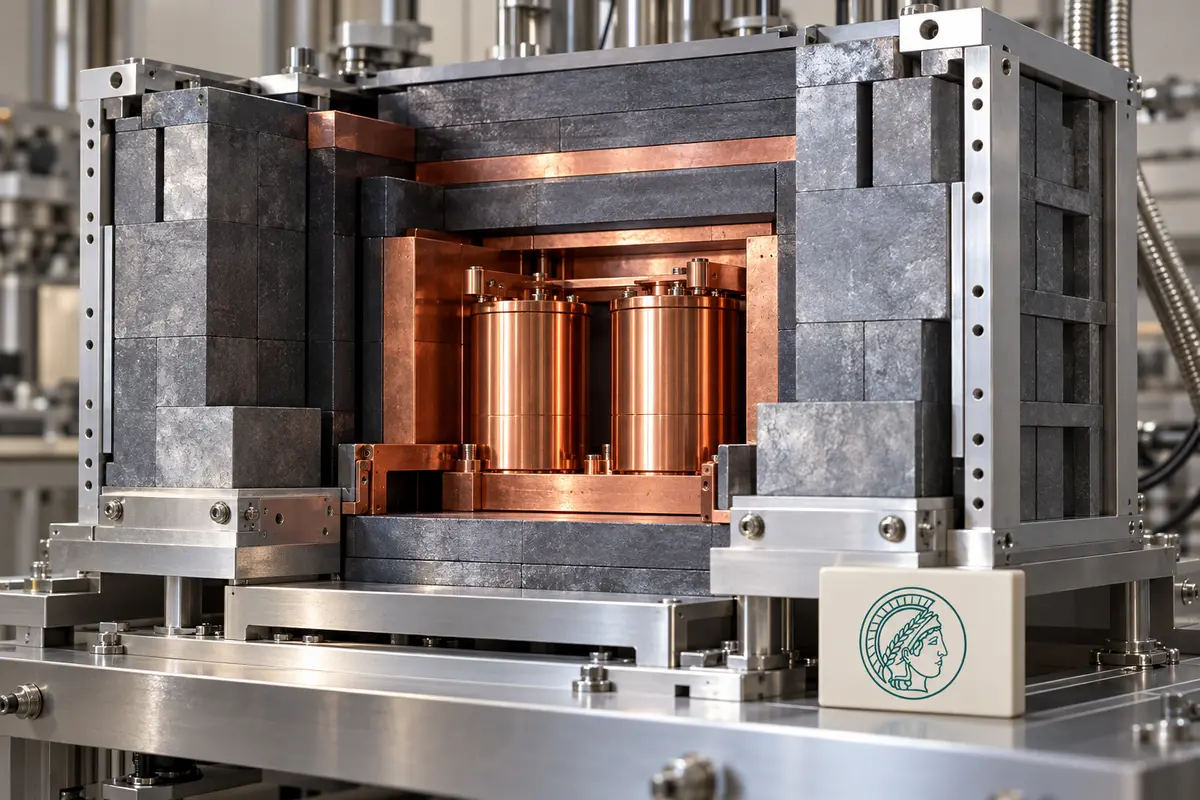
CONUS+ measured coherent elastic antineutrino–nucleus scattering at the Leibstadt nuclear power plant in Switzerland. Its first signal comprised 395 ± 106 events, compared with a Standard Model prediction of 347 ± 59, with a statistical significance of 3.7 standard deviations. The selected reactor-on exposure was 327 kilogram-days. The three analysis detectors contained 2.83 ± 0.02 kilograms of active germanium. Nuclear recoils produce small ionization signals, requiring low thresholds and substantial shielding. Duke University physicist Kate Scholberg described the result as a long-sought advance; collaborator Christian Buck identified opportunities for further neutrino tests. Virginia Tech physicist Jonathan Link emphasized the experimental difficulty. Proposed reactor-monitoring applications also face limitations from shielding, distance and reconstruction of antineutrino energies. The observation analysis distinguishes this measurement from those prospective applications.
Moving detectors to a different reactor
The CONUS+ apparatus continued the CONUS programme previously operated at Brokdorf in Germany. At Leibstadt, the setup sits 20.7 metres from a reactor core with 3.6 gigawatts of thermal power. Four point-contact high-purity germanium detectors from the earlier experiment were refurbished, with their low-energy thresholds optimized. The equipment transferred between sites included the detector technology and shielding concept, while the changed radiation environment required modifications to the installation.
The July 2024 experiment description, revised that December, details changes to both passive and active shield layers. New data-acquisition and monitoring systems accompanied those changes. A direct network connection to the Max Planck Institute for Nuclear Physics enabled real-time control and monitoring of acquisition. The design work included predictions for the first data-collection phase and prospects for a second phase with larger germanium detectors. Those larger devices were an upgrade plan at that stage, rather than the targets used in the initial measurement.

Measuring the surrounding radiation
The Leibstadt site-characterization campaign measured backgrounds during reactor operation and shutdown. At the experimental position, the estimated antineutrino flux was 1.5 × 10¹³ per square centimetre per second. An unshielded germanium detector examined gamma radiation, while a liquid-scintillator instrument measured the muon flux. The muon measurement, 107 ± 3 per square metre per second, corresponded to an average overburden of 7.4 metres water equivalent. The shallow location leaves cosmic radiation relevant to background control.
During reactor operation, the highly thermalized neutron field reached a maximum fluence rate of (2.3 ± 0.1) × 104 neutrons per square centimetre per day. Compared with the previous CONUS location, the neutron flux was 30 times higher, while the reactor-power-correlated gamma component above 2.7 megaelectronvolts was 26 times lower. Reduced overburden also increased muon-induced neutrons. These separate measurements informed modifications to shielding; the neutron and gamma comparisons refer to different components and energy selections.
Separating surface and bulk pulses
Earlier CONUS work developed a data-driven pulse-shape discrimination method for four one-kilogram germanium detectors. Background radiation depositing energy near a detector's semi-active surface can produce slower-rising pulses because diffusion dominates there. Events in the fully active bulk produce faster pulses. The August 2023 study, revised in February 2024, examined these differences down to an electron-equivalent energy of 210 electronvolts, including the effect of electronic noise close to threshold.

At 90 per cent acceptance of signal-like bulk pulses, the method rejected approximately half the surface events at threshold. Surface contributions were fully suppressed above 800 electronvolts electron equivalent in the studied data. Applying the selection to CONUS backgrounds reduced the total background budget by 15–25 per cent. These results belong to the predecessor experiment and the particular pulse selection studied. The first CONUS+ signal analysis did not yet apply pulse-shape rejection, although its digitized acquisition allowed that option for future analyses.
The predecessor's final limit
The final Brokdorf CONUS analysis used four one-kilogram germanium spectrometers inside optimized shielding. Their ionization-energy thresholds reached 210 electronvolts. The reactor supplied an antineutrino flux of up to 2.3 × 10¹³ per square centimetre per second. The final data-collection phase at that site tightened constraints on the neutrino interaction rate by an order of magnitude relative to the preceding CONUS analysis. This was a rate limit, preceding the later CONUS+ observation at Leibstadt.
The January 2024 results, subsequently revised, constrained the signal to fewer than 0.34 events per kilogram per day. That limit lay within a factor of two of the Standard Model prediction. The authors discussed it alongside conflicting results from another reactor experiment using similar detector technology. The Brokdorf constraints and the Leibstadt detection therefore belong to separate sites and datasets, with different thresholds and backgrounds. The earlier limit remains part of the programme's experimental history without serving as the event count of the successor measurement.

Decomposing the first run's background
A dedicated August 2026 analysis examined the backgrounds of the three detectors selected for CONUS+ run one. A Geant4-based Monte Carlo model decomposed the measured spectra and supplied background input to the likelihood fit. Reactor-correlated components were subdominant, including below 350 electronvolts electron equivalent, where their contribution was about an order of magnitude below the expected coherent-scattering signal. Cosmic-ray muons and neutrons dominated below one kiloelectronvolt, contributing approximately 75–90 per cent of the recorded background rate.
In the separate interval from 0.4 to 1.0 kiloelectronvolts electron equivalent, the model predicted an average reactor-on background of 47.5 ± 3.2 events per kilogram per day. The measured average was 48.0 ± 0.6 in the same units. The authors also found agreement in other reactor-on and reactor-off energy regions. This later decomposition concerns the first dataset; its comparison interval above 0.4 kiloelectronvolts must remain separate from the lower-energy region containing the principal neutrino signal.
Checking the scale near threshold
Energy-scale uncertainty contributed 14 per cent to uncertainty in the combined signal prediction for the first measurement. In April 2026, the collaboration described a dedicated neutron-activation calibration campaign using one of the new 2.4-kilogram germanium detectors. The campaign resolved the germanium-71 M-shell X-ray line at 158.7 ± 1.4 electronvolts electron equivalent. This placed a calibration feature close to the experiment's low-energy detection thresholds, extending checks of energy reconstruction into that region.

The checks covered energy scale, resolution, trigger efficiency and separation of physical events from noise. The campaign demonstrated that the energy-scale contribution to signal-prediction uncertainty could fall below four per cent. That achievable contribution concerns the prediction, rather than the complete statistical or systematic uncertainty of a neutrino measurement. The calibration study provided a basis for a future activation campaign at the reactor site. It did not claim that the proposed on-site campaign had already been completed.
Larger detectors in a later run
The second-run analysis, released on October 27, 2026, followed an upgrade replacing three original one-kilogram detectors with 2.42-kilogram germanium diodes. These detectors reached thresholds of 140–170 electronvolts electron equivalent. Background per unit mass fell by approximately a factor of two relative to the original detectors. The reactor-on exposure was 1,296 kilogram-days, accompanied by 86 kilogram-days with the reactor off. The larger targets and exposures distinguish this run from the initial result.
A blind likelihood analysis fitted the signal-event count directly, yielding 1,555 ± 152 coherent-scattering events and a significance of 10.2 standard deviations. The Standard Model expectation was 1,701 ± 198 events. Their ratio was 0.91 ± 0.14, consistent with that prediction within the quoted uncertainty. These October 2026 results are later developments in the CONUS+ programme. They do not replace the first observation's 395-event estimate or alter the original January 2025 publication date of the initial news.

How recoil energy becomes ionization
A separate germanium experiment measured the ionization produced by monoenergetic nuclear recoils. Alexander Kavner and I. Jovanovic's 2024 work used saved preamplifier waveforms to compare optimal, trapezoidal and Gaussian pulse-shaping analyses. Tagged events identified the combined deposition from a nuclear recoil and an associated gamma ray. The different analyses tested whether pulse-processing choices could account for disagreements between earlier low-energy germanium measurements.
The measured ionization was 63.8 ± 8.4 electronvolts electron equivalent for a 254.1-electronvolt nuclear recoil, giving a quenching factor of 25.1 ± 3.3 per cent at that energy. Accurate knowledge of the associated 68.75-kiloelectronvolt nuclear level was the leading uncertainty. Changing shaping time or analysis method did not account for the full discrepancy between the earlier studies. This laboratory result concerns one recoil energy and its measurement method; it does not establish a constant quenching factor across the full CONUS+ spectrum.
Quenching assumptions in combined fits
Yulun Li, Gonzalo Herrera and Patrick Huber examined the relationship between quenching and inferred coherent-scattering cross sections in 2025. Their combined study used Dresden-II, CONUS+ and COHERENT germanium data. They varied analytical descriptions of the low-energy quenching response while fitting the cross-section normalization. Reactor-on and reactor-off data entered a binned Poisson likelihood analysis, with contributions from coherent nuclear scattering, neutrino–electron scattering and the Migdal effect.

The degree of agreement between datasets depended on the chosen parametrization and assumptions. Different combinations preferred different quenching responses, and allowing the cross-section normalization to vary also affected comparisons. The combined analysis found that quenching choices could change CONUS+ magnetic-moment constraints by as much as an order of magnitude. These are conditional statistical interpretations. They retain both detector-response uncertainty and model dependence, rather than establishing that an apparent mismatch between experiments requires an undiscovered particle.
Including the electron-scattering channel
Ayan Chattaraj, Anirban Majumdar and R. Srivastava analyzed nuclear and electron scattering together. Their detector-response calculation converted nuclear recoil energy into ionization through a quenching factor, then folded the predicted spectrum with a Gaussian energy-resolution function. Electron scattering used an effective number of available atomic electrons, incorporating binding-energy thresholds through a step-function approximation. The two channels therefore used different response ingredients within the same analysis.
The statistical fit included separate normalization nuisance parameters for the nuclear and electron contributions. Quenching and nuclear-form-factor uncertainties applied to nuclear scattering, while common flux and detector uncertainties also entered the calculation. Adding electron scattering strengthened the authors' constraints on neutrino magnetic moments and millicharges relative to their nuclear-channel-only calculation. Their public-residual comparison used an effective one-kilogram detector configuration, a 160-electronvolt threshold and 119 days. That rescaled calculation is distinct from the collaboration's selected three-detector exposure.

Fitting non-standard interactions
M. Alpízar-Venegas and colleagues used a separate chi-squared analysis to extract a weak mixing angle and constrain magnetic moments and non-standard interactions. Their calculation incorporated detector-specific thresholds, livetimes and masses, together with trigger efficiencies and a Lindhard quenching parametrization. The fit minimized a normalization nuisance parameter while accounting for uncertainties in flux, threshold, quenching, active mass, efficiency and the reported signal analysis.
The non-standard-interaction formalism represented additional neutral-current couplings involving up and down quarks and different neutrino flavours. Allowed parameter regions were compared with COHERENT results using caesium iodide, liquid argon and germanium. Those comparisons were reported at 95 per cent confidence. They describe constraints under the selected interaction model and statistical treatment. Their interpretation remains separate from the collaboration's profile-likelihood extraction of the first signal and from the nuclear-plus-electron spectral fit, even though all use the initial CONUS+ measurement.
Testing hypothetical sterile-particle production
Valentina De Romeri, Dimitrios Papoulias and Gonzalo Sanchez Garcia considered additional ways in which the CONUS+ data could constrain hypothetical particles. In a sterile dipole-portal scenario, a transition magnetic moment allows an incoming active neutrino to scatter into a sterile state. The analysis considered both nuclear and atomic-electron scattering. The possible outgoing mass is restricted by the available neutrino energy and scattering kinematics. The authors also examined production of a sterile fermion through a light scalar or vector mediator, presenting exclusion regions for benchmark relationships between mediator and fermion masses. These mechanisms illustrate distinct hypotheses tested with the same underlying data:
- A magnetic transition into a sterile state.
- Scalar-mediated production of a sterile fermion.
- Vector-mediated production with specified mass ratios.
The reported regions were conditional 90 per cent confidence exclusions. No sterile particle was detected, and adding electron scattering changed the reach within the hypotheses studied.
Combining reactor and accelerator information
A May 2026 study by De Romeri and colleagues combined CONUS+ reactor data with germanium measurements from COHERENT, which uses neutrinos from pion decay at rest. The different sources provide complementary information in a joint statistical analysis. The fitted quantities included the germanium root-mean-square neutron radius, neutron skin and weak mixing angle at low momentum transfer. Spectral-shape changes and overall normalization entered as distinguishable features of the calculation.
The authors varied the Lindhard quenching description to examine detector-response uncertainty. For the nuclear form factor, they adopted the analytical Klein–Nystrand parametrization and compared it with large-scale nuclear shell-model predictions. These checks addressed how detector response and nuclear structure affect the extracted parameters. The combined study is a later interpretation using complementary neutrino sources, rather than an additional CONUS+ reactor exposure. Its nuclear and electroweak constraints retain the statistical and response assumptions of that joint fit.
Leave a comment