
Chong Liu and the materials challenge of selective lithium extraction
Iron phosphate offers a route to lithium amid competing ions. Particle engineering, membranes and later experiments reveal distinct measures of progress.
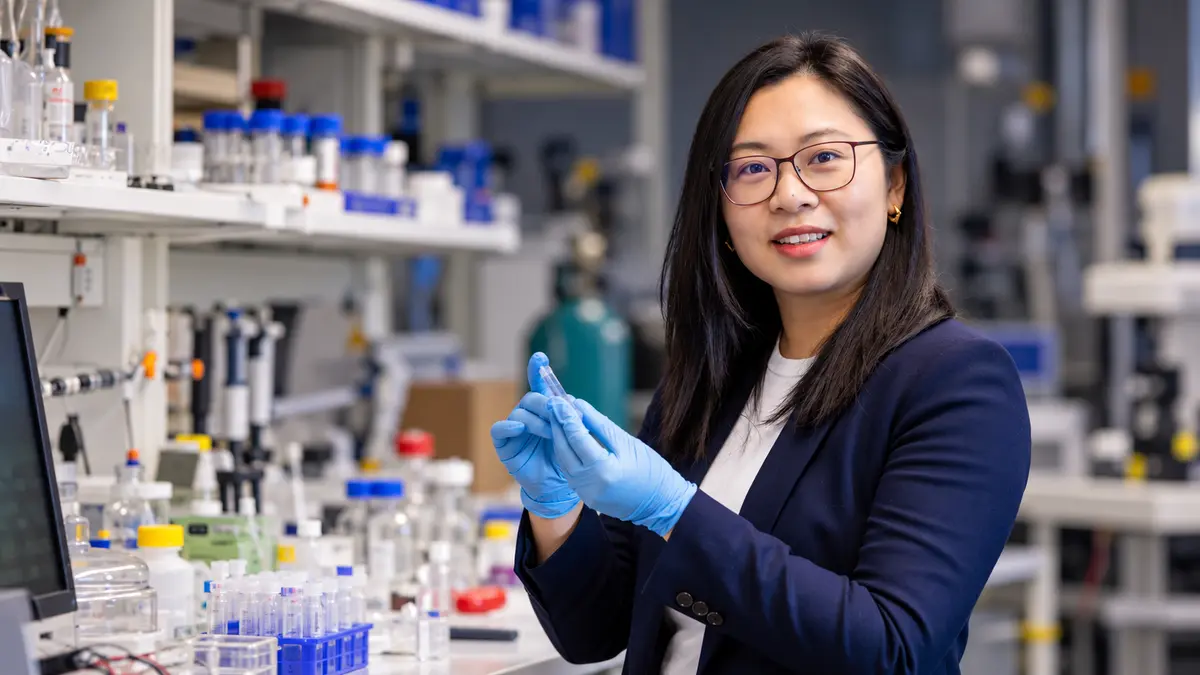
Chong Liu studies how materials can capture lithium while leaving competing ions behind. At the University of Chicago in the United States, she investigates iron phosphate, whose narrow channels admit ions from salty water. Lithium and sodium compete for those spaces. Material selection therefore affects both the amount captured and which source waters might become usable.
Liu's targets include geothermal and desalination brines, fracking wastewater and seawater. The latter contains roughly 20,000 sodium ions for each lithium ion, compared with ratios in the hundreds to one in existing source waters. Commercial recovery from such dilute mixtures still requires research. Her work connects that practical problem to the movement of ions inside confined structures.
Battery demand and the sources of supply
Electric vehicles account for about 90% of the increase in lithium demand through 2050 under the International Energy Agency's 2024 Announced Pledges Scenario. Battery storage starts from about 5% of demand. These applications sit alongside established uses in ceramics and lubricants. Under the Stated Policies Scenario, lithium demand almost triples over the decade to 2030; under the separate Net Zero Emissions Scenario, it increases tenfold by 2050. These pathways depend on their respective policy and technology assumptions.

Global lithium raw-material production reached around 190,000 tonnes of lithium content in 2023: approximately 70,000 tonnes from brines and 120,000 from hard rock. In the IEA's base case, operating and announced projects raise supply to around 450,000 tonnes near 2030. Delivery depends on those projects proceeding as planned. The agency distinguishes extraction of raw materials from production of lithium chemicals, including carbonate and hydroxide. A new separation material addresses one part of that supply chain; converting its captured ions into a usable solid remains another processing stage.
Engineering the channels in iron phosphate
Iron phosphate's preference for lithium also depends on particle geometry and the barriers encountered as ions enter its structure. Experiments published on Jun 7, 2024 examined dimensions along the material's transport channels and the resulting competition with sodium. Particles below about 100 nanometres along the relevant direction approached structural equilibrium with both ions. In larger particles, above about 500 nanometres, sodium insertion could remain out of equilibrium. Distortion and the formation of new phases contributed to the difference between the two ions.
The particle experiments achieved lithium-to-sodium selectivity as high as 23,000 under particular conditions. At a feed ratio of one lithium ion to 1,000 sodium ions, a selected material produced 95.8% lithium purity, with an uncertainty of 0.3 percentage points, in one extraction step. Another condition used a current density of 636 milliamperes per gram. That electrical measure is not a mass-production rate. Particle dimensions, operating current and feed composition each belong with the result they produced.
From capture to lithium hydroxide
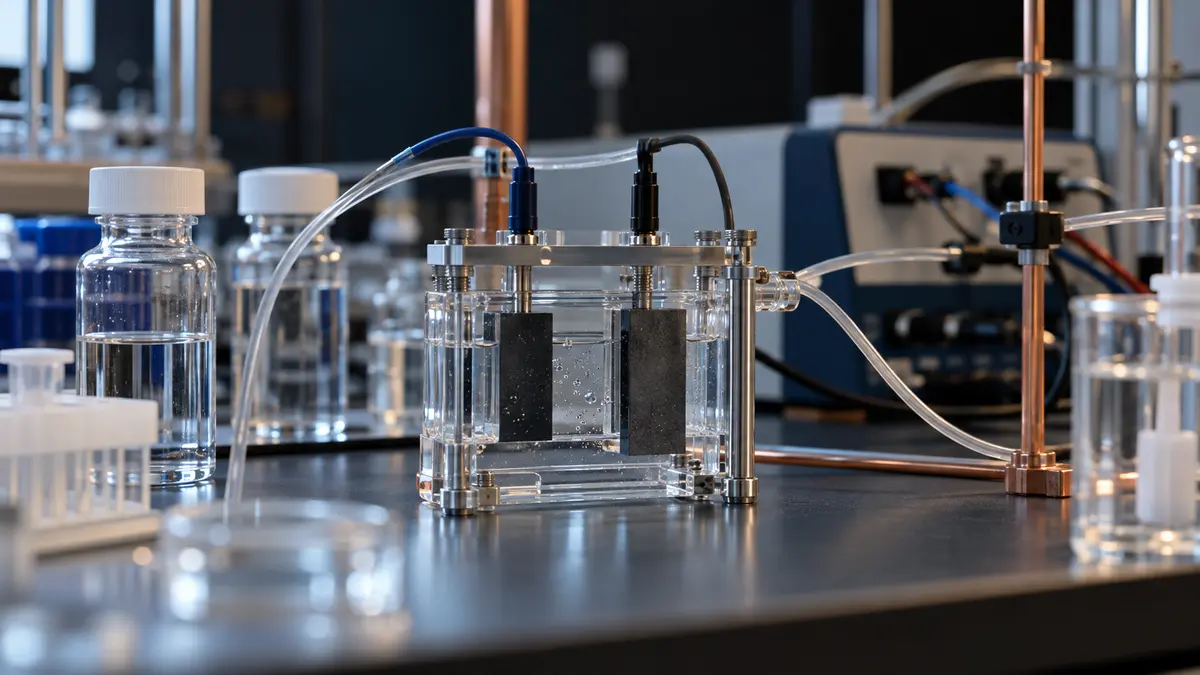
A later electrochemical process, published on Jan 18, 2025, extracted lithium from Salton Sea geothermal brine. Intercalation materials captured lithium and purified lithium chloride; bipolar membrane electrodialysis then converted it into lithium hydroxide with purity above 99.5%. A three-electrode flow arrangement controlled the intercalation potential. That control matters because lithium and sodium can both enter iron phosphate, but at different characteristic potentials. A separate reference electrode allowed the working electrode's potential to be regulated during flow.
The process's estimated levelized cost was $4.60 per kilogram of lithium hydroxide monohydrate, conditional on an electrode lifespan of half a year. This was a techno-economic estimate. Scaling also requires larger electrodes: laboratory drop casting produces centimetre-scale pieces, whereas industrial manufacture would need methods such as slot-die or roll-to-roll coating. Hot brines, mineral scale and foulants create further operating demands. Electrode capacity retention and selective capture must survive repeated use in complex water, rather than only perform well during an initial extraction.
Oriented nanosheets and a pilot product
Lithium iron phosphate nanosheets introduced on Dec 3, 2025 used crown ethers to influence crystal growth through orbital shielding around iron atoms. The resulting sheets had a strongly controlled orientation. A subsequent synthesis route replaced expensive crown ethers with diethylene glycol and enabled kilogram-scale material production. In a pilot test using Dead Sea water brine, the system produced 44.4 grams of battery-grade lithium carbonate. That quantity describes the test's recovered product, without specifying the output of a commercial plant.

A correction published on Jul 3, 2026 fixed reversed selectivity values in the abstract: the lithium-to-magnesium value is 42,162, and the lithium-to-sodium value is 1,866. These compare different competing ions. Keeping their labels attached is necessary when comparing the nanosheets with other separation materials, particularly membranes designed chiefly to reject magnesium.
Membranes with different ion preferences
A composite membrane published on Jul 24, 2026 embedded a lithium-conducting ceramic, LLTO, in a ZIF-62 glass matrix. Melt casting at approximately 450°C produced a dense structure with close contact between its components. Conventional ceramic membranes can require sintering above 1,000°C. The glass-assisted route reduced that processing temperature while improving mechanical tolerance. The ceramic supplied lithium-conducting pathways, but those pathways depended on how its particles connected through the surrounding glass.
Transport changed around a ceramic composition fraction of 0.3 as isolated domains developed into an interconnected network. An optimized fraction of 0.5 balanced conduction and mechanical stability. Under electrochemical operation in Red Sea water, lithium-to-magnesium selectivity reached approximately 59,000. Increasing ceramic content further was not an unrestricted route to improvement: fractions of 0.6 or more increased brittleness in thin films. Further scale-up requires control of the conducting network and interfaces to improve lithium flux while preserving integrity. The magnesium comparison measures ion discrimination; it does not itself state the purity of a finished lithium salt.

Separating monovalent and divalent ions
Solution-processable polymer membranes published on Mar 12, 2025 used hydrophilic pores smaller than a nanometre. Their functional groups and narrow channels combined ion partitioning with size-based separation. Lithium, sodium and potassium, each carrying a single positive charge, could pass preferentially while magnesium, carrying two positive charges, was rejected. The distinction is important for lithium extraction: strong discrimination against magnesium does not automatically provide the same discrimination against sodium. The chemical interactions within hydrated pores influence which ions enter and travel through them.
The polymer membranes operated in an electrodialysis stack with simulated salt-lake brines, and the work included production of battery-grade lithium carbonate. Their ability to be processed from solution offers a possible route to continuous roll-to-roll membrane manufacture and larger stacks. That manufacturing route remained a scale-up prospect. Further development specifically targeted lithium selectivity against other monovalent ions. The membrane's reported function therefore fits a particular separation task, removing divalent competitors, while the unresolved sodium competition overlaps with the challenge Liu investigates in intercalation hosts.
Permeance and resistance to chlorine
Another membrane design, published on Sep 7, 2023, combined a quaternized spiro-piperazine monomer with trimesoyl chloride through interfacial polymerization. Its positive charge and additional free volume supported water permeance of approximately 22 litres per square metre per hour per bar. The team made membranes measuring one by two metres. The design addressed a pairing of problems in polyamide lithium-separation membranes: limited permeance and susceptibility to chlorine damage.

The membrane's amine–acyl bonds lacked the sensitive nitrogen–hydrogen group associated with chlorine attack. Performance remained stable after 400 hours immersed in sodium hypochlorite, while control membranes degraded. The high permeance and chlorine resistance were reproducible at module level. Those are specific exposure and separation results, rather than a measured service life for years of operation. This design concerned magnesium–lithium separation and adds a durability requirement alongside the selectivity and transport requirements of other membranes.
Other ways to drive separation
A solar-driven device published on Jan 3, 2024 combined an ion-separation membrane with an evaporator, taking inspiration from selective ion uptake and salt secretion in mangroves. Its upper layer absorbed light to evaporate water. A hydrophilic porous middle layer supplied capillary pressure for water transport. At the bottom, an ultrathin membrane allowed lithium ions through while blocking other multivalent ions. Separation and evaporation thus occupied different layers of the same structure.
In artificial salt-lake brine containing 348.4 grams of salt per litre, the magnesium-to-lithium ratio fell from 19.8 to 0.3, a 66-fold reduction. The process directly yielded lithium chloride powder. Both the feed and product definitions matter: the experiment used an artificial mixture, and the recovered compound was lithium chloride. The result does not describe battery-grade lithium hydroxide. Its coupled membrane and solar-evaporation arrangement addresses concentration as well as the removal of competing multivalent ions.

Energy stored in a concentration difference
A system published on Oct 24, 2024 used the concentration difference of counter-ions, generally chloride, between feeding and receiving solutions to drive lithium extraction. A lithium-selective ceramic membrane worked with a silver electrode that stored chloride. Experimental behaviour under different feed compositions was consistent with Gibbs–Donnan equilibrium. The energy source was the chemical difference between the solutions, rather than an absence of an energy source.
With simulated brine, the system delivered electrical output of 1.6 watt-hours per mole of lithium. It remained stable over 300 hours of operation with lithium-to-magnesium selectivity of 450. Lithium enrichment could also occur when the feed's counter-ion concentration greatly exceeded its lithium concentration. These operating results concern the specified cell and solutions. They do not establish a positive energy balance for every preceding and subsequent step needed to supply brine and produce a saleable lithium compound.
Using carbon dioxide to form carbonate
Li–air chemistry supplied another approach in work published on Jul 6, 2026. Electrodialysis through a solid-state lithium-conducting membrane combined lithium enrichment with carbonate formation. Ambient carbon dioxide supplied the carbon, and the process required no added precipitants. Thermodynamically driven displacement reactions contributed to the configuration's ion selectivity. The experiment joined ion separation and formation of a solid lithium compound within one arrangement.

The recovered lithium carbonate had 93.8% purity at an applied voltage below two volts. That purity is a different result from the battery-grade carbonate or hydroxide produced in other experiments. The voltage describes the electrical potential applied to this system; it is not a complete energy-consumption figure or a production cost. The seawater feed and use of ambient carbon dioxide distinguish this route from concentrating salt-lake brines and subsequently adding reagents to obtain a solid product.
Recovering lithium from solid residues
A method published on Mar 17, 2026 began with lithium-bearing solids, including brine-mining slag. At controlled relative humidities of 12–30%, lithium chloride hydrate absorbed atmospheric moisture and formed a concentrated liquid. Coexisting halite, sylvite, bischofite and gypsum remained solid. The selective change of phase separated the lithium-bearing liquid from those salts without adding external water, reagents or heat during the described step.
Recovery reached up to 96%, with lithium concentrations reaching 97,000 parts per million. Tests covered binary and multicomponent mixtures as well as actual slag samples, and extraction took minutes to hours. Humidity and moisture flux were operating variables that the team optimized. These measurements describe a controlled deliquescence process, not direct capture of lithium ions from seawater. Concentrate strength also differs from the purity of an isolated final salt, so the concentration figure cannot replace a carbonate or hydroxide purity measurement.

Hard rock and the full processing boundary
Electrochemical extraction also extends to hard rock. Experiments published on Jun 13, 2024 leached lithium directly from alpha-phase spodumene at room temperature in dilute, 0.5-molar sulfuric acid. Hydrogen peroxide promoted the reaction by changing the exchange pathway. The leached alpha-phase retained its crystal phase with lattice shrinkage, unlike the transformation observed for beta-phase spodumene. A three-dimensional current collector combined a conducting framework, proton-conducting binder and gold catalysts that could generate the peroxide promoter locally. A high-loading demonstration used up to five grams of suspended spodumene and reached 92.2% leaching efficiency after 12 hours. The associated cost comparison estimated a 35.6% reduction against conventional leaching, but excluded labour, buildings and infrastructure. A separate emissions estimate assumed electricity from fossil-fuel power plants. These boundaries belong with the comparisons. Room-temperature leaching removes the need for elevated temperature in that step, while the acid, catalyst and electrical inputs remain part of the process. The demonstration's loading and duration should not be read as a commercial plant's production capacity.
Environmental assessment covers more than the extraction cell. A Feb 23, 2023 review of direct lithium extraction found that only 30% of the experiments it examined used real brines. Some approaches required pH adjustment or heating up to 80°C, with associated freshwater, chemical and energy inputs. Evaluation should extend from pumping the brine to obtaining a pure solid product. A dilute, purified lithium chloride solution still requires further processing, including possible removal of water.
Each salt-flat deposit also has its own hydrogeology. Well locations, depths and the distribution of brine and freshwater matter for modelling; results cannot simply be transferred from one salar to another. Monitoring should start before extraction and continue, because changes may become apparent only over time. The relevant environmental checks include:
- Freshwater consumption and chemical use across the complete process.
- Energy for separation, concentration and final solid production.
- Spent brines and other residues generated during operation.
- Precipitation, river flows and water-table measurements from observation wells.
Leave a comment