
Bigbelly’s Massachusetts assembly and public-space bin range
Bigbelly assembles public-space waste bins in Massachusetts, with products ranging from simple enclosures to connected equipment and food-scrap collection.
Assembly returns to the Merrimack Valley
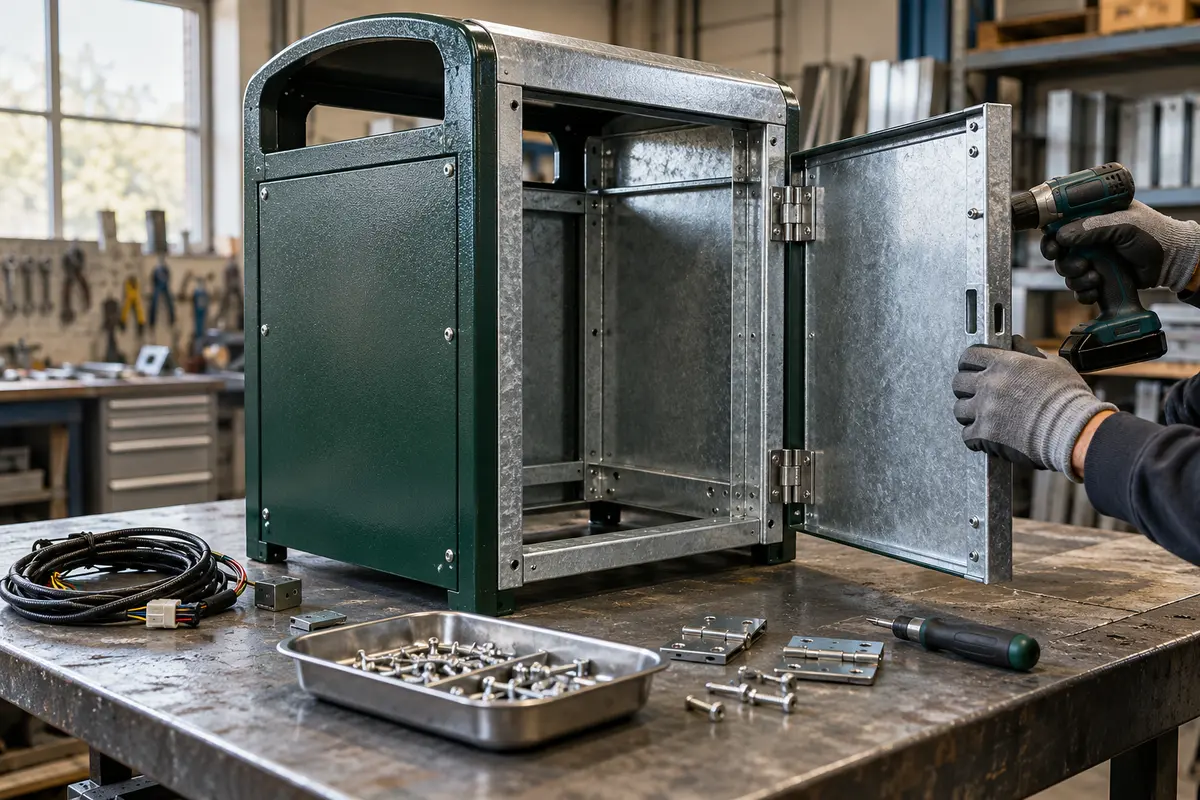
Bigbelly returned assembly from Mexico to Massachusetts in 2023, occupying former Polartec space at IndusPad on the Lawrence–Methuen border. President Brian Phillips cited custom parts and difficulties maintaining contract-manufacturing relationships. The location also brought production near the company’s Needham engineering office. Plant manager Michael Sampou said the engineering connection had improved.
In June 2025, Sampou’s 20-person team worked one shift using drills, riveters and dollies. Simple units took about an hour; complex units could take three. Output exceeded 45 units daily. Training began with subassembly and took about three months. Cofounder Jeff Satwicz described sheet-metal and plastic components; a nearby warehouse held parts inventory. The company had more than 65 Massachusetts employees. Cole Rosengren visited for Manufacturing Dive on June 18; his report appeared on August 27, 2025.
Financing supports manufacturing and product expansion
Cambridge Savings Bank arranged a credit facility for Bigbelly Solar through its asset-based lending team in October 2023. The financing was intended to refinance existing debt and provide working capital as the company brought manufacturing in-house. Bigbelly sought additional liquidity for expansion into new markets and a broader product portfolio. Its objectives included reducing costs and shortening delivery times; the facility’s value was not disclosed.

Bigbelly, founded in 2003, initially concentrated on solar-powered compacting bins for public waste collection. It added CLEAN software capabilities in 2010, giving operators real-time capacity and overflow alerts. By the October 19 financing announcement, the company had supplied more than 86,000 waste stations to over 1,800 customers across 60 countries. Its headquarters were in Needham, with manufacturing locations in Methuen and Stadtlohn, Germany. Brian Phillips was president and chief executive. Keith Broyles led the bank’s asset-based lending team as a senior vice president. Cambridge Savings Bank was a Massachusetts mutual bank with more than $6 billion in assets, providing the commercial lending relationship behind the facility.
Element starts with the enclosure
The 2026 Bigbelly product specifications set out a range extending from passive containers to powered equipment. These specifications postdate the 2025 factory visit. Element has no electronics, sensors or power supply. Its galvanized-steel interior and exterior surround an inner bin made from low-density polyethylene. Recycled-plastic side panels and a polyester powder-coated exterior complete the enclosure. Customers can install individual units or combine different bins into a kiosk for multiple waste streams.
Element stands 49.8 inches high, 25 inches wide and 26.8 inches deep. Its weight is 160 pounds, rising to 190 pounds for shipping. Chute and open configurations contain a 47-US-gallon inner bin; the hopper version contains 32 gallons. The chute opening measures 15 inches wide, seven inches high and 15 inches deep. Open interfaces offer different openings for waste, mixed recycling, paper or bottles and cans. An integrated pedal operates the chute, and the collection door locks when closed. Optional equipment includes wheeled inner bins for bar or comb lifting, graphic wraps, message panels, ashtrays and security plates.

Sense gives collection staff a local indication
Sense adds fullness detection to an enclosed bin. Embedded sensors monitor the contents, while front LEDs display readiness for collection, machine status and error codes. Bigbelly positions this model for locations where collection staff remain nearby. The indicators are on the equipment itself. A replaceable alkaline battery provides power indoors or outdoors, with a manufacturer-estimated life of two to five years depending on operating conditions. A companion unit can receive power from a hub unit.
The 2026 Sense configuration weighs 170 pounds, or 200 pounds packaged for shipping. Its chute and open versions have 47-US-gallon inner bins; a hopper configuration has 32 gallons. Users operate the enclosed chute with a foot pedal. The collection door locks automatically when shut. Exterior parts have a weather-resistant, ultraviolet-stabilized powder coating, and the internal container is polyethylene. Bigbelly offers wheeled inner bins, security plates, custom graphics and message panels as accessories. The standard enclosure can stand alone or join other units in a kiosk, allowing a collection point to accommodate separate waste and recycling streams.
Sense Max adds mechanical compaction
Sense Max combines local fullness indication with compaction. Its physical inner bin holds 32 US gallons. Bigbelly gives an approximate capacity equivalent to 150 gallons of uncompacted trash, measuring loose material rather than container volume. The company advertises a compaction ratio of five to ten times. The 2026 unit weighs 260 pounds, with a shipping weight of 290 pounds.

Outdoor equipment uses a 40-watt solar panel protected by a polycarbonate cover. A sealed lead-acid battery has a capacity of 28 amp-hours; an AC adapter is available for indoor installations. Bigbelly’s Skip-a-Cycle power management protects the battery by controlling operation. The hopper provides a physical barrier between the user and the compaction mechanism, and access doors are interlocked. A pedal opens the hopper. Front indicators show fullness, equipment status and errors. Customers can choose a chute interface, wheeled inner-bin arrangements, wraps, message panels, security plates or an ashtray. The enclosure can be installed independently or combined with other bins for multiple material streams.
Smart connects the bin to collection software
Smart is a non-compacting connected model. Embedded sensors monitor fullness, overflow, chute activity and front-door openings. Onboard GPS establishes its location. A telecommunications link sends information and equipment status to the CLEAN management console and CLEAN Mobile. Collection activity is also reported. Front LEDs retain a local display of collection readiness, the age of waste, machine status and error codes, alongside the remote software connection.
A replaceable alkaline battery is standard, with a 40-watt solar panel available as an option. Bigbelly specifies an expected battery life of two to five years depending on conditions. The solar panel has a protective polycarbonate cover. The unit is self-powered, and companion units can be supplied from a hub. Optional access equipment includes the ACS keyless access-control system and remote locking for the chute or hopper. Physical security plates, wheeled inner bins and custom graphics are also available. The 2026 range includes waste, single-stream recycling and compost configurations, with hopper, chute and open disposal interfaces. Smart can stand alone or be grouped with other Bigbelly products in a multi-stream kiosk.

Smart Max combines connected and mechanical functions
Smart Max adds connected reporting to a compacting unit. Its sensors detect fullness, overflow, hopper activity and front-door openings, while GPS supplies location information. A built-in data link communicates with CLEAN’s console and mobile software. Local LEDs display collection readiness, equipment status and errors. The hopper has a 70-degree dumping angle, which Bigbelly says helps reduce disposal jams. The compaction ram travels to within nine inches of the inner bin’s bottom.
In 2026, Smart Max offers solar power outdoors and an AC adapter indoors. Its power system includes a 40-watt panel, an insulated 28-amp-hour sealed lead-acid battery and Skip-a-Cycle energy management. Bigbelly gives an expected battery life of up to five years. Interlocked doors separate access from the compaction mechanism, and the collection door locks automatically when closed. Customers can add keyless access, remote chute or hopper locking, security plates and wheeled lift bins. Bar and comb lifting arrangements are offered. The hopper can be replaced by a chute, and wraps, message panels and stickers provide exterior identification.

Smart Compost provides controlled food-scrap access
Bigbelly’s 2024 Smart Compost configuration uses a non-compacting, 50-gallon wheeled inner bin compatible with ANSI and EN lifting devices. An internal height sensor measures fullness. Residents unlock the chute using a mobile app, then operate a foot pedal for disposal. The opening accepts normal countertop food-waste bags. LEDs indicate whether the drop-off point is available. Double and triple stations are also offered.
The free app runs on iOS and Android. It locates bins, displays availability, unlocks access and supplies local instructions. Operators can specify accepted and rejected materials, explain the program and receive issue reports. CLEAN provides map and list views of real-time fullness, collection management, program-wide and individual-bin usage, and reporting through its web interface, spreadsheets or an API. Bigbelly says the program does not collect residents’ personal information. Its proposed deployment pattern places roughly one bin per 100 residences in the public right of way. The company markets this arrangement especially to multifamily neighborhoods, with collections consolidated at drop-off locations along main roads and resident access available around the clock.
Somerville residents fund a local bin project
Somerville residents selected faster BigBelly adoption for rat abatement as one of five winning participatory-budgeting projects in 2023. The $250,000 allocation covered additional trash-can units and promotional material explaining actions residents could take to reduce rats. Mayor Katjana Ballantyne announced the winning projects on October 24. Implementation was scheduled to begin that fall, with more complicated projects taking longer.
Residents had submitted more than 900 ideas for city improvements. Budget delegates worked with city staff to assess need, impact, feasibility and cost, producing a ballot of 20 proposals. People aged 12 and older could vote from September 13 through October 13; the process received more than 3,500 votes. The five selected projects had a combined cost of $955,000. Alongside the bin project, residents funded direct community food access, bicycle-lane acceleration, bus-stop improvements and shade structures. The food-access project received $55,000, bus-stop improvements $200,000 and shade structures $200,000. The bicycle allocation of $250,000 was additional funding for one to two miles of quick-build lanes, separate from the trash-can allocation of the same value.
New York expands neighborhood drop-off access
New York had installed 250 smart composting bins by February 1, 2023. Another 150 were planned for Manhattan that spring, bringing the intended total to 400. The deployment had grown from an initial group of 25 in Astoria, through a 100-bin plan and then the expanded 250-bin installation. Residents could use the NYC Compost app on iOS or Android to access the installed bins 24 hours a day.
Locations included Bushwick, Bedford-Stuyvesant, Castle Hill, Harlem, Highbridge, the North Shore of Staten Island, Parkchester, Queensbridge Houses and Washington Heights. The additional Manhattan bins were intended for business districts and residential areas. Mayor Eric Adams and sanitation commissioner Jessica Tisch announced the expansion alongside a citywide curbside-composting schedule. Queens service was to resume on March 27, 2023 and continue year-round. Brooklyn was scheduled for October 2, 2023; Staten Island and the Bronx for March 25, 2024; and Manhattan for October 7, 2024. The curbside program accepted kitchen and garden material in separate containers, with no resident signup required. Drop-off bins provided an additional access route as that borough-by-borough service expanded.

Unlock activity rises in fiscal 2024
New York’s smart composting bins recorded 1,215,618 unlocks in fiscal 2024, compared with 303,500 in fiscal 2023. The city listed 418 bins deployed in the later year and 419 in the earlier one. These are annual operating figures for the municipal program. Unlock events count accesses rather than unique residents or a weighed quantity of food scraps. The sanitation department provided smart-bin drop-off access across dozens of neighborhoods alongside curbside service.
Across the wider organics service, New York diverted 129,600 tons in fiscal 2024, up from 105,600 tons in fiscal 2023. That broader total covered the city’s organics operations rather than smart bins alone. Brooklyn and Queens were receiving curbside composting during the reporting period. The service collected organic material for composting, while the drop-off infrastructure supplied another collection channel. The sanitation department tracked bin deployments and unlock activity under its goal of increasing composting in the fiscal 2024 Mayor’s Management Report. Both years’ figures were actual results, with no numerical fiscal 2025 target for either smart-bin indicator and no separate smart-bin-only tonnage figure.
Philadelphia adds bins alongside collection services
Philadelphia planned 1,500 new BigBelly trash and recycling cans in its 2025 municipal pledge program. The Office of Clean and Green and the Sanitation Department expected to finish installation by fall 2025. A twice-weekly trash collection pilot had begun in South Philadelphia and Center City in December 2024, with expansion to North Philadelphia planned for 2025. These initiatives formed part of the city’s Clean and Green work.
Other commitments covered collection equipment and cleaning staff:
- The Sanitation Department hired 100 workers by fall 2024 for citywide and district-based cleaning programs.
- The Sanitation and Fleet departments were receiving 67 new trash compactors, with deliveries expected by fall 2025.
- The district-based residential cleaning program launched in September 2024.
Philadelphia Taking Care of Business expanded from 116 to 155 commercial corridors. The program supplied cleaning services and work opportunities through partner organizations. Separately, the Commerce Department contracted with 55 organizations employing 324 cleaning ambassadors, with another 86 workers planned for spring 2025. The city’s equipment rollout therefore accompanied both neighborhood collection changes and staffed commercial-corridor cleaning.
Leave a comment