
BepiColombo’s route from electric cruise to Mercury science
BepiColombo has released its transfer module, leaving two connected orbiters to approach Mercury ahead of a sequence of planned separations and science operations.
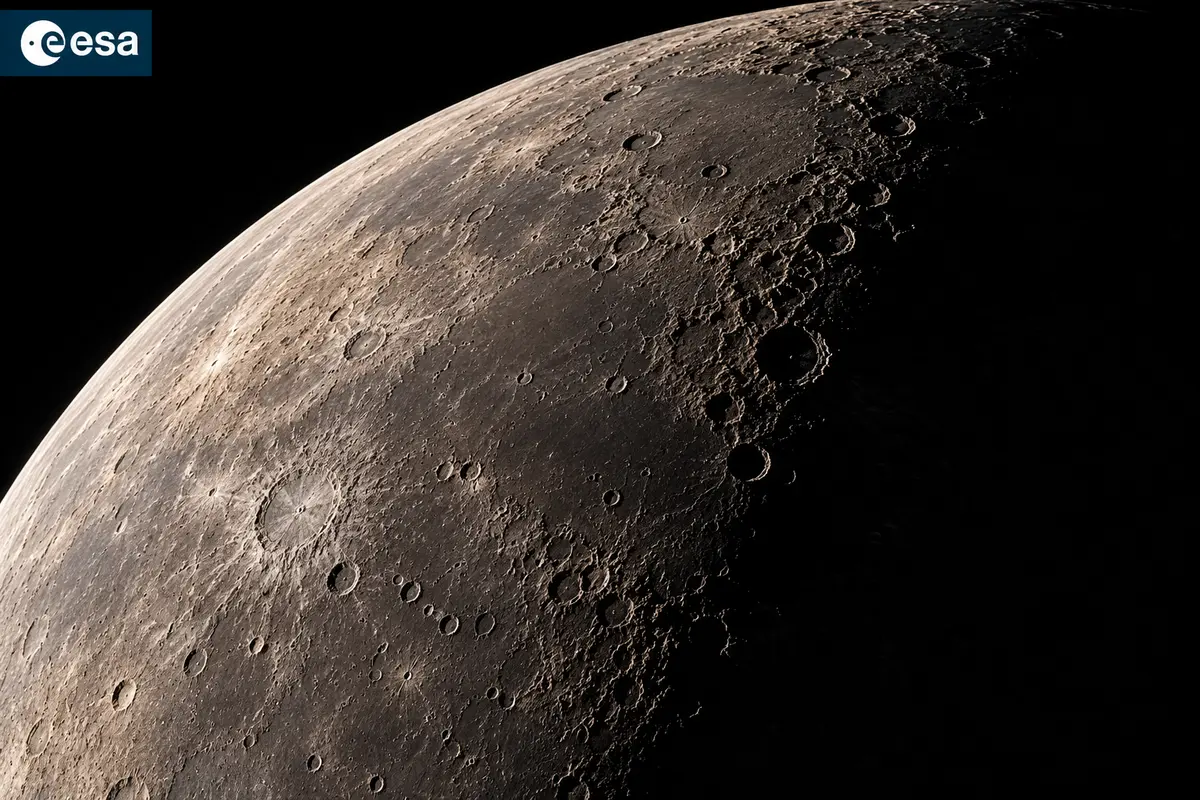
On 3 September 2026, BepiColombo released its Mercury Transfer Module, which had supplied cruise power and propulsion. ESA’s Mercury Planetary Orbiter (MPO) and JAXA’s Mio remained connected for the next stages of arrival. Orbital capture, separation and deployment into their dedicated science orbits were still ahead.
A launch built around a difficult destination
The European Space Agency and the Japan Aerospace Exploration Agency launched the joint mission from Kourou, French Guiana, on 20 October 2018. An Ariane 5 lifted off at 01:45:28 UTC. Signals received at ESA’s control centre in Darmstadt, Germany, through the New Norcia tracking station at 02:21 UTC confirmed a successful launch. The payload paired MPO with the Mercury Magnetospheric Orbiter, also called Mio, above the transfer module.
The spacecraft design addressed surroundings ranging from –180°C to above 450°C. The transfer module’s large solar arrays needed controlled tilting to limit radiation damage while supplying electricity. MPO carried a broad radiator to reject heat from its subsystems. Eight-sided Mio was designed to spin 15 times a minute when operating separately, distributing solar heating around its panels. During the journey, the two science orbiters travelled as parts of a connected stack.

Turning electricity into sustained thrust
Four QinetiQ T6 thrusters, each 22 cm in diameter, formed the transfer module’s electric propulsion system. One or two could operate at a time. Inside a thruster, electrons were removed from xenon atoms; high-voltage grids then accelerated the resulting ions outwards at 50,000 metres per second. This figure describes the exhaust, while the spacecraft’s trajectory changed gradually under the accumulated thrust. The system used electricity generated by two solar arrays, each 15 metres long. The T6 was a scaled-up descendant of the 10 cm T5 used on ESA’s GOCE gravity mission. That earlier engine helped the 2009 satellite maintain a very low orbit through diffuse atmosphere for over three years.
RUAG Space supplied movable gimbals that directed the thrust through the stack’s centre of gravity as propellant consumption changed its mass distribution. Two Power Processing Units from Airbus Crisa regulated thruster voltages and currents according to commands from the onboard computer. Bradford Engineering’s Flow Control Units provided programmable xenon delivery. Qualification also covered cold starts: although the mission headed sunward, shadowed, inactive thrusters could become extremely cold, and the equipment was tested for operation after cooling to –150°C.
Planetary encounters along the way
The first Venus flyby occurred on 15 October 2020. A subsequent navigation correction to the published account fixed closest approach at 03:58:31 UTC, 10,721.6 km above the surface. Most preparations had taken place through teleworking. Four flight controllers worked in two groups over 36 hours at mission control, supported by ground-station and image specialists. Controllers temporarily closed star-tracker shutters where the bright planet could blind the sensors. Two monitoring cameras operated in scheduled windows beginning 20 hours before closest approach. Imaging continued until 15 minutes afterwards. Venus grew from a small disc into a dominant feature behind MPO’s magnetometer boom as the probe approached.

The encounter activated seven of MPO’s eleven science instruments and its radiation monitor, together with three of Mio’s five instruments. These sensors had been designed for Mercury’s exposed environment, but could also collect information at atmospheric Venus. Coordinated observations involved JAXA’s Akatsuki orbiter around Venus and its Earth-orbiting Hisaki observatory, alongside ground-based telescopes. Akatsuki provided a wider planetary view while BepiColombo sampled closer to Venus. The science teams investigated atmospheric structure, clouds and the surrounding magnetic environment.
Electric propulsion periods, called thrust arcs, could extend from a few days to two months, with interruptions for navigation and manoeuvre optimisation. On 19 May 2023, a chemical-propulsion correction addressed errors accumulated during interruptions to the preceding one-and-a-half-month electric arc. Without that correction, ESA calculated that the spacecraft would have passed Mercury about 24,000 km too far away and on the wrong side. The manoeuvre deliberately retained an altitude margin while removing the accumulated trajectory error.
Before the third Mercury encounter, scheduled for 19 June 2023, the predicted closest altitude was 236 km, with a five-kilometre uncertainty. ESA’s forecast distinguished reference frames: approach speed was 3.6 km/s relative to Mercury, increasing to 5.4 km/s near closest approach. Across the encounter, the intended reduction relative to the Sun was 0.8 km/s, with a directional change of 2.6 degrees. Additional ground-station passes supported orbit determination and recovery from thruster interruptions. ESA also scheduled BELA’s first flyby activation as a functional test, alongside the Mercury Orbiter Radio-science Experiment, MORE. MORE’s later orbital measurements would investigate the planet’s gravitational field and core.

Reduced power changes the route
On 26 April 2024, the transfer module failed to provide enough electrical power when another manoeuvre was due to begin. ESA and industrial partners began investigating the problem and recovering propulsion capability. By 7 May, thrust had returned to approximately 90% of its previous level, but the available electrical power remained below the expected level. The operational priority was to maintain stable propulsion while estimating the consequences for subsequent manoeuvres. Engineers continued searching for the cause and ways to increase the power reaching the thrusters. The flight-control team arranged additional tracking-station passes for closer monitoring and faster responses. At this stage, ESA reported that both scientific orbiters continued to perform well. The partial recovery concerned the transfer module’s propulsion, which still could not deliver full thrust.
By September 2024, engineers had identified unexpected electrical currents between the solar arrays and the unit that extracted and distributed their power. Spacecraft data indicated that this left less energy available for propulsion. ESA’s flight-dynamics team devised a trajectory requiring lower thrust while retaining the baseline Mercury science objectives. The expected arrival moved from December 2025 to November 2026. The revised approach retained the remaining Mercury flybys and used their changes in speed and direction to reshape the cruise. Electric burns were scheduled for September and October 2024. The closer fourth pass was intended to reduce propulsion needed before the fifth, while the sixth would branch onto the revised trajectory.
The fourth encounter was planned for 4 September 2024 at an altitude of 165 km, about 35 km closer than initially intended. Ten of the mission’s sixteen instruments could operate during the flyby; others had obstructed views in the stacked configuration. The main science camera remained shielded. Instead, three transfer-module monitoring cameras supplied black-and-white, 1024-by-1024-pixel snapshots. These cameras had originally been installed to inspect spacecraft hardware, including the solar array, antenna and magnetometer boom.

Short encounters yield magnetic measurements
Measurements from the third Mercury flyby later supported an analysis of the planet’s plasma environment. During the 19 June 2023 encounter, BepiColombo crossed the magnetosphere from dusk towards dawn in about 30 minutes, reaching an actual closest altitude of 235 km. Instruments in Mio’s Mercury Plasma Particle Experiment (MPPE) sampled particle types, temperatures and motion. The published analysis used the Mass Spectrum Analyser, Mercury Ion Analyser and Mercury Electron Analyser, three instruments of the MPPE suite. Researchers combined those measurements with computer modelling to identify structures along the spacecraft’s path, including the shock boundary, the plasma sheet and a turbulent, low-latitude boundary layer.
Spacecraft charging affected which particles the instruments could detect. Under sunlight, electrical charging repelled colder, heavy ions. Entering Mercury’s shadow changed those conditions and exposed a population of cold ions, including oxygen, sodium and potassium. The researchers considered surface release through micrometeorite impacts or solar-wind interactions a likely origin. Their reconstruction described conditions sampled during a rapid pass. Mercury’s surface magnetic field is about one hundred times weaker than Earth’s, while its proximity to the Sun exposes the surrounding environment to stronger solar-wind conditions.
Infrared observations through another port
The fifth Mercury flyby, on 1 December 2024, passed 37,626 km above the surface. MERTIS observations produced the planet’s first spacecraft images in mid-infrared light, with ground resolution around 26–30 km. The instrument responds to wavelengths of 7–14 micrometres. Its observations covered part of the Caloris basin and northern volcanic terrain, with the Bashō impact crater standing out in infrared brightness.
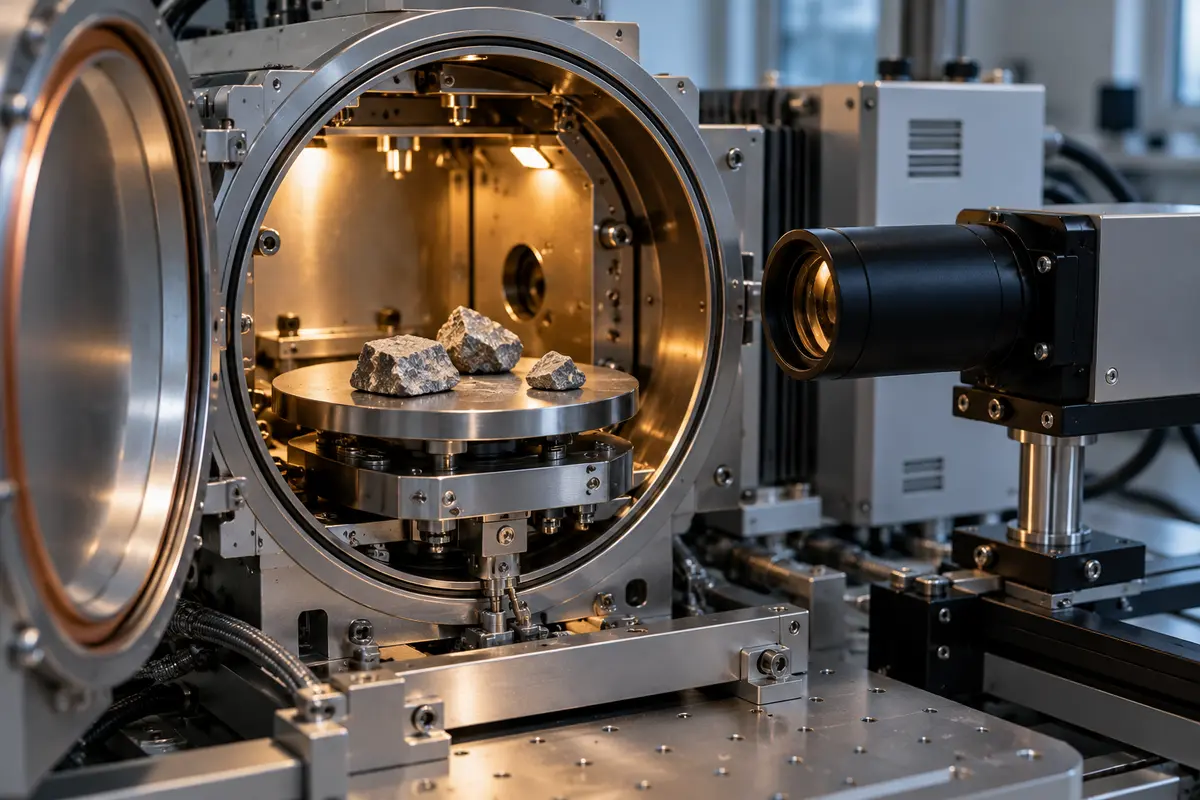
MERTIS’s intended planet-facing port was blocked by the spacecraft stack. Software changes allowed observations through the space-facing calibration port instead. Interpreting brightness requires separating mineral properties, temperature and surface roughness. Laboratory work therefore heated natural and synthetic mineral mixtures and measured their infrared emission. The flyby radiometer registered surface temperatures up to 420°C. A later orbital mapping resolution down to 500 metres remained a mission target.
Northern plains and shadowed craters
The sixth and final Mercury flyby took place on 8 January 2025. BepiColombo passed 295 km above the nightside surface, then crossed the north pole roughly seven minutes later. Its monitoring cameras obtained views towards permanently shadowed floors in the Prokofiev, Kandinsky, Tolkien and Gordimer craters. Earlier evidence suggested that such cold, dark locations could contain water ice. The images provided views of the terrain; investigating the suspected deposits remained part of the orbital science programme.
Sunlit images also showed Borealis Planitia, the planet’s largest expanse of smooth plains. Lava spreading about 3.7 billion years ago had flooded older craters there. The Mendelssohn crater’s outer rim was barely visible above its lava-filled interior, while smaller, more recent impact craters marked the smoother plains. Wrinkled terrain developed after the lava solidified, probably as Mercury’s interior cooled and contracted. The views included the Caloris basin, an impact structure more than 1,500 km across. These were the transfer module’s last close-up Mercury images before its later separation; the cameras belonged to the module that would be discarded.

Two orbiters’ science jobs
MPO’s instruments were designed to examine the surface through several measurement techniques. Examples include:
- MIXS, an imaging spectrometer for X-rays;
- SIMBIO-SYS, combining stereo imaging with visible and near-infrared spectroscopy;
- MERTIS, covering thermal infrared measurements;
- BELA, a laser altimeter for surface height and shape.
Mio’s complementary work concerns the environment around the planet. After separation, its sodium imager MSASI and dust detector MDM would become available alongside magnetic-field and particle measurements already attempted during cruise. The spacecraft were intended to observe from different locations: MPO closer to Mercury and Mio in a larger elliptical orbit. ESA’s science plan provided for a one-year nominal mission with a possible 1.5-year extension. The combined measurements target surface composition, topography and material surrounding the planet. ESA expected magnetic and particle measurements from the separated spacecraft to be more sensitive and precise than observations possible in the stacked cruise configuration.
From electric thrust to chemical manoeuvres
The transfer module completed its final electric-propulsion thrust arc on 15 June 2026 at 15:24 CEST. Its four solar-electric thrusters were then permanently switched off. By the end of electric cruise, the mission had used nine gravity-assisted encounters: one with Earth, two with Venus and six with Mercury. Commands for the shutdown had been transmitted in advance. The spacecraft continued along a ballistic trajectory towards the module-release stage. After losing the transfer module, the remaining MPO–Mio–MOSIF composite would use MPO’s chemical propulsion to adjust its course. ESA’s published plan placed Mercury orbit insertion on 21 November 2026, followed by changes towards Mio’s deployment orbit in early December. MPO would subsequently lower its own orbit, reaching its science orbit by March 2027. This sequence assigned cruise acceleration and braking to one propulsion system, then transferred the remaining arrival manoeuvres to another spacecraft’s engines. The transfer module’s propulsion task had ended before the science orbiters reached their intended operational orbits.

Rehearsing while the spacecraft keeps flying
ESA, JAXA and industrial teams rehearsed arrival operations at the European Space Operations Centre while controllers continued managing the actual mission. The simulation campaign brought together experienced launch-era staff and colleagues who had joined later. Its scenarios exercised procedures and coordination for a stack comprising MTM, MPO, Mio and the Mio Sunshield and Interface Structure, MOSIF. The shield protects Mio before deployment; it is not an additional science orbiter.
Activities on MPO and Mio needed a carefully ordered sequence during separation. Controllers aligned timelines, readiness criteria and decisions to proceed or stop. In one simulation, an anomaly required a separation exercise to be aborted and rescheduled. The rehearsals covered unusual operations alongside continuing cruise duties, with the campaign planned to continue through October. They included the successive burns and releases needed before both orbiters could begin their separate science programmes.
For the September release, ESA had published a communications schedule with separation set for 14:00 CEST and the earliest expected acquisition of signal at 15:53 CEST. Controllers would listen for the returning signal and assess the spacecraft’s health after the operation. The wider arrival plan initially kept MPO and Mio together for Mercury orbit insertion in November. The orbiters would separate in December, with MPO continuing to manoeuvre towards its own dedicated polar orbit. Routine science operations for both spacecraft were scheduled to begin in April 2027. The mission was designed as Europe and Japan’s first mission to Mercury and the first to study it with two orbiting spacecraft simultaneously. Its observation programme combined measurements of the planet itself with those of the space environment around it.
Leave a comment